A metal wire of uniform mass density having length L and mass M is bent to form a semicircular arc and a particle of mass m is placed at the centre of the arc. The gravitational force on the particle by the wire is:
- A
- B
- C
- D
Every JEE Main question on Gravitational field and potential of rings, shells and spheres, one of the ideas inside Gravitation: 11 questions from 2008–2024, 2 of them in the last five years. Newest first, answer key on every one. Free to read.
Questions
11
Years asked
10
Since
2008
Of the chapter
5%
Questions on Gravitational field and potential of rings, shells and spheres in each year it was asked.
1–11 OF 11 · NEWEST FIRST
A metal wire of uniform mass density having length L and mass M is bent to form a semicircular arc and a particle of mass m is placed at the centre of the arc. The gravitational force on the particle by the wire is:
On the -axis and at a distance from the origin, the gravitational field due to a mass distribution is given by in the -direction. The magnitude of the gravitational potential on the -axis at a distance , taking its value to be zero at infinity is:
A solid sphere of mass M and radius a is surrounded by a uniform concentric spherical shell of thickness 2a and mass 2M. The gravitational field at distance 3a from the centre will be:
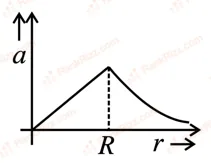
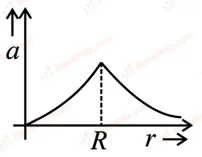
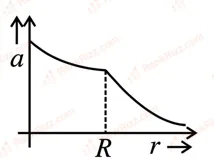
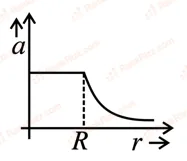
The mass density of a spherical body is given by for and for , where is the distance from the center. The correct graph that describes qualitatively the acceleration, of a test particle as a function of is:


A very long (length ) cylindrical galaxy is made of uniformly distributed mass and has radius . A star outside the galaxy is orbiting the galaxy in a plane perpendicular to the galaxy and passing through its centre. If the time period of the star is and its distance from the galaxy's axis is , then
The gravitational field in a region is given by N kg. The change in the gravitational potential energy of a particle of mass 2 kg when it is taken from the origin to a point (7 m, m) is:
71 J
J
2 J
1 J
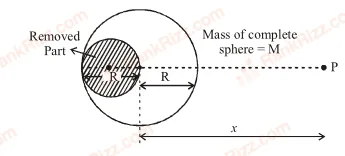
The gravitational field, due to the 'left over part' of a uniform sphere (from which a part as shown, has been 'removed out'), at a very far off point, P, located as shown, would be (nearly) :

The gravitational field in a region is given by: . If the potential at the origin is taken to be zero, then the ratio of the potential at the points (12 m, 0) and (0, 5 m) is :
Zero
1
A point particle is held on the axis of a ring of mass and radius at a distance from its centre . When released, it reaches under the gravitational attraction of the ring. Its speed at will be
Two bodies of masses and are placed at a distance . The gravitational potential at a point on the line joining them where the gravitational field is zero is:
zero
This question contains Statement-1 and Statement-2. Of the four choices given after the statements, choose the one that best describes the two statements. Statement - I: For a mass kept at the centre of a cube of side '', the flux of gravitational field passing through its sides is . Statement - II: If the direction of a field due to a point source is radial and its dependence on the distance '' for the source is given as , its flux through a closed surface depends only on the strength of the source enclosed by the surface and not on the size or shape of the surface.
Statement-1 is false, Statement-2 is true.
Statement-1 is true, Statement-2 is true; Statement-2 is correct explanation for Statement-1.
Statement-1 is true, Statement-2 is true; Statement-2 is not a correct explanation for Statement-1.
Statement-1 is true, Statement-2 is False.