JEE MAIN 2023 · 12 APR S1Electric power and heating effect of currentTRANSCRIBED
The current flowing through a conductor connected across a source is A and A at C and C respectively. The current flowing through the conductor at C will be _____ mA.
Every JEE Main question on Electric power and heating effect of current, one of the ideas inside Current Electricity: 60 questions from 2004–2026, 25 of them in the last five years. Newest first, answer key on every one. Free to read.
Questions
60
Years asked
17
Since
2004
Of the chapter
16%
21–40 OF 60 · NEWEST FIRST
The current flowing through a conductor connected across a source is A and A at C and C respectively. The current flowing through the conductor at C will be _____ mA.
Given below are two statements:
Statement I: A uniform wire of resistance 80 is cut into four equal parts. These parts are now connected in parallel. The equivalent resistance of the combination will be 5 .
Statement II: Two resistances 2R and 3R are connected in parallel in an electric circuit. The value of thermal energy developed in 3R and 2R will be in the ratio 3:2.
In the light of the above statements, choose the most appropriate answer from the options given below
Both statement I and statement II are correct
Both statement I and statement II are incorrect
Statement I is correct but statement II is incorrect
Statement I is incorrect but statement II is correct
Two coils require 20 minutes and 60 minutes respectively to produce same amount of heat energy when connected separately to the same source. If they are connected in parallel arrangement to the same source; the time required to produce same amount of heat by the combination of coils, will be ______ min.
An electrical bulb rated 220 V, 100 W, is connected in series with another bulb rated 220 V, 60 W. If the voltage across combination is 220 V, the power consumed by the 100 W bulb will be about _____ W.
A resistor develops J of thermal energy in s, when a current of A is passed through it. If the current increases to A, the energy developed in s is ______ J.
Due to cold weather, a 1 m water pipe of cross-sectional area 1 cm is filled with ice at -10°C. Resistive heating is used to melt the ice. Current of 0.5 A is passed through 4 k resistance. Assuming that all the heat produced is used for melting, what is the minimum time required?
(Given latent heat of fusion for water/ice = J kg, specific heat of ice = J kg °C and density of ice = kg m)
3.53 s
0.353 s
35.3 s
70.6 s
A resistor develops 500 J of thermal energy in 20 s when a current of 1.5 A is passed through it. If the current is increased from 1.5 A to 3 A, what will be the energy developed in 20 s.
1500 J
1000 J
500 J
2000 J
In the given figure, the emf of the cell is 2.2 V and if internal resistance is 0.6 . Calculate the power dissipated in the whole circuit:
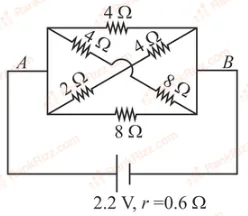
1.32 W
4.4 W
0.65 W
2.2 W
An electric bulb of 500 W at 100 V is used in a circuit having a 200 V supply. Calculate the resistance to be connected in series with the bulb so that the power delivered by the bulb is 500 W.
30
5
20
10
The resistance of a conductor at 15°C is 16 and at 100°C is 20 . What will be the temperature coefficient of resistance of the conductor?
0.010°C
0.033°C
0.003°C
0.042°C
A resistor dissipates 192 J of energy in 1 s when a current of 4 A is passed through it. Now, when the current is doubled, the amount of thermal energy dissipated in 5 s is _________ J.
A uniform heating wire of resistance 36 is connected across a potential difference of 240 V. The wire is then cut into half and a potential difference of 240 V is applied across each half separately. The ratio of power dissipation in first case to the total power dissipation in the second case would be 1 : , where is _________.
An electric bulb rated as 200 W at 100 V is used in a circuit having 200 V supply. The resistance R that must be put in series with the bulb so that the bulb delivers the same power is ___ .
The energy dissipated by a resistor is 10 mJ in 1 s, when an electric current of 2 mA flows through it. The resistance is ________ . (Round off to the Nearest Integer)
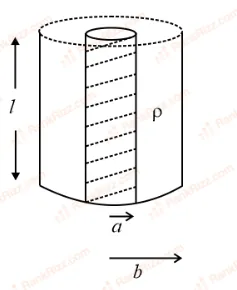
Model a torch battery of length to be made up of a thin cylindrical bar of radius and a concentric thin cylindrical shell of radius filled in between with an electrolyte of resistivity (see figure). If the battery is connected to a resistance of value , the maximum Joule heating in will take place for:
In a building there are 15 bulbs of 45 W, 15 bulbs of 100 W, 15 small fans of 10 W and 2 heaters of 1 kW. The voltage of electric main supply is 220 V. The minimum fuse capacity (rated value) of the building will be:
5 A
25 A
15 A
20 A
A battery of 3.0 V is connected to a resistor dissipating 0.5 W of power. If the terminal voltage of the battery is 2.5 V, the power dissipated within the internal resistance is:
0.50 W
0.072 W
0.10 W
0.125 W
An electrical power line, having a total resistance of , delivers at . The efficiency of the transmission line is approximately:
72%
91%
85%
96%
Two equal resistances when connected in series to a battery, consume electric power of 60 W. If these resistance are now connected in parallel combination to the same battery, the electric power consumed will be:
60 W
240 W
120 W
30 W
Two electric bulbs, rated at (25 W, 220 V) and (100 W, 220 V), are connected in series across a 220 V voltage source. If the 25 W and 100 W bulbs draw powers and respectively, then:
W, W
W, W
W, W
W, W
RELATED CURRENT ELECTRICITY TOPICS