JEE Main 2020 Physics question — Electric power and heating effect of current
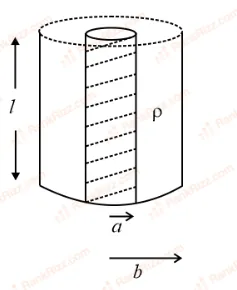
Model a torch battery of length to be made up of a thin cylindrical bar of radius and a concentric thin cylindrical shell of radius filled in between with an electrolyte of resistivity (see figure). If the battery is connected to a resistance of value , the maximum Joule heating in will take place for:
SOLUTION
We model the torch battery as an ideal emf source in series with its internal resistance, which is the resistance of the electrolyte that fills the space between the inner solid rod (radius ) and the outer cylindrical shell (inner radius ). Our first task is therefore to calculate this internal resistance, which we shall denote by .
To find , we remember the differential formula for the resistance of a conductor:
where is the resistivity, is the infinitesimal length of the current path, and is the cross-sectional area perpendicular to the current.
In the present arrangement the current flows radially outward from the inner rod to the outer shell. Choose an imaginary cylindrical surface of radius (with ) and thickness . The current crosses this surface normally, so:
• The path length for the current element is the radial thickness .
• The area normal to the current is the curved area of the cylinder, , where is the length of the battery.
Substituting these into the differential resistance formula, we obtain
To get the total internal resistance, integrate from the inner radius to the outer radius :
Now the circuit consists of the emf , the internal resistance and the external resistance in series. The Joule heating (power) in the external resistor is
The maximum power transfer theorem states that, for a fixed internal resistance , the power delivered to is maximum when
Therefore, using the explicit form of we just calculated, the condition for maximum Joule heating is
This expression matches Option B.
Hence, the correct answer is Option B.
Tagged Electric power and heating effect of current. Machine-assigned, so read it as a strong shortlist rather than a verdict.