In the line spectra of hydrogen atom, difference between the largest and the shortest wavelengths of the Lyman series is 305 . The corresponding difference for the Paschan series in is __________ (nearest integer)
Every JEE Main question on Hydrogen spectrum and spectral series, one of the ideas inside Atoms & Nuclei: 116 questions from 2005–2026, 66 of them in the last five years. Newest first, answer key on every one. Free to read.
Questions
116
Years asked
18
Since
2005
Of the chapter
38%
81–100 OF 116 · NEWEST FIRST
In the line spectra of hydrogen atom, difference between the largest and the shortest wavelengths of the Lyman series is 305 . The corresponding difference for the Paschan series in is __________ (nearest integer)
The first member of the Balmer series of hydrogen atom has a wavelength of 6561 . The wavelength of the second member of the Balmer series (in nm) is
Consider an electron in a hydrogen atom, revolving in its second excited state (having radius 4.65 Å). The de-Broglie wavelength of this electron is:
12.9 Å
6.6 Å
9.7 Å
3.5 Å
A particle of mass m moves in a circular orbit in a central potential field . If Bohr's quantization conditions are applied, radii of possible orbitals and energy levels vary with quantum number n as:
,
,
,
,
The electron in a hydrogen atom first jumps from the third excited state to the second excited state and subsequently to the first excited state. The ratio of the respective wavelengths, , of the photons emitted in this process is:
A hydrogen atom, initially in the ground state is excited by absorbing a photon of wavelength 980 . The radius of the atom in the excited state, in terms of Bohr radius , will be:
None of the above
In a hydrogen like atom, when an electron jumps from the M-shell to the L-shell, the wavelength of emitted radiation is . If an electron jumps from N-shell to the L-shell, the wavelength of emitted radiation will be:
Radiation coming from transitions to of hydrogen atoms fall on He ions in and states. The possible transition of helium ions as they absorb energy from the radiation is:
In Li, electron in first Bohr orbit is excited to a level by a radiation of wavelength . When the ion gets de-excited to the ground state in all possible ways (including intermediate emissions), a total of six spectral lines are observed. What is the value of ?
(Given: h = J s; c = m s)
10.8 nm
9.4 nm
11.4 nm
12.3 nm
Taking the wavelength of first Balmer line in hydrogen spectrum (n = 3 to n = 2) as 660 nm, the wavelength of the 2nd Balmer line (n = 4 to n = 2) will be:
889.2 nm
488.9 nm
388.9 nm
642.7 nm
An excited He ion emits two photons in succession, with wavelengths 108.5 nm and 30.4 nm in making a transition to the ground state. The quantum number n, corresponding to its initial excited state is
(for a photon of wavelength , energy E = )
n = 6
n = 5
n = 7
n = 4
A He ion is in its first excited state. Its ionization energy is:
13.60 eV
48.36 eV
54.40 eV
6.04 eV
The energy required to remove the electron from a singly ionized Helium atom is 2.2 times the energy required to remove an electron from Helium atom. The total energy required to ionize the Helium atom completely is:
20 eV
79 eV
109 eV
34 eV
Muon () is negatively charged (|q| = |e|) with a mass m = 200 m, where m is the mass of the electron and e is the electronic charge. If is bound to a proton to form a hydrogen like atom, identify the correct statements:
(A) Radius of the muonic orbit is 200 times smaller than that of the electron
(B) The speed of the in the nth orbit is times that of the electron in the nth orbit
(C) The ionization energy of muonic atom is 200 times more than that of an hydrogen atom
(D) The momentum of the muon in the nth orbit is 200 times more than that of the electron
(A), (B), (D)
(B), (D)
(C), (D)
(A), (C), (D)
According to Bohr's theory, the time averaged magnetic field at the centre (i.e., nucleus) of a hydrogen atom due to the motion of electrons in the orbit is proportional to: ( = principal quantum number)
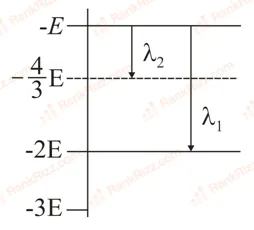
Some energy levels of a molecule are shown in the figure. The ratio of the wavelengths , is given by:

The acceleration of an electron in the first orbit of the hydrogen atom () is:
An electron in a hydrogen atom makes a transition from to and emits a photon. This photon strikes a doubly ionized lithium atom which was already in an excited state and completely removes the orbiting electron. The least quantum number for the excited state of the lithium-ion for the process is
2
4
5
3
A neutron moving with a speed 'v' makes a head on collision with a stationary hydrogen atom in ground state. The minimum kinetic energy of the neutron for which perfectly inelastic collision will take place is:
20.4 eV
10.2 eV
12.1 eV
16.8 eV
If one were to apply the Bohr model to a particle of mass and charge moving in a plane under the influence of a magnetic field 'B', the energy of the charged particle in the level will be: