RankRizz

Hydrogen spectrum and spectral series — JEE Main Previous Year Questions

Every JEE Main question on Hydrogen spectrum and spectral series, one of the ideas inside Atoms & Nuclei: 116 questions from 2005–2026, 66 of them in the last five years. Newest first, answer key on every one. Free to read.

Questions

116

Years asked

18

Since

2005

Of the chapter

38%

Every Hydrogen spectrum and spectral series question

101–116 OF 116 · NEWEST FIRST

JEE MAIN 2015 · 11 APR ONLINEHydrogen spectrum and spectral seriesTRANSCRIBED

The de-Broglie wavelength associated with the electron in the n=4n = 4 level is:

  1. A

    Half of the de-Broglie wavelength of the electron in the ground state
  2. B

    Four times the de-Broglie wavelength of the electron in the ground state

  3. C

    14\frac{1}{4}th of the de-Broglie wavelength of the electron in the ground state

  4. D

    Two times the de-Broglie wavelength of the electron in the ground state

JEE MAIN 2015 · 04 APR OFFLINEHydrogen spectrum and spectral seriesTRANSCRIBED

As an electron makes a transition from an excited state to the ground state of a hydrogen-like atom/ion

  1. A

    kinetic energy and total energy decrease but potential energy increases

  2. B

    its kinetic energy increases but potential energy and total energy decrease

  3. C

    kinetic energy, potential energy and total energy decrease

  4. D

    kinetic energy decreases, potential energy increases but total energy remains same

JEE MAIN 2014 · 06 APR OFFLINEHydrogen spectrum and spectral seriesTRANSCRIBED

The radiation corresponding to 3→23 \to 2 transition of hydrogen atom falls on a metal surface to produce photoelectrons. These electrons are made to enter a magnetic field of 3×10−43 \times 10^{-4} T. If the radius of the largest circular path followed by these electrons is 10.0 mm, the work function of the metal is close to:

  1. A

    1.8 eV

  2. B

    1.1 eV

  3. C

    0.8 eV

  4. D

    1.6 eV

JEE MAIN 2014 · 09 APR ONLINEHydrogen spectrum and spectral seriesTRANSCRIBED

If the binding energy of the electron in a hydrogen atom is 13.6 eV, the energy required to remove the electron from the first excited state of Li++^{++} is:

  1. A

    13.6 eV

  2. B

    3.4 eV

  3. C

    122.4 eV

  4. D

    30.6 eV

JEE MAIN 2014 · 06 APR OFFLINEHydrogen spectrum and spectral seriesTRANSCRIBED

Hydrogen (1H1_1H^1), Deuterium (1H2_1H^2), singly ionised Helium (2He4_2He^4)+^+ and doubly ionised lithium (3Li6_3Li^6)++^{++} all have one electron around the nucleus. Consider an electron transition from n=2n = 2 to n=1n = 1. If the wave lengths of emitted radiation are λ1\lambda_1, λ2\lambda_2, λ3\lambda_3 and λ4\lambda_4 respectively then approximately which one of the following is correct?

  1. A

    4λ1=2λ2=2λ3=λ44\lambda_1 = 2\lambda_2 = 2\lambda_3 = \lambda_4

  2. B

    λ1=2λ2=2λ3=λ4\lambda_1 = 2\lambda_2 = 2\lambda_3 = \lambda_4

  3. C

    λ1=λ2=4λ3=9λ4\lambda_1 = \lambda_2 = 4\lambda_3 = 9\lambda_4

  4. D

    λ1=2λ2=3λ3=4λ4\lambda_1 = 2\lambda_2 = 3\lambda_3 = 4\lambda_4

JEE MAIN 2013 · 09 APR ONLINEHydrogen spectrum and spectral seriesTRANSCRIBED

In the Bohr model an electron moves in a circular orbit around the proton. Considering the orbiting electron to be a circular current loop, the magnetic moment of the hydrogen atom, when the electron is in nthn^{th} excited state, is :

  1. A

    (e2m)n2h2π\left(\frac{e}{2m}\right)\frac{n^2h}{2\pi}

  2. B

    (em)nh2π\left(\frac{e}{m}\right)\frac{nh}{2\pi}

  3. C

    (e2m)nh2π\left(\frac{e}{2m}\right)\frac{nh}{2\pi}

  4. D

    (em)n2h2π\left(\frac{e}{m}\right)\frac{n^2h}{2\pi}

JEE MAIN 2013 · 23 APR ONLINEHydrogen spectrum and spectral seriesTRANSCRIBED

In the Bohr's model of hydrogen-like atom the force between the nucleus and the electron is modified as F=e24πϵ0(1r2+βr3)F = \frac{e^2}{4\pi\epsilon_0}\left(\frac{1}{r^2} + \frac{\beta}{r^3}\right), where β\beta is a constant. For this atom, the radius of the nthn^{th} orbit in terms of the Bohr radius (a0=ϵ0h2mπe2)\left(a_0 = \frac{\epsilon_0 h^2}{m\pi e^2}\right) is :

  1. A

    rn=a0n−βr_n = a_0 n - \beta

  2. B

    rn=a0n2+βr_n = a_0 n^2 + \beta

  3. C

    rn=a0n2−βr_n = a_0 n^2 - \beta

  4. D

    rn=a0n+βr_n = a_0 n + \beta

JEE MAIN 2013 · 07 APR ONLINEHydrogen spectrum and spectral seriesTRANSCRIBED

In a hydrogen like atom electron makes transition from an energy level with quantum number n to another with quantum number (n - 1). If n >> 1, the frequency of radiation emitted is proportional to :

  1. A

    1n3/2\frac{1}{n^{3/2}}

  2. B

    1n3\frac{1}{n^3}

  3. C

    1n\frac{1}{n}

  4. D

    1n2\frac{1}{n^2}

JEE MAIN 2013 · 25 APR ONLINEHydrogen spectrum and spectral seriesTRANSCRIBED

A 12.5 eV electron beam is used to bombard gaseous hydrogen at room temperature. It will emit:

  1. A

    2 lines in the Lyman series and 1 line in the Balmer series

  2. B

    3 lines in the Lyman series

  3. C

    1 line in the Lyman series and 2 lines in the Balmer series

  4. D

    3 lines in the Balmer series

JEE MAIN 2012Hydrogen spectrum and spectral seriesTRANSCRIBED

Hydrogen atom is excited from ground state to another state with principal quantum number equal to 44. Then the number of spectral lines in the emission spectra will be

  1. A

    22

  2. B

    33

  3. C

    55

  4. D

    66

JEE MAIN 2012Hydrogen spectrum and spectral seriesTRANSCRIBED

The electron of a hydrogen atom makes a transition from the (n+1)th(n+1)^{\text{th}} orbit to the nthn^{\text{th}} orbit. For large nn the wavelength of the emitted radiation is proportional to

  1. A

    nn

  2. B

    n3n^3

  3. C

    n4n^4

  4. D

    n2n^2

JEE MAIN 2012Hydrogen spectrum and spectral seriesTRANSCRIBED

A hypothetical atom has only three energy levels. The ground level has energy, E1=−8E_1 = -8 eV. The two excited states have energies, E2=−6E_2 = -6 eV and E3=−2E_3 = -2 eV. Then which of the following wavelengths will not be present in the emission spectrum of this atom?

  1. A

    207207 nm

  2. B

    465465 nm

  3. C

    310310 nm

  4. D

    620620 nm

JEE MAIN 2012Hydrogen spectrum and spectral seriesTRANSCRIBED

A doubly ionised Li atom is excited from its ground state (n=1n = 1) to n=3n = 3 state. The wavelengths of the spectral lines are given by λ32\lambda_{32}, λ31\lambda_{31} and λ21\lambda_{21}. The ratio λ32/λ31\lambda_{32}/\lambda_{31} and λ21/λ31\lambda_{21}/\lambda_{31} are, respectively

  1. A

    8.1,0.678.1, 0.67

  2. B

    8.1,1.28.1, 1.2

  3. C

    6.4,1.26.4, 1.2

  4. D

    6.4,0.676.4, 0.67

JEE MAIN 2009Hydrogen spectrum and spectral seriesTRANSCRIBED

The transition from the state n=4n = 4 to n=3n = 3 in a hydrogen like atom results in ultraviolet radiation. Infrared radiation will be obtained in the transition from

  1. A

    2→12 \to 1

  2. B

    3→23 \to 2

  3. C

    4→24 \to 2

  4. D

    5→45 \to 4

JEE MAIN 2007Hydrogen spectrum and spectral seriesTRANSCRIBED

Which of the following transitions in hydrogen atoms emit photons of highest frequency?

  1. A

    n=2n = 2 to n=6n = 6

  2. B

    n=6n = 6 to n=2n = 2

  3. C

    n=2n = 2 to n=1n = 1

  4. D

    n=1n = 1 to n=2n = 2

JEE MAIN 2005Hydrogen spectrum and spectral seriesTRANSCRIBED

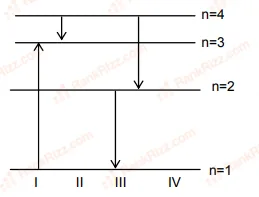
The diagram shows the energy levels for an electron in a certain atom. Which transition shown represents the emission of a photon with the most energy? Figure for JEE Main 2005 Physics question on Hydrogen spectrum and spectral series

  1. A

    III

  2. B

    IV

  3. C

    I

  4. D

    II