JEE MAIN 2023 · 24 JAN S2Hydrogen spectrum and spectral seriesTRANSCRIBED
A photon is emitted in transition from to level in hydrogen atom. The corresponding wavelength for this transition is (given, eV s)
- A
941 nm
- B
974 nm
- C
99.3 nm
- D
94.1 nm
Every JEE Main question on Hydrogen spectrum and spectral series, one of the ideas inside Atoms & Nuclei: 116 questions from 2005–2026, 66 of them in the last five years. Newest first, answer key on every one. Free to read.
Questions
116
Years asked
18
Since
2005
Of the chapter
38%
41–60 OF 116 · NEWEST FIRST
A photon is emitted in transition from to level in hydrogen atom. The corresponding wavelength for this transition is (given, eV s)
941 nm
974 nm
99.3 nm
94.1 nm
The radius of electron's second stationary orbit in Bohr's atom is . The radius of 3 orbit will be
2.25
Speed of an electron in Bohr's orbit for Hydrogen atom is m s. The corresponding speed of the electron in orbit, in m s is:
The angular momentum for the electron in Bohr's orbit is . If the electron is assumed to revolve in second orbit of hydrogen atom, then the change in angular momentum will be
Zero
The energy of He ion in its first state is, (The ground state energy for the Hydrogen atom eV):
eV
eV
eV
eV
The energy levels of an atom is shown in figure.
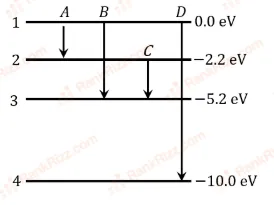
Which one of these transitions will result in the emission of a photon of wavelength 124.1 nm?
Given ( J s)
B
A
C
D
The radius of 2 orbit of He of Bohr's model is and that of fourth orbit of Be is represented as . Now the ratio is . The value of is _____.
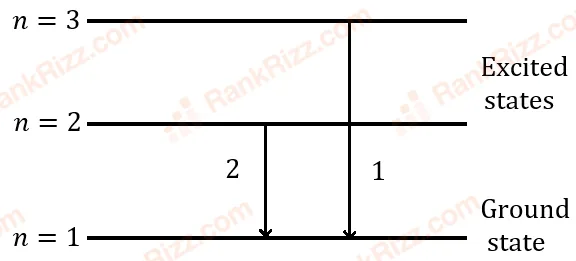
For hydrogen atom, and are the wavelengths corresponding to the transitions 1 and 2 respectively as shown in figure. The ratio of and is . The value of is ______.
If the binding energy of ground state electron in a hydrogen atom is 13.6 eV, then, the energy required to remove the electron from the second excited state of Li will be: eV. The value of is ______.
The wavelength of the radiation emitted is when an electron jumps from the second excited state to the first excited state of hydrogen atom. If the electron jumps from the third excited state to the second orbit of the hydrogen atom, the wavelength of the radiation emitted will be . The value of is _____.
The radius of fifth orbit of Li is ______ m. Take: radius of hydrogen atom = 0.51
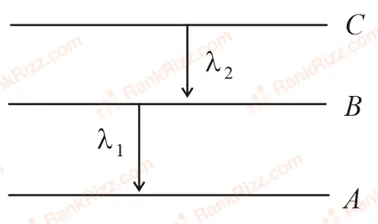
As per the given figure , and are the first, second and third excited energy levels of hydrogen atom respectively. If the ratio of the two wavelengths (i.e. ) is , then the value of will be _____.
The ratio of wavelength of spectral lines and in the Balmer series is . The value of is _____.
A light of energy 12.75 eV is incident on a hydrogen atom in its ground state. The atom absorbs the radiation and reaches to one of its excited states. The angular momentum of the atom in the excited state is eVs. The value of is _____ (use eVs, m s)
If 917 be the lowest wavelength of Lyman series then the lowest wavelength of Balmer series will be _______ .
A monochromatic light is incident on a hydrogen sample in ground state. Hydrogen atoms absorb a fraction of light and subsequently emit radiation of six different wavelengths. The frequency of incident light is Hz. The value of x is _______.
(Given eVs)
Find the ratio of energies of photons produced due to transition of an electron of hydrogen atom from its (i) second permitted energy level to the first level, and (ii) the highest permitted energy level to the first permitted level.
3 : 4
4 : 3
1 : 4
4 : 1
The ratio for the speed of the electron in the orbit of to the speed of the electron in the orbit of hydrogen atom will be :
Given below are two statements
Statement I: In hydrogen atom, the frequency of radiation emitted when an electron jumps from lower energy orbit () to higher energy orbit (), is given as
Statement II: The jumping of electron from higher energy orbit () to lower energy orbit () is associated with frequency of radiation given as . This condition is Bohr's frequency condition.
In the light of the above statements, choose the correct answer from the options given below:
Both statement I and statement II are true.
Both statement I and statement II are false.
Statement I is correct but statement II is false.
Statement I is incorrect but statement II is true.
A hydrogen atom in its ground state absorbs eV of energy. The angular momentum of electron of the hydrogen atom will increase by the value of (Given, Planck's constant Js).
Js
Js
Js
Js