JEE MAIN 2021 · 27 JUL S2Abnormal molar mass and van't Hoff factorTRANSCRIBED
In a solvent 50% of an acid HA dimerizes and the rest dissociates. The van't Hoff factor of the acid is _________ (Round off to the nearest integer)
Every Solutions question JEE Main has set, grouped by the idea it tests rather than the order of the syllabus. 200 questions across 7 distinct ideas. Free to read, answer key on every one.
Questions
200
Distinct ideas
7
Share of marks
4.8%
Difficulty
MEDIUM
A chapter is not one subject — it is a handful of procedures the examiner reuses. These are the ones Solutions questions actually test.
121–140 OF 200 · NEWEST FIRST
In a solvent 50% of an acid HA dimerizes and the rest dissociates. The van't Hoff factor of the acid is _________ (Round off to the nearest integer)
1.22 g of an organic acid is separately dissolved in 100 g of benzene (K = 2.6 K kg mol) and 100 g of acetone (K = 1.7 K kg mol). The acid is known to dimerize in benzene but remain as a monomer in acetone. The boiling point of the solution in acetone increases by 0.17°C. The increase in boiling point of solution in benzene in °C is . The value of x is _________. (Nearest integer)
[Atomic mass : C = 12.0, H = 1.0, O = 16.0]
83 g of ethylene glycol dissolved in 625 g of water. The freezing point of the solution is _________ K. (Nearest integer)
[Use: Molal Freezing point depression constant of water = 1.86 K kg mol
Freezing point of water = 273 K
Atomic masses: C : 12.0u, O : 16.0u, H : 1.0u]
When 12.2 g of benzoic acid is dissolved in 100 g of water, the freezing point of solution was found to be °C ( K kg mol). The number (n) of benzoic acid molecules associated (assuming 100% association) is ______.
When 3.00 g of a substance X' is dissolved in 100 g of CCl, it raises the boiling point by 0.60 K. The molar mass of the substance 'X' is _________ g mol. (Nearest integer).
[Given K for CCl is 5.0 K kg mol]
is 10% dissociated in water to and . The boiling point of 10.0 molal aqueous solution of is ________ °C. (Round off to the Nearest Integer).
[Given: Molal elevation constant of water K kg mol, boiling point of pure water = 100°C]
1 molal aqueous solution of an electrolyte is 60% ionised. The boiling point of the solution at 1 atm is ______ K. (Rounded-off to the nearest integer) [Given for K kg mol]
The oxygen dissolved in water exerts a partial pressure of 20 kPa in the vapour above water. The molar solubility of oxygen in water is ________ mol dm. (Round off to the Nearest Integer).
[Given: Henry's law constant = kPa for O. Density of water with dissolved oxygen = 1.0 kg dm]
CO gas is bubbled through water during a soft drink manufacturing process at 298 K. If CO exerts a partial pressure of 0.835 bar then x m mol of CO would dissolve in 0.9 L of water. The value of x is ___.
(Nearest integer)
(Henry's law constant for CO at 298 K is bar)
When 9.45 g of is added to 500 mL of water, its freezing point drops by 0.5°C. The dissociation constant of is . The value of is ______ (off to the nearest integer)
K kg mol
An open beaker of water in equilibrium with water vapour is in a sealed container. When a few grams of glucose are added to the beaker of water, the rate at which water molecules:
leaves the vapour increases
leaves the solution increases
leaves the solution decreases
leaves the vapour decreases
Two open beakers one containing a solvent and the other containing a mixture of that solvent with a non volatile solute are together sealed in a container. Over time:
the volume of the solution increases and the volume of the solvent decreases
the volume of the solution decreases and the volume of the solvent increases
the volume of the solution and the solvent does not change the volume of the solution does not
change and the volume of the solvent decreases
A set of solutions is prepared using 180 g of water as a solvent and 10 g of different non-volatile solutes A, B and C. The relative lowering of vapour pressure in the presence of these solutes are in the order [Given, molar mass of ; ; ]
B > C > A
C > B > A
A > B > C
A > C > B
Henry's constant (in kbar) for four gases , , and in water at 298 K is given below:
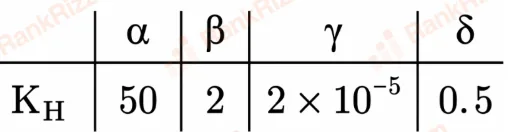
(density of water = 10 kg m at 298 K) This table implies that:
has the highest solubility in water at a given pressure
solubility of at 308K is lower than at 298K
The pressure of a 55.5 molal solution of is 250 bar
The pressure of 55.5 molal solution of is 1 bar
The size of a raw mango shrinks to a much smaller size when kept in a concentrated salt solution. Which one of the following process can explain this?
Osmosis
Dialysis
Diffusion
Reverse osmosis
At 35 C, the vapour pressure of CS is 512 mmHg and that of acetone is 144 mmHg. A solution of CS in acetone has a total vapour pressure of 600 mmHg. The false statement amongst the following is:
Raoult's law is not obeyed by this system
a mixture of 100 mL CS and 100 mL acetone has a volume < 200 mL
CS and acetone are less attracted to each other than to themselves
heat must be absorbed in order to produce the solution at 35C
A graph of vapour pressure and temperature for three different liquids X, Y and Z is shown below:
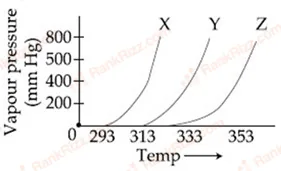
The following inferences are made:
(A) X has higher intermolecular interactions compared to Y.
(B) X has lower intermolecular interactions compared to Y.
(C) Z has lower intermolecular interactions compared to Y.
The correct inferences is/are:
(A) and (C)
(A)
(B)
(C)
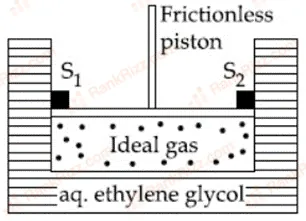
A cylinder containing an ideal gas (0.1 mol of 1.0 dm) is in thermal equilibrium with a large volume of 0.5 molal aqueous solution of ethylene glycol at its freezing point. If the stoppers and (as shown in the figure) are suddenly withdrawn, the volume of the gas in litres after equilibrium is achieved will be ___________.
(Given, (water) K kg mol, R dm atm K mol)
If 250 cm of an aqueous solution containing 0.73g of a protein A is isotonic with one litre of another aqueous solution containing 1.65g of a protein B, at 298K, the ratio of the molecular masses of A and B is _________ (to the nearest integer).
How much amount of NaCl should be added to 600 g of water to decrease the freezing point of water to °C? ___________. (The freezing point depression constant for water K )
OTHER CHEMISTRY CHAPTERS