Every Solid State question JEE Main has set, grouped by the idea it tests rather than the order of the syllabus. 78 questions across 6 distinct ideas. Free to read, answer key on every one.
A chapter is not one subject — it is a handful of procedures the examiner reuses. These are the ones Solid State questions actually test.
01Classification of solidsset 6×
02Crystal lattices, unit cells and densityset 41×
03Close packing and packing efficiencyset 2×
04Voids, radius ratio and structures of ionic solidsset 18×
05Defects in solidsset 9×
06Electrical and magnetic properties of solidsset 2×
Every Solid State question
41–60 OF 78 · NEWEST FIRST
JEE MAIN 2019 · 09 JAN S2Crystal lattices, unit cells and densityTRANSCRIBED
At 100∘C, copper (Cu) has FCC unit cell structure with cell edge length of xA˚. What is the approximate density of Cu (in g cm−3) at this temperature? [Atomic Mass of Cu = 63.55 u]
JEE MAIN 2019 · 10 JAN S2Voids, radius ratio and structures of ionic solidsTRANSCRIBED
A compound of formula A2B3 has the HCP lattice. Which atom forms the HCP lattice and what fraction of the tetrahedral voids are occupied by the other atoms?
JEE MAIN 2019 · 11 JAN S2Crystal lattices, unit cells and densityTRANSCRIBED
The radius of the largest sphere which fits properly at the centre of the edge of a body centred cubic unit cell is: (Edge length is represented by 'a')
JEE MAIN 2019 · 08 APR S2Crystal lattices, unit cells and densityTRANSCRIBED
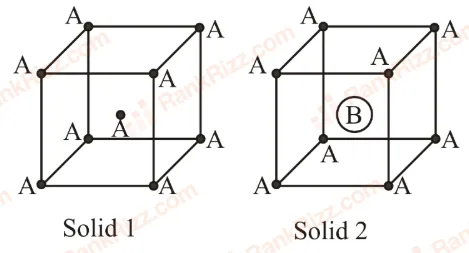
Consider the bcc unit cells of the solids 1 and 2 with the position of atoms as shown below. The radius of atom B is twice that of atom A. The unit cell edge length is 50% more in solid 2 than in 1. What is the approximate packing efficiency in solid 2?
JEE MAIN 2019 · 09 APR S2Crystal lattices, unit cells and densityTRANSCRIBED
10 mL of 1 mM surfactant solution forms a monolayer covering 0.24 cm2 on a polar substrate. If the polar head is approximated as a cube, what is its edge length?
JEE MAIN 2019 · 11 JAN S1Crystal lattices, unit cells and densityTRANSCRIBED
A solid having density of 9×10³ kg m−3 forms face centred cubic crystals of edge length 2002 pm. What is the molar mass of the solid? [Avogadro constant ≈6×10²³ mol−1, π≈3]
JEE MAIN 2019 · 08 APR S1Crystal lattices, unit cells and densityTRANSCRIBED
Element B forms ccp structure and A occupies half of the octahedral voids, while oxygen atoms occupy all the tetrahedral voids. The structure of bimetallic oxide is:
JEE MAIN 2019 · 12 APR S1Crystal lattices, unit cells and densityTRANSCRIBED
An element has a face-centered cubic fcc structure with a cell edge of a. The distance between the centres of two nearest tetrahedral voids in the lattice is
JEE MAIN 2017 · 02 APR OFFLINECrystal lattices, unit cells and densityTRANSCRIBED
A metal crystallizes in a face centred cubic structure. If the edge length of its unit cell is 'a', the closest approach between two atoms in the metallic crystal will be
JEE MAIN 2014 · 09 APR ONLINECrystal lattices, unit cells and densityTRANSCRIBED
In a face centered cubic lattice atoms A are at the corner points and atoms B at the face centered points. If atom B is missing from one of the face centered points, the formula of the ionic compound is:
JEE MAIN 2013 · 23 APR ONLINECrystal lattices, unit cells and densityTRANSCRIBED
In a face centred cubic lattice, atoms of A form the corner points and atoms of B form the face centred points. If two atoms of A are missing from the corner points, the formula of the ionic compound is :