The correct order of conductivity of ions in water is:
- A
Na^+ > K^+ > Rb^+ > Cs^+
- B
Cs^+ > Rb^+ > K^+ > Na^+
- C
K^+ > Na^+ > Cs^+ > Rb^+
- D
Rb^+ > Na^+ > K^+ > Li^+
Every s-Block Elements question JEE Main has set, grouped by the idea it tests rather than the order of the syllabus. 98 questions across 4 distinct ideas. Free to read, answer key on every one.
Questions
98
Distinct ideas
4
Share of marks
0%
Difficulty
EASY
A chapter is not one subject — it is a handful of procedures the examiner reuses. These are the ones s-Block Elements questions actually test.
61–80 OF 98 · NEWEST FIRST
The correct order of conductivity of ions in water is:
Na^+ > K^+ > Rb^+ > Cs^+
Cs^+ > Rb^+ > K^+ > Na^+
K^+ > Na^+ > Cs^+ > Rb^+
Rb^+ > Na^+ > K^+ > Li^+
One of the by-products formed during the recovery of NH from Solvay process is:
Ca(OH)
NaHCO
CaCl
NHCl
Given below are two statements: one is labelled as Assertion (A) and the other is labelled as Reason (R).
Assertion (A): Barium carbonate is insoluble in water and is highly stable.
Reason (R): The thermal stability of the carbonates increases with increasing cationic size.
Choose the most appropriate answer from the options given below:
(A) is true but (R) is false.
Both (A) and (R) are true.
(A) is false but (R) is true.
Both (A) and (R) are false.
Match List I with List II:
List-I (Elements) List-II (Properties)
(a) Li (i) Poor water solubility of I salt
(b) Na (ii) Most abundant element in cell fluid
(c) K (iii) Bicarbonate salt used in fire extinguisher
(d) Cs (iv) Carbonate salt decomposes easily on heating
Choose the correct answer from the options given below:
(a)-(iv), (b)-(iii), (c)-(ii), (d)-(i)
(a)-(i), (b)-(iii), (c)-(ii), (d)-(iv)
(a)-(iv), (b)-(ii), (c)-(iii), (d)-(i)
(a)-(i), (b)-(ii), (c)-(iii), (d)-(iv)
Match the following compounds (Column-I) with their uses (Column-II):
S. No. Column-I S.No. Column-II
(I) - (A) casts of statues
(II) NaCl - (B) white wash
(III) - (C) antacid
(IV) - (D) washing soda preparation
(I)-(D), (II)-(A), (III)-(C), (IV)-(B)
(I)-(B), (II)-(D), (III)-(A), (IV)-(C)
(I)-(B), (II)-(C), (III)-(D), (IV)-(A)
(I)-(D), (II)-(C), (III)-(B), (IV)-(A)
On combustion of Li, Na and K in excess of air, the major oxides formed, respectively, are:
, and
, and
, and
, and
Among the statements (a) - (d), the correct ones are:
(a) Lithium has the highest hydration enthalpy among the alkali metals.
(b) Lithium chloride is insoluble in pyridine.
(c) Lithium cannot form ethynide upon its reaction with ethyne.
(d) Both lithium and magnesium react slowly with .
(a), (b) and (d) only
(a), (c) and (d) only
(b) and (c) only
(a) and (d) only
When gypsum is heated to 393K, it forms:
Anhydrous CaSO
CaSO . 5HO
CaSO . 0.5HO
Dead burnt plaster
The metal mainly used in devising photoelectric cells is:
Na
Li
Rb
Cs
The metal that forms nitride by reacting directly with of air is:
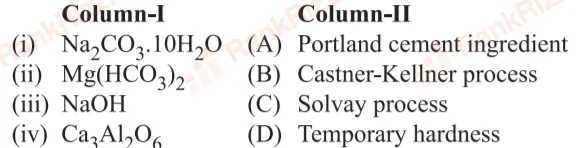
Match the following items in column I with the corresponding items in column II.

(i) (B); (ii) (C); (iii) (A); (iv) (D)
(i) (C); (ii) (B); (iii) (D); (iv) (A)
(i) (D); (ii) (A); (iii) (B); (iv) (C)
(i) (C); (ii) (D); (iii) (B); (iv) (A)
Magnesium powder burns in air to give:
MgO and MgN
MgO only
Mg(NO) and MgN
MgO and Mg(NO)
The structures of beryllium chloride in the solid state and vapour phase, respectively, are:
chain and chain
dimeric and chain
chain and dimeric
dimeric and dimeric
The incorrect statement is:
LiNO decomposes on heating to give LiNO and O.
LiCl crystallises from aqueous solution as LiCl - 2HO.
Lithium is the strongest reducing agent among the alkali metals.
Lithium is least reactive with water among the alkali metals.
The correct order of hydration enthalpies of alkali metal ions is:
Na^{+} > Li^{+} > K^{+} > Rb^{+}
Na^{+} > Li^{+} > K^{+} > Cs^{+} > Rb^{+}
Li^{+} > Na^{+} > K^{+} > Rb^{+} > Cs^{+}
Na^{+} > K^{+} > Cs^{+} > Rb^{+}
The alkaline earth metal nitrate that does not crystallise with molecules is:
The alloy used in the construction of aircrafts is:
Mg - Al
Mg - Mn
Mg - Sn
Mg - Zn
A hydrated solid X on heating initially gives a monohydrated compound Y. Y upon heating above 373 K leads to an anhydrous white powder Z. X and Z, respectively, are;
washing soda and soda ash.
baking soda and soda ash.
washing soda and dead burnt plaster.
baking soda and dead burnt plaster.
The metal used for making X-ray tube window is:
Mg
Na
Be
Ca
A metal on combustion in excess air forms X. X upon hydrolysis with water yields and along with another product. The metal is:
Na
Mg
Li
Rb
OTHER CHEMISTRY CHAPTERS