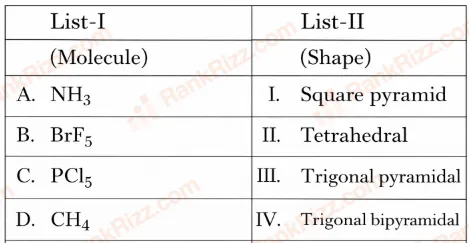
Match List I with List II
Choose the correct answer from the options given below:
- A
A-II, B-IV, C-I, D-III
- B
A-III, B-I, C-IV, D-II
- C
A-IV, B-III, C-I, D-II
- D
A-III, B-IV, C-I, D-II
Every Classification of Elements and Periodicity question JEE Main has set, grouped by the idea it tests rather than the order of the syllabus. 201 questions across 6 distinct ideas. Free to read, answer key on every one.
Questions
201
Distinct ideas
6
Share of marks
4.2%
Difficulty
EASY
A chapter is not one subject — it is a handful of procedures the examiner reuses. These are the ones Classification of Elements and Periodicity questions actually test.
61–80 OF 201 · NEWEST FIRST
Match List I with List II
Choose the correct answer from the options given below:
A-II, B-IV, C-I, D-III
A-III, B-I, C-IV, D-II
A-IV, B-III, C-I, D-II
A-III, B-IV, C-I, D-II
The statement(s) that are correct about the species and . (A) All are isoelectronic (B) All have the same nuclear charge (C) has the largest ionic radii (D) has the smallest ionic radii. Choose the most appropriate answer from the options given below :
(B), (C) and (D) only
(C) and (D) only
(A), (C) and (D) only
(A), (B), (C) and (D)
Given below are two statements :
Statement I : The electronegativity of group 14 elements from Si to Pb gradually decreases.
Statement II : Group 14 contains non-metallic, metallic, as well as metalloid elements.
In the light of the above statements, choose the most appropriate from the options given below :
Statement I is false but Statement II is true
Statement I is true but Statement II is false
Both Statement I and Statement II are true
Both Statement I and Statement II are false
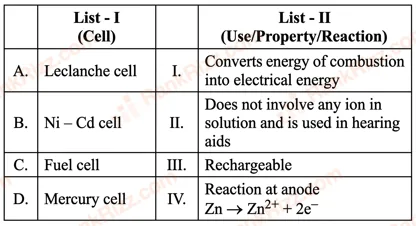
Match List I with List II:
Choose the correct answer from the options given below:
A-II, B-III, C-IV, D-I
A-I, B-II, C-III, D-IV
A-III, B-I, C-IV, D-II
A-IV, B-III, C-I, D-II
The transition metal having highest 3rd ionisation enthalpy is:
Cr
Mn
V
Fe
Given below are two statements :
Statement (I) : The 4f and 5f-series of elements are placed separately in the Periodic table to preserve the principle of classification. Statement (II) : s-block elements can be found in pure form in nature.
In light of the above statements, choose the most appropriate answer from the options given below:
Statement I is false but Statement II is true
Both Statement I and Statement II are true
Statement I is true but Statement II is false
Both Statement I and Statement II are false
If IUPAC name of an element is "Unununnium" then the element belongs to th group of periodic table. The value of is _______.
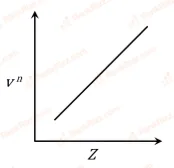
It is observed that characteristic X-ray spectra of elements show regularity. When frequency to the power 'n' i.e. of X-rays emitted is plotted against atomic number Z, the following graph is obtained.
The value of 'n' is
1
2
3
Given below are two statements:
Statement I: The decrease in first ionization enthalpy from B to Al is much larger than that from Al to Ga.
Statement II: The d orbitals in Ga are completely filled.
In the light of the above statements, choose the most appropriate answer from the options given below
Statement I is incorrect but statement II is correct.
Both the statements I and II are correct
Statement I is correct but statement II is incorrect
Both the statements I and II are incorrect
Match List - I with List - II
| LIST-I (Atomic number) | LIST-II (Block of periodic table) |
|---|---|
| (A) 37 | I. p-block |
| (B) 78 | II. d-block |
| (C) 52 | III. f-block |
| (D) 65 | IV. s-block |
Choose the correct answer from the options given below:
A-II, B-IV, C-I, D-III
A-I, B-III, C-IV, D-II
A-IV, B-III, C-II, D-I
A-IV, B-II, C-I, D-III
The correct order of electronegativity for given elements is
P > Br > C > At
Br > P > At > C
Br > C > At > P
C > P > At > Br
The correct increasing order of the ionic radii is
Cl^- < Ca^{2+} < K^+ < S^{2-}
K^+ < S^{2-} < Ca^{2+} < Cl^-
S^{2-} < Cl^- < Ca^{2+} < K^+
Ca^{2+} < K^+ < Cl^- < S^{2-}
For electron gain enthalpies of the elements denoted as H, the incorrect option is:
H(Cl) < H(F)
H(Se) < H(S)
H(I) < H(At)
H(Te) < H(Po)
Which of the following statements are not correct?
A. The electron gain enthalpy of F is more negative than that of Cl.
B. Ionization enthalpy decreases in a group of periodic table.
C. The electronegativity of an atom depends upon the atoms bonded to it.
D. AlO and NO are examples of amphoteric oxides.
Choose the most appropriate answer from the options given below:
A, B, C and D
A, B and D only
B and D only
A, C and D only
Which one of the following elements will remain as liquid inside pure boiling water?
Ga
Br
Li
Cs
Given below are two statements: one is labelled as Assertion (A) and the other is labelled as Reason (R).
Assertion (A): The first ionization enthalpy of 3d series elements is more than that of group 2 metals
Reason (R): In 3d series of elements successive filling of d-orbitals takes place.
In the light of the above statements, choose the correct answer from the options given below:
Both (A) and (R) are true and (R) is the correct explanation of (A)
(A) is true but (R) is false
(A) is false but (R) is true
Both (A) and (R) are true but (R) is not the correct explanation of (A)
Group-13 elements react with O in amorphous form to form oxides of type MO (M = element). Which among the following is the most basic oxide?
AlO
BO
TlO
GaO
Choose the correct statement(s):
A. Beryllium oxide is purely acidic in nature.
B. Beryllium carbonate is kept in the atmosphere of CO.
C. Beryllium sulphate is readily soluble in water.
D. Beryllium shows anomalous behavior.
A, B and C only
B, C and D only
A and B only
A only
Given below are two statements: one is labelled as Assertion A and the other is labelled as Reason R.
Assertion A: The energy required to form Mg from Mg is much higher than that required to produce Mg
Reason R: Mg is small ion and carry more charge than Mg
In the light of the above statements, choose the correct answer from the options given below.
Both A and R are true but R is NOT the correct explanation of A
A is true but R is false
A is false but R is true
Both A and R are true and R is the correct explanation of A
Given below are two statements:
Statement I: Lithium and Magnesium do not form superoxide
Statement II: The ionic radius of Li is larger than ionic radius of Mg
In the light of the above statements, choose the most appropriate answer from the questions given below:
Statement I is incorrect but Statement II is correct
Statement I is correct but Statement II is incorrect
Both statement I and Statement II are incorrect
Both Statement I and Statement II are correct
OTHER CHEMISTRY CHAPTERS