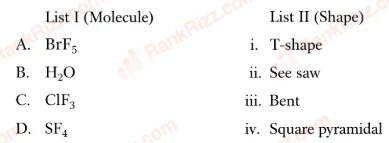
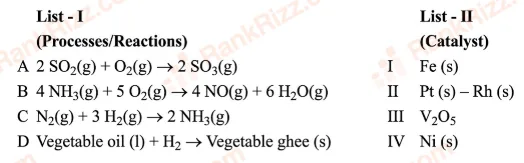
Match List - I with List-II

- A
(A)-I, (B)-II, (C)-IV, (D)-III
- B
(A)-II, (B)-I, (C)-III, (D)-IV
- C
(A)-III, (B)-IV, (C)-I, (D)-II
- D
(A)-IV, (B)-III, (C)-I, (D)-II
Every JEE Main question on Dinitrogen, ammonia, nitric acid and oxides of nitrogen, one of the ideas inside p-Block Elements: Groups 15 to 18: 10 questions from 2004–2024, 4 of them in the last five years. Newest first, answer key on every one. Free to read.
Questions
10
Years asked
7
Since
2004
Of the chapter
6%
Questions on Dinitrogen, ammonia, nitric acid and oxides of nitrogen in each year it was asked.
1–10 OF 10 · NEWEST FIRST
Match List - I with List-II

(A)-I, (B)-II, (C)-IV, (D)-III
(A)-II, (B)-I, (C)-III, (D)-IV
(A)-III, (B)-IV, (C)-I, (D)-II
(A)-IV, (B)-III, (C)-I, (D)-II
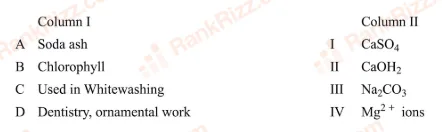
Match Column I with Column II

A - III, B - IV, C - I, D - II
A - II, B - I, C - III, D - IV
A - III, B - I, C - II, D - IV
A - II, B - III, C - IV, D - I
Match List - I with List - II.

Choose the correct answer from the options given below
A-III, B-I, C-II, D-IV
A-III, B-II, C-I, D-IV
A-IV, B-III, C-I, D-II
A-IV, B-II, C-III, D-I
is well known but is not. Because,
N - does not have vacant d-orbital
P - does not have 2d orbitals
Back bonding in is not possible
N atom is more electronegative so does not forms 5 bonds
When metal M is treated with NaOH, a white gelatinous precipitate X is obtained, which is soluble in excess of NaOH. Compound X when heated strongly gives an oxide which is used in chromatography as an adsorbent. The metal M is:
Fe
Zn
Ca
Al
The recommended concentration of fluoride ion in drinking water is up to 1 ppm as fluoride ion is required to make teeth enamel harder by converting [3Ca(PO).Ca(OH)] to:
[3Ca(OH).CaF]
[CaF]
[3(CaF).Ca(OH)]
[3Ca(PO).CaF]
The compound that does not produce nitrogen gas by thermal decomposition is:
The reaction of zinc with dilute and concentrated nitric acid, respectively, produces:
NO and
and
and
and NO
A metal on heating in nitrogen gas gives . on treatment with gives a colourless gas which when passed through solution gives a blue colour. is
One mole of magnesium nitride on the reaction with an excess of water gives
one mole of ammonia
two moles of nitric acid
two moles of ammonia
one mole of nitric acid