JEE MAIN 2022 · 26 JUL S2Group 15: trends and hydridesTRANSCRIBED
The number of non-ionisable protons present in the product B obtained from the following reaction is ______
Every p-Block Elements: Groups 15 to 18 question JEE Main has set, grouped by the idea it tests rather than the order of the syllabus. 173 questions across 8 distinct ideas. Free to read, answer key on every one.
Questions
173
Distinct ideas
8
Share of marks
2%
Difficulty
EASY
A chapter is not one subject — it is a handful of procedures the examiner reuses. These are the ones p-Block Elements: Groups 15 to 18 questions actually test.
81–100 OF 173 · NEWEST FIRST
The number of non-ionisable protons present in the product B obtained from the following reaction is ______
Find number of ionisable hydrogen in B
Consider the following sulphur based oxoacids. and . Amongst these oxoacids, the number of those with peroxo (O-O) bond is
In polythionic acid, HSO ( = 3 to 5) the oxidation state(s) of sulphur is/are:
+6 only
+5 only
0 and +5 only
+3 and +5 only
A group 15 element, which is a metal and forms a hydride with strongest reducing power among group 15 hydrides. The element is:
Sb
P
As
Bi
The species given below that does NOT show disproportionation reaction is:
BrO
BrO
BrO
BrO
Which one of the following is formed (mainly) when red phosphorus is heated in a sealed tube at 803 K?
-Black phosphorus
White phosphorus
Yellow phosphorus
-Black phosphorus
Match List - I with List - II:
List - I (compound) List - II (effect/affected species)
a. Carbon monoxide i. Carcinogenic
b. Sulphur dioxide ii. Metabolized by pyrus plants
c. Polychlorinated biphenyls iii. Haemoglobin
d. Oxides of Nitrogen iv. Stiffness of flower buds
Choose the correct answer from the options given below:
(a)-(iii), (b)-(iv), (c)-(i), (d)-(ii)
(a)-(iv), (b)-(i), (c)-(iii), (d)-(ii)
(a)-(i), (b)-(ii), (c)-(iii), (d)-(iv)
(a)-(iii), (b)-(iv), (c)-(ii), (d)-(i)
The number of S = O bonds present in sulphurous acid, peroxodisulphuric acid and pyrosulphuric acid, respectively are:
1, 4 and 3
1, 4 and 4
2, 3 and 4
2, 4 and 3
The oxide without nitrogen-nitrogen bond is:
NO
NO
NO
NO
Match List-I with List-II:
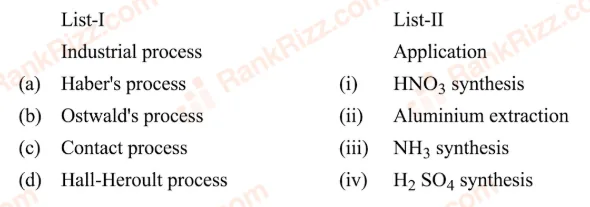
Choose the correct answer from the options given below:
(a)-(ii), (b)-(iii), (c)-(iv), (d)-(i)
(a)-(iii), (b)-(iv), (c)-(i), (d)-(ii)
(a)-(iii), (b)-(i), (c)-(iv), (d)-(ii)
(a)-(iv), (b)-(i), (c)-(ii), (d)-(iii)
Chemical nature of the nitrogen oxide compound obtained from a reaction of concentrated nitric acid and PO (in 4 : 1 ratio) is:
acidic
basic
amphoteric
neutral
The correct order of bond dissociation enthalpy of halogens is:
F_2 > Cl_2 > Br_2 > I_2
Cl_2 > F_2 > Br_2 > I_2
I_2 > Br_2 > Cl_2 > F_2
Cl_2 > Br_2 > F_2 > I_2
Which one of the following correctly represents the order of stability of oxides, XO; (X = halogen)?
Cl > I > Br
Br > Cl > I
I > Cl > Br
Br > I > Cl
The number of non-ionisable hydrogen atoms present in the final product obtained from the hydrolysis of PCl is:
0
1
2
3
Match List-I with List-II:
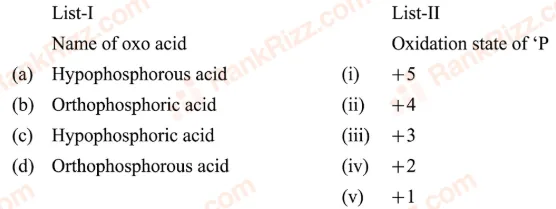
Choose the correct answer from the options given below:
(a)-(v), (b)-(i), (c)-(ii), (d)-(iii)
(a)-(iv), (b)-(i), (c)-(ii), (d)-(iii)
(a)-(iv), (b)-(v), (c)-(ii), (d)-(iii)
(a)-(v), (b)-(iv), (c)-(ii), (d)-(iii)
The product obtained from the electrolytic oxidation of acidified sulphate solutions, is:
Number of Cl = O bonds in chlorous acid, chloric acid and perchloric acid respectively are:
3, 1 and 1
4, 1 and 0
1, 1 and 3
1, 2 and 3
Given below are two statements:
Statement I: and forms of sulphur can change reversibly between themselves with slow heating or slow cooling.
Statement II: At room temperature the stable crystalline form of sulphur is monoclinic sulphur.
In the light of the above statements, choose the correct answer from the options given below:
Both Statement I and Statement II are true.
Statement I is true but Statement II is false.
Statement I is false but Statement II is true.
Both Statement I and Statement II are false.
The incorrect statement is:
is a stronger oxidizing agent than Cl in aqueous solution.
On hydrolysis ClF forms HOCl and HF.
Cl is more reactive than ClF.
is more reactive than ClF.
OTHER CHEMISTRY CHAPTERS