JEE MAIN 2025 · 03 APR S1Other important compounds of transition metalsTRANSCRIBED
Consider the following reactions
(Little amount)
The number of terminal 'O' present in the compound 'C' is _________.
Every d- and f-Block Elements question JEE Main has set, grouped by the idea it tests rather than the order of the syllabus. 229 questions across 7 distinct ideas. Free to read, answer key on every one.
Questions
229
Distinct ideas
7
Share of marks
4.2%
Difficulty
MEDIUM
A chapter is not one subject — it is a handful of procedures the examiner reuses. These are the ones d- and f-Block Elements questions actually test.
41–60 OF 229 · NEWEST FIRST
Consider the following reactions
(Little amount)
The number of terminal 'O' present in the compound 'C' is _________.
The spin only magnetic moment ( ) value (B.M.) of the compound with strongest oxidising power among TiO and VO is ____ B.M. (Nearest integer).
The electronic configuration for Neodymium is: [Atomic Number for Neodymium 60]
Which of the following electronic configuration would be associated with the highest magnetic moment?
The electronic configuration of Einsteinium is : (Given atomic number of Einsteinium )
decomposes on heating at K to form along with
&
&
&
&
Arrange the following elements in the increasing order of number of unpaired electrons in it. (A) Sc (B) Cr (C) V (D) Ti (E) Mn. Choose the correct answer from the options given below :
(A) < (D) < (C) < (B) < (E)
(C) < (E) < (B) < (A) < (D)
(A) < (D) < (C) < (E) < (B)
(B) < (C) < (D) < (E) < (A)
Which of the following acts as a strong reducing agent? (Atomic number: Ce = 58, Eu = 63, Gd = 64, Lu = 71)
Lu
Gd
Eu
Ce
Choose the correct option having all the elements with electronic configuration from the following:
Which of the following statements are correct about Zn, Cd and Hg?
A. They exhibit high enthalpy of atomization as the d-subshell is full.
B. Zn and Cd do not show variable oxidation state while Hg shows +I and +II.
C. Compounds of Zn, Cd and Hg are paramagnetic in nature.
D. Zn, Cd and Hg are called soft metals.
Choose the most appropriate from the options given below:
B, D only
B, C only
A, D only
C, D only
Diamagnetic Lanthanoid ions are:
and
and
and
and
Given below are two statements:
Statement (I) : In the Lanthanoids, the formation of is favoured by its noble gas configuration.
Statement (II) : is a strong oxidant reverting to the common +3 state.
In the light of the above statements, choose the most appropriate answer from the options given below:
Statement I is false but Statement II is true
Both Statement I and Statement II are true
Statement I is true but Statement II is false
Both Statement I and Statement II are false
Match List-I with List-II
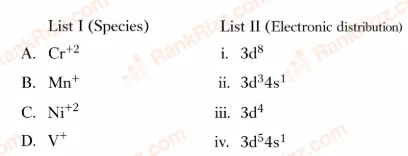
(A)-I, (B)-II, (C)-III, (D)-IV
(A)-III, (B)-IV, (C)-I, (D)-II
(A)-IV, (B)-III, (C)-I, (D)-II
(A)-II, (B)-I, (C)-IV, (D)-III
The orange colour of and purple colour of is due to
Charge transfer transition in both
transition in and charge transfer transitions in
transition in and charge transfer transitions in
transition in both
Given below are two statements: Statement I : The higher oxidation states are more stable down the group among transition elements unlike p-block elements. Statement II : Copper can not liberate hydrogen from weak acids. In the light of the above statements, choose the correct answer from the options given below :
Both Statement I and Statement II are true
Statement I is false but Statement II is true
Both Statement I and Statement II are false
Statement I is true but Statement II is false
The element which shows only one oxidation state other than its elemental form is:
Cobalt
Titanium
Nickel
Scandium
and formed in the following reactions are:
,
,
,
,
Choose the correct statements from the following:
A. is an oil at room temperature
B. reacts with acid to give
C. CrO is a basic oxide
D. does not react with acid
Choose the correct answer from the options given below:
A, B and D only
A and C only
A, B and C only
B and C only
The number of ions from the following that have the ability to liberate hydrogen from a dilute acid is ______. and
2
3
1
0
The number of elements from the following that do not belong to lanthanoids is and
3
4
1
5
OTHER CHEMISTRY CHAPTERS