RankRizzStart free

Coordination Compounds — JEE Main Previous Year Questions

Every Coordination Compounds question JEE Main has set, grouped by the idea it tests rather than the order of the syllabus. 373 questions across 10 distinct ideas. Free to read, answer key on every one.

Questions

373

Distinct ideas

10

Share of marks

7.7%

Difficulty

MEDIUM

The ideas inside Coordination Compounds

A chapter is not one subject — it is a handful of procedures the examiner reuses. These are the ones Coordination Compounds questions actually test.

01Werner's theory and coordination terminologyset 36×
02Ligands, denticity and chelationset 7×
03IUPAC nomenclature of coordination compoundsset 9×
04Structural isomerism in complexesset 52×
05Geometrical and optical isomerism in complexesset 6×
06Valence bond theory of complexesset 79×
07Crystal field splitting, CFSE and spectrochemical seriesset 9×
08Colour and magnetic behaviour of complexes from CFTset 145×
09Metal carbonyls and synergic bondingset 3×
10Stability and applications of coordination compoundsset 27×

Every Coordination Compounds question

61–80 OF 373 · NEWEST FIRST

JEE MAIN 2025 · 04 APR S2Colour and magnetic behaviour of complexes from CFTTRANSCRIBED

'X' is the number of electrons in orbitals of the most stable complex ion among , , and . The nature of oxide of vanadium of the type is:

  1. A

    Acidic

  2. B

    Neutral

  3. C

    Basic

  4. D

    Amphoteric

JEE MAIN 2025 · 08 APR S2Valence bond theory of complexesTRANSCRIBED

The number of species from the following that are involved in hybridization is : , , , , , and

  1. A

    5

  2. B

    6

  3. C

    4

  4. D

    3

JEE MAIN 2025 · 22 JAN S1Colour and magnetic behaviour of complexes from CFTTRANSCRIBED

In which of the following complexes the CFSE, will be equal to zero?

  1. A

  2. B

  3. C

  4. D

JEE MAIN 2025 · 23 JAN S2Colour and magnetic behaviour of complexes from CFTTRANSCRIBED

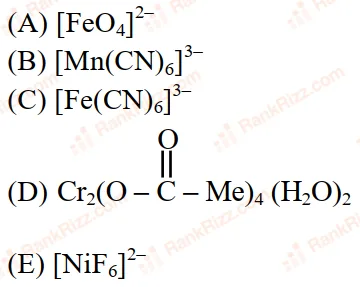
Identify the coordination complexes in which the central metal ion has configuration.

page13_img1

Choose the correct answer from the options given below :

  1. A

    (B), (C) and (D) only

  2. B

    (C) and (E) only

  3. C

    (B) and (D) only

  4. D

    (A), (B) and (E) only

JEE MAIN 2025 · 23 JAN S1Colour and magnetic behaviour of complexes from CFTTRANSCRIBED

The d- electronic configuration of an octahedral Co(II) complex having magnetic moment of 3.95 BM is:

  1. A

  2. B

  3. C

  4. D

JEE MAIN 2025 · 07 APR S1Structural isomerism in complexesTRANSCRIBED

An octahedral complex having molecular composition has two isomers A and B. The solution of A gives a white precipitate with solution and the solution of B gives white precipitate with solution. The type of isomerism exhibited by the complex is,

  1. A

    Co-ordinate isomerism

  2. B

    Linkage isomerism

  3. C

    Ionisation isomerism

  4. D

    Geometrical isomerism

JEE MAIN 2025 · 08 APR S2Colour and magnetic behaviour of complexes from CFTTRANSCRIBED

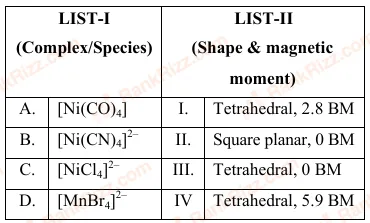
Match the LIST-I with LIST-II

image

Choose the correct answer from the options given below :

  1. A

    A-III, B-IV, C-II, D-I

  2. B

    A-I, B-III, C-I, D-IV

  3. C

    A-III, B-II, C-I, D-IV

  4. D

    A-IV, B-I, C-III, D-II

JEE MAIN 2025 · 22 JAN S1Colour and magnetic behaviour of complexes from CFTTRANSCRIBED

From the magnetic behaviour of  (diamagnetic), choose the correct geometry and oxidation state.

  1. A

  2. B


  3. C

  4. D


JEE MAIN 2025 · 29 JAN S1Colour and magnetic behaviour of complexes from CFTTRANSCRIBED

The correct increasing order of stability of the complexes based on value is: I. II. III. IV.

  1. A

    IV < III < II < I

  2. B

    I < II < IV < III

  3. C

    III < II < IV < I

  4. D

    II < III < I < IV

JEE MAIN 2025 · 02 APR S1Colour and magnetic behaviour of complexes from CFTTRANSCRIBED

A transition metal among and has the highest standard electrode potential (). It forms a metal complex of the type . The number of electrons present in the orbital of the complex is ______.

JEE MAIN 2025 · 03 APR S1Structural isomerism in complexesTRANSCRIBED

The number of optical isomers exhibited by the iron complex (A) obtained from the following reaction is _________.

JEE MAIN 2025 · 29 JAN S2Colour and magnetic behaviour of complexes from CFTTRANSCRIBED

Consider the following low-spin complexes , , , The sum of the spin-only magnetic moment values of
complexes having yellow colour is. _____ B.M. (answer in nearest integer)

JEE MAIN 2025 · 04 APR S2Structural isomerism in complexesTRANSCRIBED

A metal complex with a formula is involved in hybridisation. It upon reaction with excess of solution gives 'x' moles of AgCl. Consider 'x' is equal to the number of lone pairs of electron present in central atom of . Then the number of geometrical isomers exhibited by the complex is ______.

JEE MAIN 2025 · 07 APR S2Crystal field splitting, CFSE and spectrochemical seriesTRANSCRIBED

Consider a neutral, mononuclear octahedral complex represented by the formula:

(where gly is the unsymmetrical bidentate glycinate ligand, NH₂CH₂COO⁻).Calculate the total number of stereoisomers (including both geometrical isomers and their corresponding optical enantiomers) that exist for this complex.

JEE MAIN 2025 · 22 JAN S2Werner's theory and coordination terminologyTRANSCRIBED

The complex of ion and dimethyl glyoxime contains ________ number of Hydrogen (H) atoms.

JEE MAIN 2025 · 02 APR S2Colour and magnetic behaviour of complexes from CFTTRANSCRIBED

The spin-only magnetic moment value of ion formed among Ni, Zn, Mn and Cu that has the least enthalpy of atomisation is _________. (in nearest integer)

Here n is equal to the number of diamagnetic complexes among , , and

JEE MAIN 2025 · 07 APR S1Valence bond theory of complexesTRANSCRIBED

The number of paramagnetic complex among , , , , and , which involved hybridisation of metal is ______.

JEE MAIN 2024 · 06 APR S2Crystal field splitting, CFSE and spectrochemical seriesTRANSCRIBED

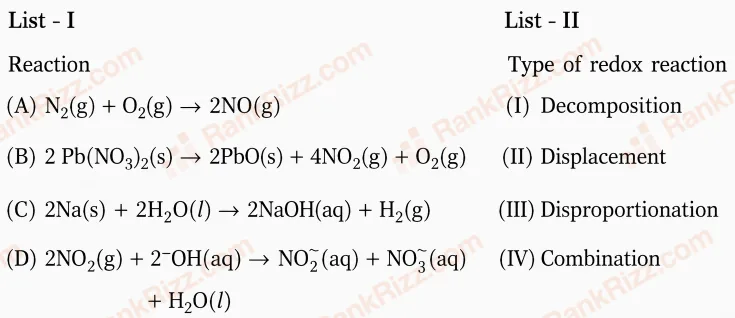
Match List - I with List - II.

image

Choose the correct answer from the options given below :

  1. A

    (A)-(II), (B)-(III), (C)-(IV), (D)-(I)

  2. B

    (A)-(III), (B)-(II), (C)-(I), (D)-(IV)

  3. C

    (A)-(IV), (B)-(I), (C)-(II), (D)-(III)

  4. D

    (A)-(I), (B)-(II), (C)-(III), (D)-(IV)

JEE MAIN 2024 · 08 APR S1Stability and applications of coordination compoundsTRANSCRIBED

Given below are two statements: Statement I: and can act as ligands to form transition metal complexes. Statement II: As N and P are from same group, the nature of bonding of and is always same with transition metals. In the light of the above statements, choose the most appropriate answer from the options given below:

  1. A

    Statement I is correct but Statement II is incorrect.

  2. B

    Statement I is incorrect but Statement II is correct.

  3. C

    Both Statement I and Statement II are correct.

  4. D

    Both Statement I and Statement II are incorrect.

JEE MAIN 2024 · 06 APR S2IUPAC nomenclature of coordination compoundsTRANSCRIBED

The correct IUPAC name of is :

  1. A

    dibromodi(trimethylphosphine)platinum(II)

  2. B

    bis(trimethylphosphine)dibromoplatinum(II)

  3. C

    dibromobis(trimethylphosphine)platinum(II)

  4. D

    bis[bromo(trimethylphosphine)]platinum(II)