JEE Main 2025 Chemistry question — Rate law, order and molecularity
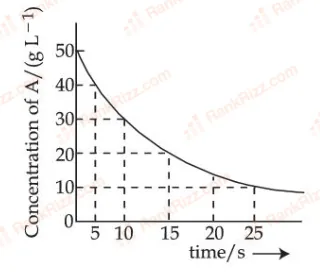
For the reaction the following graph was obtained. The time required (in seconds) for the concentration of A to reduce to 2.5 g L (if the initial concentration of A was 50 g L) is _________.
(Nearest integer)
Given :
SOLUTION
By analyzing the given concentration versus time graph, we observe that:
- At , the initial concentration is
- At , the concentration becomes
Since the concentration decreases from to in , the half-life of the reaction is
A constant half-life is characteristic of a first-order reaction.
For a first-order reaction,
The relationship between the rate constant and half-life is
Substituting this expression for into the integrated rate equation,
Using the given data,
we get
Since
the equation becomes
Using the logarithmic identity,
we obtain
Rounding to the nearest integer,
Hence, the required time is
Tagged Rate law, order and molecularity. Machine-assigned, so read it as a strong shortlist rather than a verdict.