JEE Main 2026 Chemistry question — Rate law, order and molecularity
Consider the reaction , for which the rate constant at 30°C is mol L s. Which of the following statements are true?
A. When concentration of 'X' is increased to four times, the rate of reaction becomes 16 times.
B. The reaction is a second order reaction.
C. The half-life period is independent of the concentration of X.
D. Decomposition of is an example of the above reaction.
E.
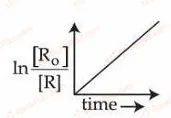
is valid for the above reaction.
Choose the correct answer from the option given below:
SOLUTION
The rate law for a reaction is written as , where is the overall order.
Units of depend on and are given by
.
For the given reaction at 30 °C, .
Compare this with the general unit expression:
• If , then , which matches the given unit.
• Therefore the reaction is second order with respect to X, i.e. and .
Now test each statement:
Statement A: Increase fourfold: . Rate becomes 16 times TRUE.
Statement B: Reaction is second order. We have already established TRUE.
Statement C: Half-life for a second-order (single-reactant) reaction is , which clearly depends on the initial concentration . Hence it is not independent FALSE.
Statement D: Decomposition of in the gas phase and in many solvents follows first-order kinetics, not second order FALSE.
Statement E: A linear plot of versus time is the integrated form of a first-order reaction.
For a second-order reaction (single reactant) the linear plot is versus time.
Hence this statement is FALSE.
Only Statements A and B are correct.
Correct option: Option A which is: A and B Only
Tagged Rate law, order and molecularity. Machine-assigned, so read it as a strong shortlist rather than a verdict.