JEE MAIN 2022 · 26 JUN S2Reactions of carboxylic acidsTRANSCRIBED
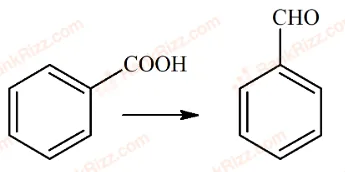
The reagent, from the following, which converts benzoic acid to benzaldehyde in one step is
- A
- B
- C
MnO
- D
Every JEE Main question on Reactions of carboxylic acids, one of the ideas inside Carboxylic Acids and Derivatives: 49 questions from 2014–2026, 24 of them in the last five years. Newest first, answer key on every one. Free to read.
Questions
49
Years asked
11
Since
2014
Of the chapter
64%
21–40 OF 49 · NEWEST FIRST
The reagent, from the following, which converts benzoic acid to benzaldehyde in one step is
MnO
Two statements are given below :
Statement I : The melting point of monocarboxylic acid with even number of carbon atoms is higher than that of with odd number of carbon atoms acid immediately below and above it in the series.
Statement II : The solubility of monocarboxylic acids in water decreases with increase in molar mass.
Choose the most appropriate option :
Both Statement I and Statement II are correct.
Both Statement I and Statement II are incorrect.
Statement I is correct but Statement II is incorrect.
Statement I is incorrect but Statement II is correct.
Given below are two statements:
Statement I: The esterification of carboxylic acid with an alcohol is a nucleophilic acyl substitution.
Statement II: Electron withdrawing groups in the carboxylic acid will increase the rate of esterification reaction.
Choose the most appropriate option
Statement I is correct but Statement II is incorrect.
Both Statement I and Statement II are incorrect.
Both Statement I and Statement II are correct.
Statement I is incorrect but Statement II is correct.
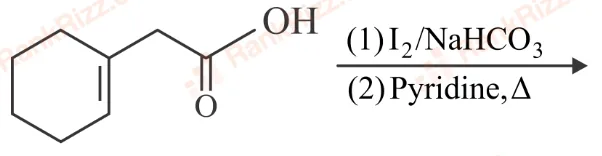
Find out the major product for the above reaction.
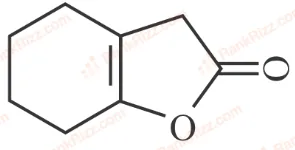
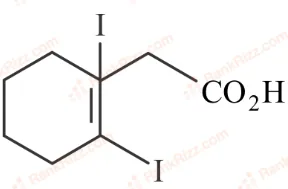
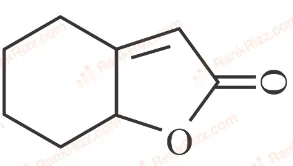
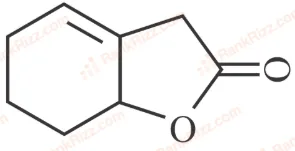
Compound(s) which will liberate carbon dioxide with sodium bicarbonate solution is/are:
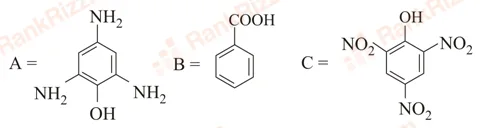
A and B only
B and C only
C only
B only
Given below are two statements:
Statement I : Ethyl pent-4-yn-oate on reaction with CHMgBr gives a 3°-alcohol.
Statement II : In this reaction one mole of ethyl pent-4-yn-oate utilizes two moles of CHMgBr.
In the light of the above statements, choose the most appropriate answer from the options given below:
Both Statement I and Statement II are false
Statement I is true but Statement II is false
Statement I is false but Statement II is true
Both Statement I and Statement II are true
In the above reaction, the reagent "A" is:
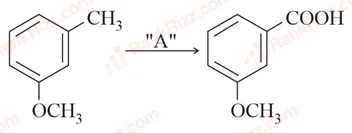
NaBH, HO
LiAlH
Alkaline KMnO, H
HCl, Zn-Hg
The structure of product C, formed by the following sequence of reactions is:
CHCOOH + SOCl A B C
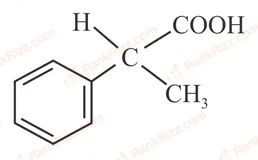
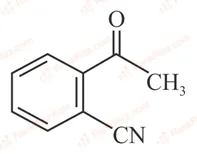
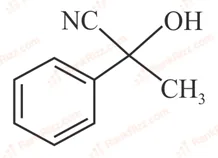
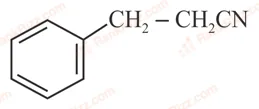
Which one of the following reactions will not yield propanoic acid?
CHCHCHBr + Mg, CO dry ether /HO
CHCHCH + KMnO(Heat), OH /HO
CHCHCCl + OH /HO
CHCHCOCH + OI /HO
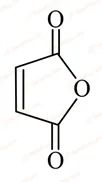
Maleic anhydride
Maleic anhydride can be prepared by:
Heating trans-but-2-enedioic acid
Heating cis-but-2-enedioic acid
Treating cis-but-2-enedioic acid with alcohol and acid
Treating trans-but-2-enedioic acid with alcohol and acid
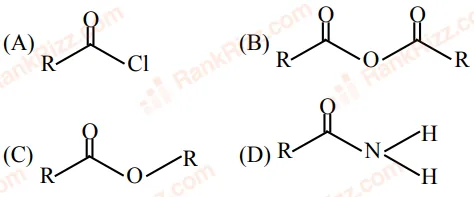
The correct order of their reactivity towards hydrolysis at room temperature is:
(A) > (B) > (C) > (D)
(D) > (A) > (B) > (C)
(D) > (B) > (A) > (C)
(A) > (C) > (B) > (D)
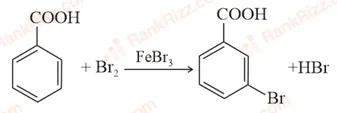
Consider the above reaction where 6.1 g of benzoic acid is used to get 7.8 g of m-bromo benzoic acid. The percentage yield of the product is ___.
(Round off to the Nearest integer)
[Given : Atomic masses : C = 12.0 u, H : 1.0 u, O : 16.0 u, Br = 80.0 u]
The number of compound/s given below which contain/s group is ______. (Integer answer)
(A) Sulphanilic acid (B) Picric acid (C) Aspirin (D) Ascorbic acid
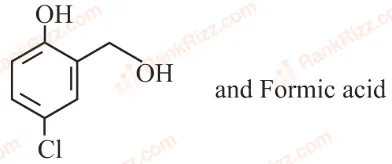
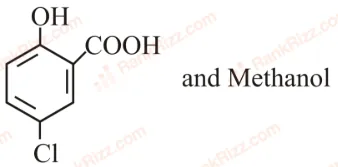
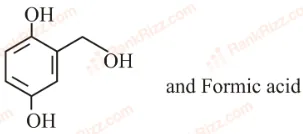
The major products of the following reaction are:
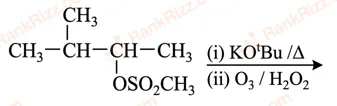
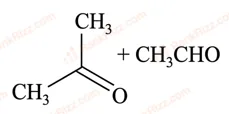
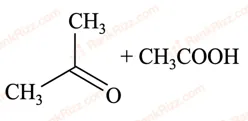
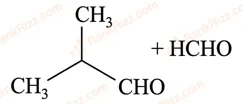
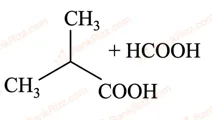
An unsaturated hydrocarbon X absorbs two hydrogen molecules on catalytic hydrogenation, and also gives following reaction:
X A B (3-oxo-hexanedicarboxylic acid). X will be:
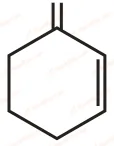
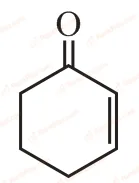
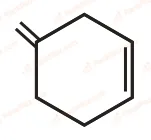
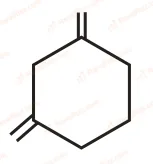
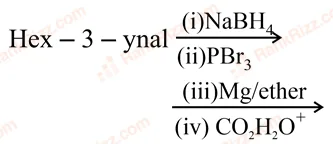
What is the product of the following reaction?
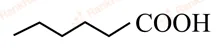



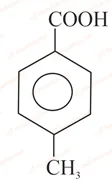
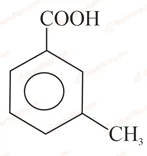
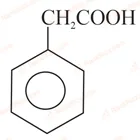
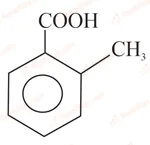
[P] on treatment with in produced a single isomer while heating [P] with sodalime gives toluene. The compound [P] is:
The most suitable reagent for the given conversion is:
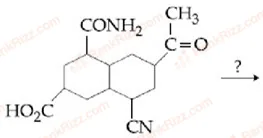
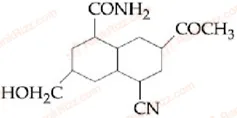
BH
NaBH
LiAlH
H/Pd
An organic compound [A], molecular formula was hydrolyzed with dilute sulphuric acid to give a carboxylic acid [B] and an alcohol [C]. Oxidation of [C] with produced [B]. Which of the following structures are not possible for [A]?
P)
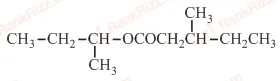
Q)
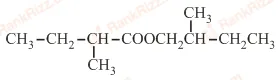
R)
S)
P and Q
Q and R
P and R
Q and S
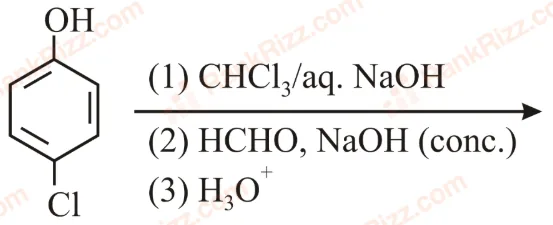
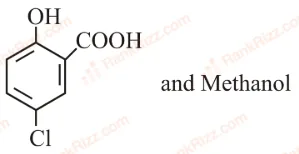
The major products of the following reaction are:
RELATED CARBOXYLIC ACIDS AND DERIVATIVES TOPICS