JEE Main 2020 Chemistry question — Reactions of carboxylic acids
An unsaturated hydrocarbon X absorbs two hydrogen molecules on catalytic hydrogenation, and also gives following reaction:
X A B (3-oxo-hexanedicarboxylic acid). X will be:
SOLUTION
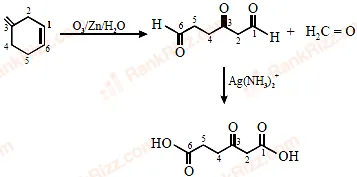
Step 1: Analyze Hydrogen Absorption
The problem states that X absorbs two moles of hydrogen () during catalytic hydrogenation. This directly tells us that X contains two carbon-carbon double bonds (a diene).
Step 2: Work Backwards from the Final Product B
Product B is given as 3-oxo-hexanedicarboxylic acid (commonly known as 3-oxohexanedioic acid). Its chemical structure is:
Product B is obtained by treating intermediate A with Tollens' reagent (). Tollens' reagent is a mild oxidizing agent that selectively oxidizes aldehyde groups () into carboxylic acids () without altering ketones.
Therefore, intermediate A must be a keto-dialdehyde with the following structure:
Step 3: Deduce the Structure of X via Ozonolysis Cleavage
Intermediate A is formed via the reductive ozonolysis () of hydrocarbon X. Ozonolysis cleaves double bonds and inserts oxygen atoms to form carbonyl compounds.
To reconstruct X, we connect the carbonyl carbons of A where the cleavage took place. Since one of the carbonyls is a ketone inside a continuous chain flanked by two aldehydes, X must be a cyclic system containing one endocyclic double bond and one exocyclic methylene () group:
- Connecting the aldehyde groups at positions 1 and 6 forms a 6-membered ring.
- The ketone at position 3 implies that an exocyclic double bond () was attached there before cleavage (yielding a side product of formaldehyde, ).
This corresponds perfectly to 4-methylenecyclohex-1-ene.
Ozonolysis Mechanism Verification:
Conclusion:
The structural features match 4-methylenecyclohex-1-ene, which corresponds to the layout presented in Option C.
Answer: Option C
Tagged Reactions of carboxylic acids. Machine-assigned, so read it as a strong shortlist rather than a verdict.