JEE Main 2021 Chemistry question — Reactions of carboxylic acids
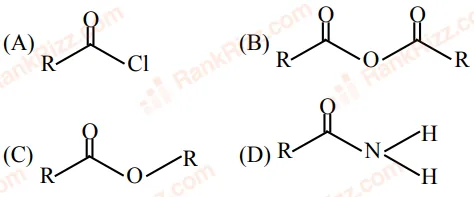
The correct order of their reactivity towards hydrolysis at room temperature is:
SOLUTION
The reactivity of carboxylic acid derivatives towards nucleophilic acyl substitution depends on:
1. Electrophilicity of the carbonyl carbon
2. Stability of the leaving group
A better leaving group increases reactivity.
Groups showing strong effect increase the positive charge on the carbonyl carbon and enhance reactivity.
Groups showing strong effect donate electron density and decrease reactivity.
(A) Acid Chloride:
Chlorine shows a strong:
making the carbonyl carbon highly electrophilic.
The resonance donation from chlorine is very weak due to poor overlap.
Also:
is an excellent leaving group.
Therefore, acid chlorides are highly reactive.
(B) Acid Anhydride:
The leaving group is:
which is resonance stabilised and a good leaving group.
The central oxygen donates electron density through resonance, but this effect is shared between two carbonyl groups.
Thus, anhydrides are less reactive than acid chlorides.
(C) Ester:
The leaving group is:
which is a stronger base and poorer leaving group.
The alkoxy oxygen strongly donates electron density through:
thereby reducing electrophilicity of the carbonyl carbon.
Hence, esters are less reactive than anhydrides.
(D) Amide:
The leaving group would be:
which is an extremely poor leaving group.
Nitrogen strongly donates electron density through resonance:
greatly stabilising the carbonyl group and reducing its electrophilicity.
Therefore, amides are the least reactive derivatives.
Hence, the order of reactivity is:
Therefore, the correct option is:
Tagged Reactions of carboxylic acids. Machine-assigned, so read it as a strong shortlist rather than a verdict.