JEE MAIN 2022 · 25 JUL S2Hydrogen spectrum and spectral seriesTRANSCRIBED
When the excited electron of a H atom from drops to the ground state, the maximum number of emission lines observed are ______.
Every Atomic Structure question JEE Main has set, grouped by the idea it tests rather than the order of the syllabus. 226 questions across 9 distinct ideas. Free to read, answer key on every one.
Questions
226
Distinct ideas
9
Share of marks
6.1%
Difficulty
EASY
A chapter is not one subject — it is a handful of procedures the examiner reuses. These are the ones Atomic Structure questions actually test.
121–140 OF 226 · NEWEST FIRST
When the excited electron of a H atom from drops to the ground state, the maximum number of emission lines observed are ______.
If the wavelength for an electron emitted from atom is m, then energy absorbed by the electron in its ground state compared to minimum energy required for its escape from the atom, is _____ times. [Given: Js, Mass of electron kg]
The wavelength of an electron and a neutron will become equal when the velocity of the electron is times the velocity of neutron. The value of is ______ (the nearest integer) (Mass of electron is and mass of neutron is )
The longest wavelength of light that can be used for the ionisation of lithium ion is m. The value of is ______ (Nearest Integer)
(Given : Energy of the electron in the first shell of the hydrogen atom is J; Js and ms)
Given below are two statements:
Statement I : Bohr's theory accounts for the stability and line spectrum of Li ion.
Statement II : Bohr's theory was unable to explain the splitting of spectral lines in the presence of a magnetic field.
In the light of the above statements, choose the most appropriate answer from the options given below:
Both statement I and statement II are true.
Statement I is false but statement II is true.
Both statement I and statement II are false.
Statement I is true but statement II is false.
According to Bohr's atomic theory:
(A) Kinetic energy of electron is .
(B) The product of velocity (v) of electron and principal quantum number (n), .
(C) Frequency of revolution of electron in an orbit is .
(D) Coulombic force of attraction on the electron is .
Choose the most appropriate answer from the options given below:
(A), (C) and (D) only
(A) and (D) only
(C) only
(A) only
Given below are two statements:
Statement I : Rutherford's gold foil experiment cannot explain the line spectrum of hydrogen atom.
Statement II : Bohr's model of hydrogen atom contradicts Heisenberg's uncertainty principle.
In the light of the above statements, choose the most appropriate answer from the options given below:
Statement I is false but statement II is true.
Statement I is true but statement II is false.
Both statement I and statement II are false.
Both statement I and statement II are true.
If the Thomson model of the atom was correct, then the result of Rutherford's gold foil experiment would have been:
All of the -particles pass through the gold foil without decrease in speed.
-particles are deflected over a wide range of angles.
All -particles get bounced back by 180°.
-particles pass through the gold foil deflected by small angles and with reduced speed.
Given below are two statements:
Statement I : According to Bohr's model of an atom, qualitatively the magnitude of velocity of electron increases with decrease in positive charges on the nucleus as there is no strong hold on the electron by the nucleus.
Statement II : According to Bohr's model of an atom, qualitatively the magnitude of velocity of electron increases with decrease in principle quantum number.
In the light of the above statements, choose the most appropriate answer from the options given below:
Statement I is false but Statement II is true
Statement I is true but Statement II is false
Both Statement I and Statement II are false
Both Statement I and Statement II are true
The plots of radial distribution functions for various orbitals of hydrogen atom against 'r' are given below. The correct plot for 3s orbital is:
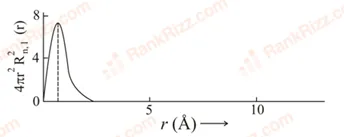
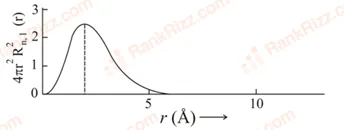
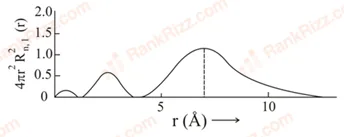
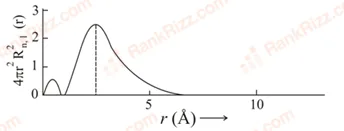
The Azimuthal quantum number for the valence electrons of Ga ion is (Atomic number of Ga = 31)
Ge (Z = 32) in its ground state electronic configuration has x completely filled orbitals with m = 0. The value of x is _________.
The wavelength of electrons accelerated from rest through a potential difference of 40 kV is X m. The value of X is. (Nearest integer)
Given: Mass of electron = 9.1 kg
Charge on an electron = 1.6 C
Planck's constant = 6.63 Js
Electromagnetic radiation of wavelength 663 nm is just sufficient to ionise the atom of metal A. The ionization energy of metal A in kJ mol is ______. (Rounded-off to the nearest integer)
[ Js, ms, mol]
The value of magnetic quantum number of the outermost electron of Zn ion is _________. (Integer answer)
A proton and a nucleus are accelerated by the same potential. If and denote the de Broglie wavelengths of and proton respectively, then the value of is . The value of is ______ (Rounded off to the nearest integer) [Mass of = 8.3 mass of proton]
An accelerated electron has a speed of ms with an uncertainty of 0.02%. The uncertainty in finding its location while in motion is m. The value of is _________. (Nearest integer)
[Use mass of electron = kg, h = Js, = 3.14]
The number of photons emitted by a monochromatic (single frequency) infrared range finder of power 1 mW and wavelength of 1000 nm, in 0.1 second is . The value of x is _________. (Nearest integer)
(h = Js, c = ms)
The number of orbitals with , is ________. (Round off to the Nearest Integer).
A 50 watt bulb emits monochromatic red light of wavelength of 795 nm. The number of photons emitted per second by the bulb is . The value of x is _________. (Nearest integer)
[Given: h = Js and c = ms]
OTHER CHEMISTRY CHAPTERS