JEE MAIN 2020 · 09 JAN S2+4 / −1MEDIUMTRANSCRIBED
JEE Main 2020 Chemistry question — Preparation of aldehydes and ketones
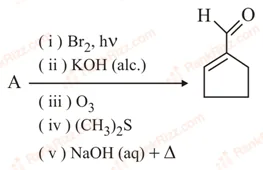
In the following reaction A is:
SOLUTION
-
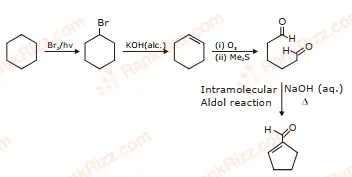
Step 1: Free Radical Substitution
When cyclohexane is treated with bromine in the presence of light (), it undergoes photochemical free-radical bromination to form bromocyclohexane:
-
Step 2: Dehydrohalogenation (Formation of A)
When bromocyclohexane is treated with a strong, hot base like alcoholic potassium hydroxide (), it undergoes an elimination reaction. The base abstracts a adjacent proton along with the loss of the bromide leaving group to introduce a carbon-carbon double bond:
Validation via Subsequent Steps:
We can confirm that A is cyclohexene by tracking the remaining reactions shown in the diagram:
- Reductive Ozonolysis: Treating cyclohexene with followed by oxidatively cleaves the double bond down into a dicarbonyl compound, hexanedial (adipaldehyde).
- Intramolecular Aldol Condensation: Heating hexanedial with aqueous base () triggers a ring-closing aldol pathway, yielding the final 5-membered cyclic conjugated product, cyclopent-1-ene-1-carbaldehyde.
Tagged Preparation of aldehydes and ketones. Machine-assigned, so read it as a strong shortlist rather than a verdict.