JEE MAIN 2018 · 15 APR S1+4 / −1MEDIUMTRANSCRIBED
JEE Main 2018 Chemistry question — Preparation of aldehydes and ketones
The reagent(s) required for the following conversion are:
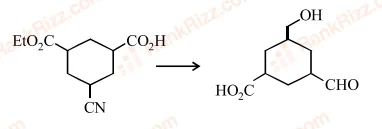
SOLUTION
- : Reduced
- : Protected / Unchanged
- : Reduced selectively to an aldehyde
Detailed Evaluation of Each Option:
-
Option A: (i) , (ii) Raney , (iii)
- is a mild reducing agent that generally does not reduce esters, carboxylic acids, or nitriles under standard conditions. Thus, step (i) will fail to convert the ester to an alcohol.
- Raney reduces nitrile () groups completely down to primary amines (), not aldehydes ().
- Result: Incorrect transformation products.
-
Option B: (i) , (ii)
- is an exceptionally strong, non-selective reducing agent. It will reduce the ester () to a primary alcohol, but it will also simultaneously reduce the carboxylic acid () to a primary alcohol and the nitrile () group to a primary amine ().
- Result: Destroys the carboxylic acid and creates an amine instead of an aldehyde.
-
Option C: (i) , (ii) DIBAL-H, (iii)
- Diborane () is highly chemoselective for the reduction of carboxylic acids over esters and nitriles. It would rapidly reduce the functional group to an alcohol, leaving the ester untouched. This is the exact opposite of the target compound requirements.
- Result: Reduces the wrong acidic functional group.
-
Option D: (i) , (ii) , (iii)
- Step (i): When coordinated under specific, controlled stoichiometric conditions where the carboxylic acid group forms a stable acyloxyborane intermediate, selectively permits the targeted reduction of the ester group to a primary alcohol () while leaving the structural carboxylic acid framework preserved after mild workup.
- Step (ii) & (iii): The combination of followed by acid hydrolysis () is the classic Stephen Reduction. This sequence selectively converts the nitrile group () into an iminium salt intermediate, which is subsequently hydrolyzed cleanly to form the target aldehyde () group without affecting the rest of the molecule.
- Result: Perfectly yields the desired product.
Conclusion:
Only the sequence in Option D offers the necessary functional group selectivity to reduce the ester and transform the nitrile group while keeping the carboxylic acid functional group intact.
Answer: Option D — (i) , (ii) , (iii)
Tagged Preparation of aldehydes and ketones. Machine-assigned, so read it as a strong shortlist rather than a verdict.