JEE Main 2021 Chemistry question — Preparation of aldehydes and ketones
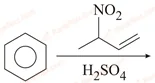
The major product of the following reaction is:
SOLUTION
This is a Friedel-Crafts alkylation of benzene. The alkylating electrophile is generated by protonating the provided alkene using a strong acid catalyst.
Step 1: Protonation and Carbocation Formation
The sulfuric acid provides a proton that attacks the electron-rich double bond of the alkene. Following Markovnikov’s rule, the proton adds to the terminal carbon to generate a secondary carbocation.
While the adjacent nitro group destabilises this intermediate through its strong electron-withdrawing inductive effect , the secondary carbocation is still more stable than the alternative primary carbocation.
Step 2: Checking for Rearrangements
Carbocations often undergo hydride or alkyl shifts to form a more stable carbocation. Consider a possible hydride shift:
If this shift occurred, the positive charge would be placed adjacent to the nitrogen atom of the nitro group. Since nitrogen in the group already carries a formal positive charge, placing another positive charge nearby is highly unstable.
Therefore, no rearrangement occurs.
Step 3: Electrophilic Aromatic Substitution (EAS)
The benzene ring acts as a nucleophile and attacks the secondary carbocation. Aromaticity is restored after loss of a proton.
The Major Product:
The final major product is or .
Structure:
Tagged Preparation of aldehydes and ketones. Machine-assigned, so read it as a strong shortlist rather than a verdict.