JEE MAIN 2019 · 12 APR S2Reactions of phenolsTRANSCRIBED
What will be the major product when m-cresol is reacted with propargyl bromide (HC ≡ C - CHBr) in presence of KCO in acetone?
- A
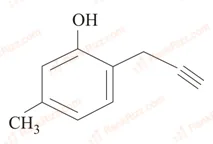
- B
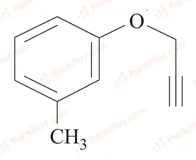
- C
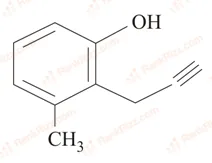
- D
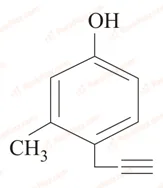
Every Alcohols, Phenols and Ethers question JEE Main has set, grouped by the idea it tests rather than the order of the syllabus. 182 questions across 5 distinct ideas. Free to read, answer key on every one.
Questions
182
Distinct ideas
5
Share of marks
2.8%
Difficulty
MEDIUM
A chapter is not one subject — it is a handful of procedures the examiner reuses. These are the ones Alcohols, Phenols and Ethers questions actually test.
141–160 OF 182 · NEWEST FIRST
What will be the major product when m-cresol is reacted with propargyl bromide (HC ≡ C - CHBr) in presence of KCO in acetone?
The major product of the following reaction is:
CHCH = CHCOCH
CHCHCHCOCH
CHCH = CHCHOH
CHCHCHCHOH
CHCHCHCHO
The major product of the following reaction is: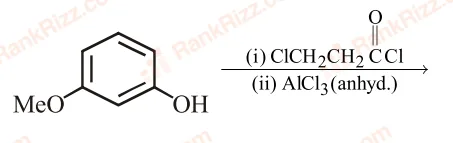
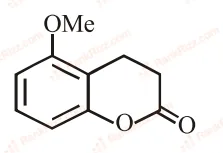
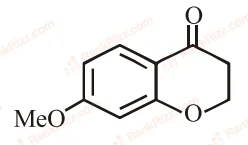
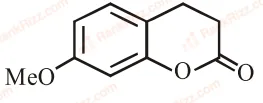
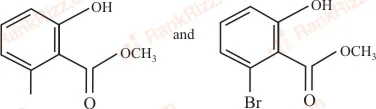
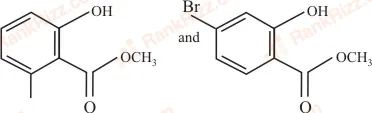
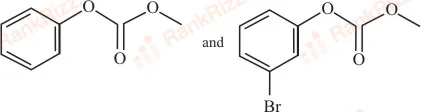
Phenol reacts with methyl chloroformate in the presence of NaOH to form product A. A reacts with Br to form product B. A and B are respectively:

The major product formed in the following reaction is: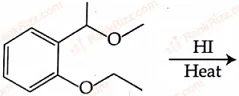
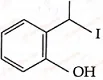
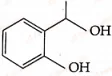

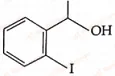
The major product of the following reaction is:
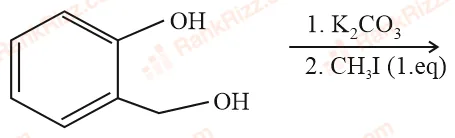
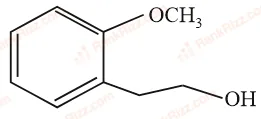
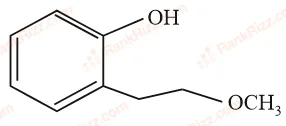
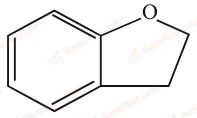
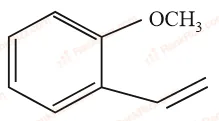
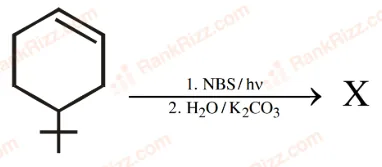
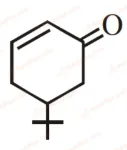
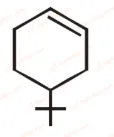
The product of the reaction given below is:
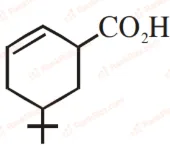
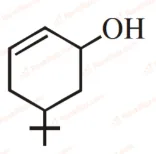
The gas evolved on heating in methanol is:
Methane
Ethane
Propane
HBr
2-chloro-2-methylpentane on reaction with sodium methoxide in methanol yields:
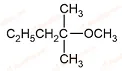
(i)
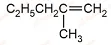
(ii)
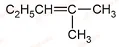
(iii)
iii only
i and ii
i and iii
All of these
Bouveault-Blanc reduction reaction involves:
Reduction of an acyl halide with .
Reduction of an anhydride with
Reduction of an ester with .
Reduction of a carbonyl compound with Na/Hg and HCl.
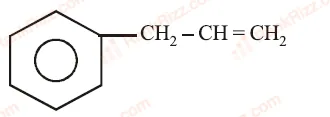
on mercuration-demercuration produces the major product:
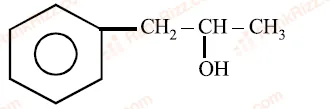
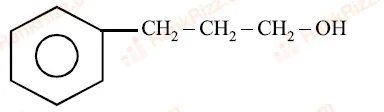
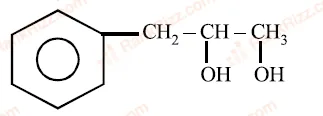
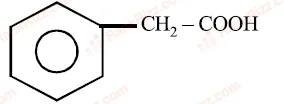
Allyl phenyl ether can be prepared by heating:
CH = CH - Br + CH - CH - ONa
CH - CH = CH - Br + CH - ONa
CH = CH - CH - Br + CHONa
CHBr + CH = CH - CH - ONa
The most suitable reagent for the conversion of is:
KMnO
KCrO
CrO
PCC (Pyridinium Chlorochromate)
In the hydroboration-oxidation reaction of propene with diborane, HO and NaOH, the organic compound formed is:
CH CH CH OH
CH CH OH
CH CHOHCH
(CH) COH
Williamson synthesis of ether is an example of:
Nucleophilic substitution
Electrophilic addition
Nucleophilic addition
Electrophilic substitution
What is the product "C" after following reactions:

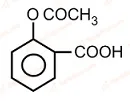
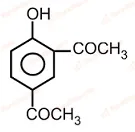
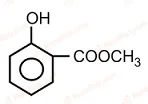
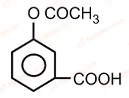
Which one of the following statements is not correct?
Alcohols are weaker acids than water
Acid strength of alcohols decreases in the following order: RCHOH > RCHOH > RCOH
Carbon-oxygen bond length in methanol, CHOH is shorter than that of C-O bond length in phenol.
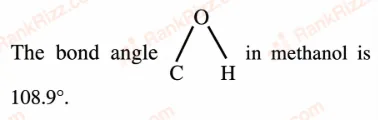
In the Victor-Meyer's test, the colour given by 1°, 2° and 3° alcohols are respectively:
Red, colourless, blue
Red, blue, colourless
Colourless, red, blue
Red, blue, violet
Phthalic acid reacts with resorcinol in the presence of concentrated HSO to give:
Phenolphthalein
Alizarin
Coumarin
Fluorescein
Rate of dehydration of alcohols follows the order:
2° > 1° > CH_3OH > 3°
3° > 2° > 1° > CH_3OH
2° > 3° > 1° > CH_3OH
CH_3OH > 1° > 2° > 3°
OTHER CHEMISTRY CHAPTERS