Q26Proteins and enzymesTRANSCRIBED
In the given pentapeptide, find out an essential amino acid (Y) and the sequence present in the pentapeptide:

Choose the correct answer from the options given below:
- A

- B

- C

- D

The 25 Chemistry questions of JEE Main 28 Jan 2026, Shift 1, numbered across the whole paper. Pick an answer on any question to check it against the key. Free to read, nothing to download.
In the given pentapeptide, find out an essential amino acid (Y) and the sequence present in the pentapeptide:
Choose the correct answer from the options given below:
Consider a weak base 'B' of . 'x' mL of 0.02 M HCI and 'y' mL of 0.02 M weak base 'B' are mixed to make 100 mL of a buffer of pH 9 at 25 °C. The values of 'x' and 'y' respectively are:
[Given: log 2 = 0.3010, log 3 = 0.4771, log 5 = 0.699]
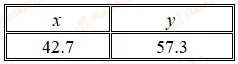
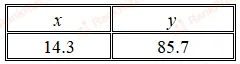
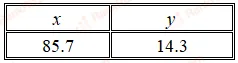
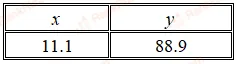
The correct statement among the followring is:
is diamagnetic and are paramagnetic.
are diamagnetic and is paramagnetic.
are diamagnetic and is paramagnetic.
are diamagnetic and is paramagnetic.
Given below are two statements:
Statement I: Griss-Ilosvay test is used for the detection of nitrite ion, which involves the use of sulphanilic acid and reagent.
Statement II: In the above test, sulphanilic acid is diazotized by the acidified nitrite ion, which on further coupling with forms an azo-dye.
In the light of the above statements, choose the correct answer from the options given below
Statement I is true but Statement II is false
Statement I is false but Statement II is true
Both Statement I and Statement II are false
Both Statement I and Statement II are true
In period 4 of the periodic table, the elements with highest and lowest atomic radii are respectively.
K & Br
K & Se
Na & Cl
Rb & Br
Consider the following reactions giving major product. Identify the correct reaction.



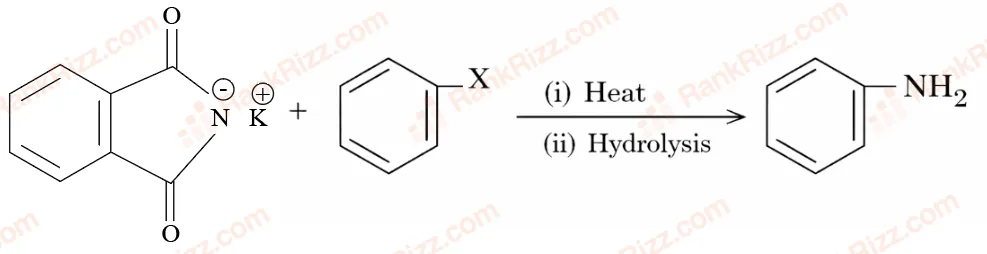
Given below are two statements:
Statement I: The number of pairs, from the following, in which both the ions are coloured in aqueous solution is 3.
and
Statement II: is the strongest reducing agent among .
In the light of the above statements, choose the correct answer from the options given below
Statement I is true but Statement II is false
Both Statement I and Statement II are true
Staten1ent I is false but Statement II is true
Both Statement I and Statement II are false
Consider the following reaction sequence

Compound (y) develops characterstic colour with neutral solution.
Identify the INCORRECT statement from the following for the above sequence.
Compound y win dissolve in and evolve a gas.
Compotmd x is more acidic than compmmd y.
Both compounds x and y will burn with sooty flame.
Both compounds x and y will dissolve in NaOH.
An organic compound undergoes first order decomposition. The time taken for decomposition to and of its initial concentration are and respectively. What is the value of ?
0.9
3
9
30
20.0 of an ideal gas 'X' at 600 K and 0.5 MPa undergoes isothermal reversible expansion until pressure of the gas is 0.2 MPa. Which of the following option is correct?
(Given: )
w = +4.1kJ, U = 0, H = 0; q = -4.1kJ
w = 9.1kJ, U = 9.1J, H = 0; q = 0
w = -3.9kJ, U = 0, H = 0; q = 3.9kJ
w = -9.1kJ, U = 0, H = 0; q = 9.1kJ
Method used for separation of mixture of products (B and C) obtained in the following reaction is
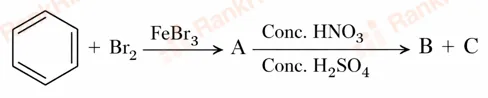
fractional distillation
sublimation
steam distillation
simple distillation
Given below are two statements for the following reaction sequence.
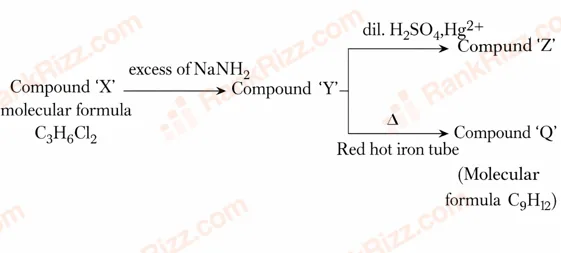
Statement I: Compound 'Z' will give yellow precipitate with NaOI.
Statement II: Compound 'Q' has two different types of'H' atoms (aromatic:aliphatic) in the ratio 1 :3.
In the light of the above statements, choose the correct answer from the options given below:
Statement I is false but Statement II is true
Statement I is true but Statement II is false
Both Statement I and Statement II are false
Both Statement I and Statement II are true
At T(K), 2 moles of liquid A and 3 moles of liquid B are mixed. The vapour pressure of ideal solution fonned is 320 mm Hg. At this stage, one mole of A and one mole of B are added to the solution. The vapour pressure is now measmed as 328.6 mm Hg. The vapom pressure (in mm Hg) of A and B are respectively:
400,300
500,200
600,400
300,200
Given below are the four isomeric compounds (P, Q, R, S)
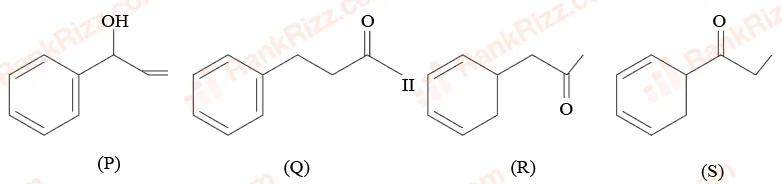
Identify correct statements from below
A. Q, R and S will give precipitate with 2, 4 - DNP.
B. P and Q will give positive Bayer's test.
C. Q and R will give sooty flame.
D. Rand S will give yellow precipitate with .
E. Q alone will deposit silver with Tollen's reagent.
Choose the correct option.
C and E only
A, B, D and E only
A, C and E only
A and E only
The wave numbers of three spectral lines of H atom are considered. Identify the set of spectral lines belonging to Balmer series.
(R = Rydberg constant)
Given below are two statements:
Statement I: The number of species among ,that have unequal E-F bond lengths is two. Here, E is the central atom.
Satement II: Among has the highest bond order.
In the light of the above statements, choose the correct answer from the options given below
Statement I is false but Statement II is true
Both Statement I and Statement II are true
Statement I is true but Statement II is false
Both Statement I and Statement II are false
CORRECT order of stability for the following is
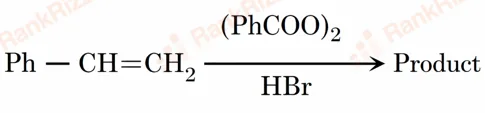
Consider the above reaction
A. The reaction proceeds through a more stable radical intermediate.
B. The role of peroxide is to generate (Hydrogen radical).
C. During this reaction, benzene is formed as a byproduct.
D. 1-Bromo-2- phenylethane is formed as the minor product.
E. The same reaction in absence of peroxide proceeds via carbocation intermediate.
Identify the correct statements. Choose the correct answer from the options given below:
A, C & E Only
A & E Only
A, B & D Only
C, D & E Only
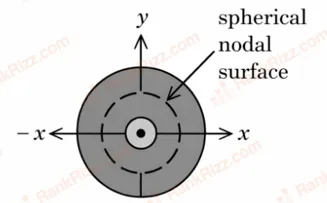
Figure 1. electron probability density for 2s orbital
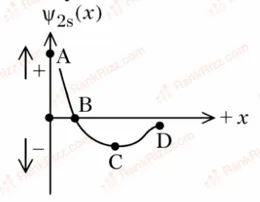
Figure 2. wave function for 2s orbital
Which of the following point in Figure 2 most accurately represents the nodal surface as shown in Figure 1?
B
D
C
A
Regarding the hydrides of group 15 elements (E = N, P, As, Sb), select the correct statement from the following:
A. The stability of hydrides decreases down the group.
B. The basicity of hydrides decreases down the group.
C. The reducing character increases down the group.
D. The boiling point increases down the group.
Choose the correct answer from the options given below:
A, B & C only
B & C only
A & D only
A,B, C & D
500 mL of 1.2 M KI solution is ,mixed with 500 mL of 0.2 M solution in basic medium. The liberated iodine was titrated with standard 0.1 M solution in the presence of starch indicator till the blue color disappeared. The volume (in L) of consumed is_________.(Nearest integer)
X is the number of geometrical isomers exhibited by .
Y is the number of optically inactive isomer(s) exhibited by
z is the number of geometrical isomers exhibited by .
The value of X + Y + Z is________.
0.53 g of an organic compound (x) when heated with excess of nitric acid ( concentrated) and then with silver nitrate gave 0. 75 g of silver bromide precipitate. 1.0 g of (x) gave 1.32 g of gas on combustion. The percentage of hydrogen in the compound (x) is __ %. [Nearest Integer]
[Given: Molar mass in g H : 1, C : 12, Br: 80, Ag: 108, O : 16 ; Compound (x) :]
Consider the dissociation equilibrium of the following weak acid If the pKa of the acid is 4, then the pH of 10 mM HA solution is __ .(Nearest integer)
[Given: The degree of dissociation can be neglected with respect to unity]
Consider the following redox reaction taking place in acidic medium
If the Nerst equation for the above balanced reaction is , then the value of n is______.(Nearest integer)