JEE MAIN 2026 · 28 JAN S1+4 / −1MEDIUMTRANSCRIBED
JEE Main 2026 Chemistry question — Electrophilic addition to alkenes
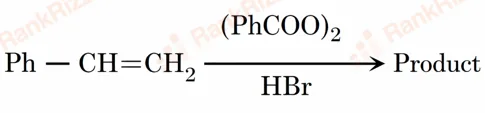
Consider the above reaction
A. The reaction proceeds through a more stable radical intermediate.
B. The role of peroxide is to generate (Hydrogen radical).
C. During this reaction, benzene is formed as a byproduct.
D. 1-Bromo-2- phenylethane is formed as the minor product.
E. The same reaction in absence of peroxide proceeds via carbocation intermediate.
Identify the correct statements. Choose the correct answer from the options given below:
SOLUTION

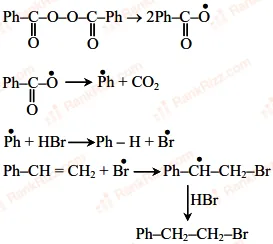
Statement Analysis:
- (A) The reaction proceeds through a more stable radical intermediate: Correct. The addition of the bromine radical () to the terminal carbon forms the highly stable, resonance-stabilized benzylic radical ().
- (B) The role of peroxide is to generate : Incorrect. The peroxide undergoes homolysis to produce phenyl radicals (), which abstract a hydrogen atom from to generate the bromine radical (). It does not produce free hydrogen radicals ().
- (C) During this reaction, benzene is formed as a byproduct: Correct. When the phenyl radical () abstracts hydrogen from to initiate the chain, it is converted into benzene ().
- (D) 1-Bromo-2-phenylethane is formed as the minor product: Incorrect. Under peroxide conditions (anti-Markovnikov addition), the bromine radical attacks the terminal position, making 1-bromo-2-phenylethane () the major product.
- (E) The same reaction in the absence of peroxide proceeds via carbocation intermediate: Correct. Without peroxides, the reaction proceeds via classic electrophilic addition (Markovnikov pathway) involving a stable benzylic carbocation ().
Conclusion:
Statements (A), (C), and (E) are correct.
Answer: Option A — A, C & E Only
Tagged Electrophilic addition to alkenes. Machine-assigned, so read it as a strong shortlist rather than a verdict.