RankRizz

JEE Main 05 Sep 2020, Shift 2: Chemistry

The 25 Chemistry questions of JEE Main 05 Sep 2020, Shift 2, numbered across the whole paper. Pick an answer on any question to check it against the key. Free to read, nothing to download.

Chemistry

Q26Quantum mechanical model, wave function and probabilityTRANSCRIBED

The correct statement about probability density (except at infinite distance from nucleus) is:

  1. A

    It can be zero for 1s orbital

  2. B

    It can be negative for 2p orbital

  3. C

    It can be zero for 3p orbital

  4. D

    It can never be zero for 2s orbital
Q27Atomic and ionic radiiTRANSCRIBED

The correct order of the ionic radii of O2−\text{O}^{2-}, N3−\text{N}^{3-}, F−\text{F}^-, Mg2+\text{Mg}^{2+}, Na+\text{Na}^+ and Al3+\text{Al}^{3+} is:

  1. A

    N3−<O2−<F−<Na+<Mg2+<Al3+\text{N}^{3-} < \text{O}^{2-} < \text{F}^- < \text{Na}^+ < \text{Mg}^{2+} < \text{Al}^{3+}

  2. B

    Al3+<Na+<Mg2+<O2−<F−<N3−\text{Al}^{3+} < \text{Na}^+ < \text{Mg}^{2+} < \text{O}^{2-} < \text{F}^- < \text{N}^{3-}

  3. C

    Al3+<Mg2+<Na+<F−<O2−<N3−\text{Al}^{3+} < \text{Mg}^{2+} < \text{Na}^+ < \text{F}^- < \text{O}^{2-} < \text{N}^{3-}

  4. D

    N3−<F−<O2−<Mg2+<Na+<Al3+\text{N}^{3-} < \text{F}^- < \text{O}^{2-} < \text{Mg}^{2+} < \text{Na}^+ < \text{Al}^{3+}

Q28Hydrogen bonding and intermolecular forcesTRANSCRIBED

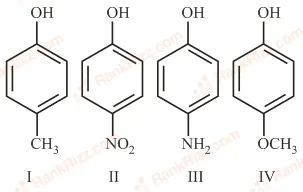
The increasing order of boiling points of the following compounds is:

Figure for JEE Main 2020 Chemistry question on Hydrogen bonding and intermolecular forces
  1. A

    I < III < IV < II

  2. B

    I < IV < II < III

  3. C

    IV < I < II < III

  4. D

    III < I < II < IV

Q29VSEPR theory and shapes of molecules and ionsTRANSCRIBED

The compound that has the largest H−M−HH-M-H bond angle (M=N,O,S,CM = N, O, S, C) is:

  1. A

    H2O\text{H}_2\text{O}

  2. B

    NH3\text{NH}_3

  3. C

    H2S\text{H}_2\text{S}

  4. D

    CH4\text{CH}_4

Q30Enthalpies of reaction and Hess's lawTRANSCRIBED

Lattice enthalpy and enthalpy of solution of NaCl are 788 kJ mol−1788\,\text{kJ mol}^{-1} and 4 kJ mol−14\,\text{kJ mol}^{-1}, respectively. The hydration enthalpy of NaClNaCl is:

  1. A

    −780 kJ mol−1-780\,\text{kJ mol}^{-1}

  2. B

    780 kJ mol−1780\,\text{kJ mol}^{-1}

  3. C

    −784 kJ mol−1-784\,\text{kJ mol}^{-1}

  4. D

    784 kJ mol−1784\,\text{kJ mol}^{-1}

Q31Hydrogen peroxideTRANSCRIBED

Hydrogen peroxide, in the pure state, is:

  1. A

    non-planar and almost colorless

  2. B

    Linear and blue in color

  3. C

    Linear and almost colorless

  4. D

    planar and blue in color

Q32Hardness of water and its removalTRANSCRIBED

The one that is NOT suitable for the removal of permanent hardness of water is:

  1. A

    Clark's method

  2. B

    Ion-exchange method

  3. C

    Calgon's method

  4. D

    Treatment with sodium carbonate

Q33Structural isomerismTRANSCRIBED

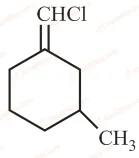
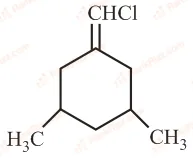
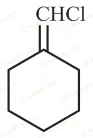
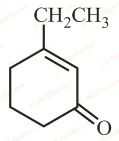
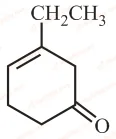
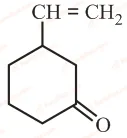
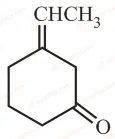
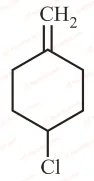
Among the following compounds, geometrical isomerism is exhibited by:

  1. A
    Figure for JEE Main 2020 Chemistry question on Structural isomerism
  2. B
    Figure for JEE Main 2020 Chemistry question on Structural isomerism
  3. C
    Figure for JEE Main 2020 Chemistry question on Structural isomerism
  4. D
    Figure for JEE Main 2020 Chemistry question on Structural isomerism
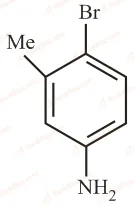
Q34Diazonium saltsTRANSCRIBED

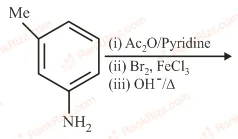
The final major product of the following reaction is:

Figure for JEE Main 2020 Chemistry question on Diazonium salts
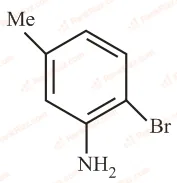
  1. A
    Figure for JEE Main 2020 Chemistry question on Diazonium salts
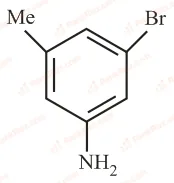
  2. B
    Figure for JEE Main 2020 Chemistry question on Diazonium salts
  3. C
    Figure for JEE Main 2020 Chemistry question on Diazonium salts
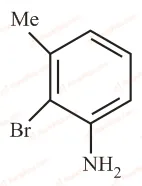
  4. D
    Figure for JEE Main 2020 Chemistry question on Diazonium salts
Q35Nucleophilic substitution (SN1 and SN2)TRANSCRIBED

The major product formed in the following reaction is:
CH2CH=CHCH(CH3)2→HBr\text{CH}_2\text{CH} = \text{CHCH(CH}_3)_2 \xrightarrow{\text{HBr}}

  1. A

    CH3CH2CH(Br)CH(CH3)2\text{CH}_3\text{CH}_2\text{CH(Br)CH(CH}_3)_2

  2. B

    CH3CH(Br)CH2CH(CH3)2\text{CH}_3\text{CH(Br)CH}_2\text{CH(CH}_3)_2

  3. C

    Br(CH2)3CH(CH3)2\text{Br(CH}_2)_3\text{CH(CH}_3)_2

  4. D

    CH3CH2CH2C(Br)(CH3)2\text{CH}_3\text{CH}_2\text{CH}_2\text{C(Br)(CH}_3)_2

Q36Voids, radius ratio and structures of ionic solidsTRANSCRIBED

An element crystallises in a face-centred cubic (fcc) unit cell with cell edge aa. The distance between the centres of two nearest octahedral voids in the crystal lattice is:

  1. A

    a2\frac{a}{\sqrt{2}}

  2. B

    aa

  3. C

    2a\sqrt{2}a

  4. D

    a2\frac{a}{2}

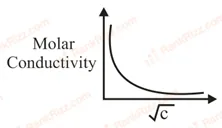
Q37Conductance, conductivity and molar conductivityTRANSCRIBED

The variation of molar conductivity with concentration of an electrolyte (X) in aqueous solution is shown in the given figure.

Figure for JEE Main 2020 Chemistry question on Conductance, conductivity and molar conductivity


The electrolyte X is:

  1. A

    HCl

  2. B

    NaClNaCl

  3. C

    KNO3\text{KNO}_3

  4. D

    CH3COOH\text{CH}_3\text{COOH}

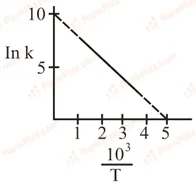
Q38Arrhenius equation and activation energyTRANSCRIBED

The rate constant (k)(k) of a reaction is measured at different temperature (T)(T), and the data are plotted in the given figure. The activation energy of the reaction in kJ mol−1\text{kJ mol}^{-1} is: (R is gas constant)

Figure for JEE Main 2020 Chemistry question on Arrhenius equation and activation energy
  1. A

    2/R2/R

  2. B

    1/R1/R

  3. C

    RR

  4. D

    2R2R

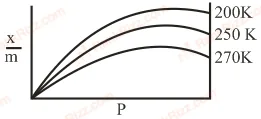
Q39Adsorption and adsorption isothermsTRANSCRIBED

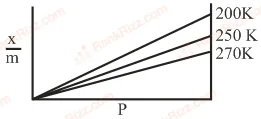
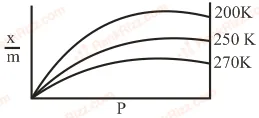
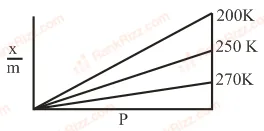
Adsorption of a gas follows Freundlich adsorption isotherm. If xx is the mass of the gas adsorbed on mass mm of the adsorbent, the correct plot of xm\frac{x}{m} versus pp is:

  1. A
    Figure for JEE Main 2020 Chemistry question on Adsorption and adsorption isotherms
  2. B
    Figure for JEE Main 2020 Chemistry question on Adsorption and adsorption isotherms
  3. C
    Figure for JEE Main 2020 Chemistry question on Adsorption and adsorption isotherms
  4. D
    Figure for JEE Main 2020 Chemistry question on Adsorption and adsorption isotherms
Q40Refining of metalsTRANSCRIBED

Boron and silicon of very high purity can be obtained through:

  1. A

    liquation

  2. B

    zone refining

  3. C

    vapour phase refining

  4. D

    electrolytic refining

Q41Group 15: trends and hydridesTRANSCRIBED

Reaction of ammonia with excess Cl2Cl_2 gives:

  1. A

    NH4Cl\text{NH}_4\text{Cl} and N2\text{N}_2

  2. B

    NH4Cl\text{NH}_4\text{Cl} and HCl\text{HCl}

  3. C

    NCl3\text{NCl}_3 and NH4Cl\text{NH}_4\text{Cl}

  4. D

    NCl3\text{NCl}_3 and HCl\text{HCl}

Q42Structural isomerism in complexesTRANSCRIBED

Consider the complex ions, trans-[Co(en)2Cl2]+[\text{Co(en)}_2\text{Cl}_2]^+ (A) and cis-[Co(en)2Cl2]+[\text{Co(en)}_2\text{Cl}_2]^+ (B). The correct statement regarding them is:

  1. A

    both (A) and (B) cannot be optically active

  2. B

    (A) can be optically active, but (B) cannot be optically active

  3. C

    both (A) and (B) can be optically active

  4. D

    (A) cannot be optically active, but (B) can be optically active

Q43Properties and reactions of alcoholsTRANSCRIBED

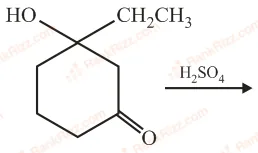
The major product of the following reaction is:

Figure for JEE Main 2020 Chemistry question on Properties and reactions of alcohols
  1. A
    Figure for JEE Main 2020 Chemistry question on Properties and reactions of alcohols
  2. B
    Figure for JEE Main 2020 Chemistry question on Properties and reactions of alcohols
  3. C
    Figure for JEE Main 2020 Chemistry question on Properties and reactions of alcohols
  4. D
    Figure for JEE Main 2020 Chemistry question on Properties and reactions of alcohols
Q44Important polymers and their monomersTRANSCRIBED

Which one of the following polymers is not obtained by condensation polymerisation?

  1. A

    Nylon 6, 6

  2. B

    Buna - N

  3. C

    Bakelite

  4. D

    Nylon 6

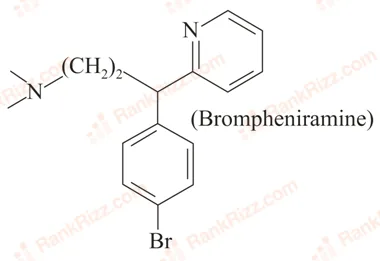
Q45Drugs and medicinesTRANSCRIBED

The following molecule acts as an:

Figure for JEE Main 2020 Chemistry question on Drugs and medicines
  1. A

    Antiseptic

  2. B

    Anti-depressant

  3. C

    Anti-bacterial

  4. D

    Anti-histamine

Q46Gibbs energy and spontaneityTRANSCRIBED

For a dimerization reaction,
2A(g)→A2(g)2A(g) \to A_2(g)
at 298K, ΔU−=−20 kJ mol−1\Delta U^- = -20\,\text{kJ mol}^{-1}, ΔS−=−30 JK−1mol−1\Delta S^- = -30\,\text{JK}^{-1}\text{mol}^{-1}, then the ΔG−\Delta G^- will be .....J.

Q47Law of mass action and equilibrium constants Kc and KpTRANSCRIBED

For a reaction X+Y=2ZX + Y = 2Z, 1.0 mol1.0\,\text{mol} of X, 1.5 mol1.5\,\text{mol} of Y and 0.5 mol0.5\,\text{mol} of Z were taken in a 1L vessel and allowed to react. At equilibrium, the concentration of Z was 1.0 mol L−11.0\,\text{mol L}^{-1}. The equilibrium constant of the reaction is x15\frac{x}{15}. The value of x is.......

Q48Redox titrationsTRANSCRIBED

The volume, in mL, of 0.02 M K2Cr2O70.02\,\text{M}\,\text{K}_2\text{Cr}_2\text{O}_7 solution required to react with 0.288 g0.288\,\text{g} of ferrous oxalate in acidic medium is............ (Molar mass of Fe = 56 g mol−156\,\text{g mol}^{-1})

Q49Colour and magnetic behaviour of complexes from CFTTRANSCRIBED

Considering that Δ0>P\Delta_0 > P, the magnetic moment (in BM) of [Ru(H2O)6]2+[\text{Ru}(\text{H}_2\text{O})_6]^{2+} would be

Q50Carbohydrates: classification and monosaccharidesTRANSCRIBED

The number of chiral carbons present in sucrose is..........

NEXT IN THIS PAPER →Maths, Q51 onwards