JEE Main 2020 Chemistry question — Diazonium salts
The final major product of the following reaction is:
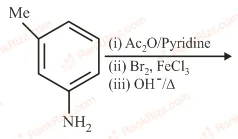
SOLUTION
The reaction sequence involves treatment of an amide with in an aqueous alkaline medium (/). This combination is the classical Hofmann bromamide degradation (also called the Hofmann rearrangement).
Step 1 - Formation of N-bromoamide
The amide first undergoes base-catalysed deprotonation to give the anion, which is rapidly brominated by to form an -bromoamide.
Step 2 - Rearrangement to an isocyanate
On warming, the -bromoamide loses . A concerted 1,2-migration (the “Hofmann rearrangement”) shifts the acyl group onto nitrogen, generating an isocyanate and releasing .
Step 3 - Hydrolysis of the isocyanate
Because the reaction medium is aqueous, the isocyanate is immediately attacked by water. Proton transfers followed by decarboxylation give a primary amine that contains one carbon fewer than the starting amide.
Thus an amide is converted into the primary amine .
Among the given options, Option D shows that primary amine. Hence the final major product is the amine obtained after Hofmann degradation.
Therefore, the correct choice is:
Option D which is: the corresponding primary amine ()
Tagged Diazonium salts. Machine-assigned, so read it as a strong shortlist rather than a verdict.