RankRizz

Vector Algebra — JEE Advanced Previous Year Questions

Every Vector Algebra question JEE Advanced has set from 2007–2026, grouped by the idea it tests rather than the order of the syllabus. 40 questions across 4 distinct ideas. Free to read, answer key on every one.

Questions

40

Distinct ideas

4

Share of marks

5.4%

Difficulty

MEDIUM

The ideas inside Vector Algebra

A chapter is not one subject — it is a handful of procedures the examiner reuses. These are the ones Vector Algebra questions actually test.

01Vector algebra, components and section formulaset 3×
02Scalar (dot) productset 12×
03Projection and resolution of vectorsNot set in Advanced
04Vector (cross) product and areaset 11×
05Scalar triple product and coplanarityset 14×
06Vector triple product and vector equationsNot set in Advanced
07Vectors in geometryNot set in Advanced

Every Vector Algebra question

21–40 OF 40 · NEWEST FIRST

JEE ADVANCED 2015 · PAPER 1Scalar (dot) productTRANSCRIBED

Let △PQR\triangle PQR be a triangle. Let a→=QR→,b→=RP→\overrightarrow{a} = \overrightarrow{QR}, \overrightarrow{b} = \overrightarrow{RP} and c→=PQ→\overrightarrow{c} = \overrightarrow{PQ}. If ∣a→∣=12,∣b→∣=43|\overrightarrow{a}| = 12, |\overrightarrow{b}| = 4 \sqrt 3 and b→.c→\overrightarrow{b}. \overrightarrow{c} then which of the following is (are) true?

  1. A

    ∣c→∣22−∣a→∣=12\frac{|\overrightarrow{c}|^2}{2} - |\overrightarrow{a}| = 12

  2. B

    ∣c→∣22+∣a→∣=30\frac{|\overrightarrow{c}|^2}{2} + |\overrightarrow{a}| = 30

  3. C

    ∣a→×b→+c→×a→∣=483|\overrightarrow{a} \times \overrightarrow{b} + \overrightarrow{c} \times \overrightarrow{a}| = 48 \sqrt 3

  4. D

    a→.b→=−72\overrightarrow{a} . \overrightarrow{b} = -72

JEE ADVANCED 2014 · PAPER 1Scalar triple product and coplanarityTRANSCRIBED

Let x→,y→\overrightarrow{x}, \overrightarrow{y} and z→\overrightarrow{z} be three vectors each of magnitude 2\sqrt 2 and the angle between each pair of them is π3.\frac{\pi}{3}. If a→\overrightarrow{a} is a nonzero vector perpendicular to x→\overrightarrow{x} and y→×z→\overrightarrow{y} \times \overrightarrow{z} and b→\overrightarrow{b} is a nonzero vector perpendicular to y→\overrightarrow{y} and z→×x→\overrightarrow{z} \times \overrightarrow{x}, then

  1. A

    b→=(b→.z→)(z→−x→)\overrightarrow{b} = (\overrightarrow{b} . \overrightarrow{z})(\overrightarrow{z} - \overrightarrow{x})

  2. B

    a→=(a→.y→)(y→−z→)\overrightarrow{a} = (\overrightarrow{a} . \overrightarrow{y})(\overrightarrow{y} - \overrightarrow{z})

  3. C

    a→.b→=−(a→.y→)(b→.z→)\overrightarrow{a} . \overrightarrow{b} = - (\overrightarrow{a} . \overrightarrow{y}) (\overrightarrow{b} . \overrightarrow{z})

  4. D

    a→=(a→.y→)(z→−y→)\overrightarrow{a} = (\overrightarrow{a} . \overrightarrow{y})(\overrightarrow{z} - \overrightarrow{y})

JEE ADVANCED 2014 · PAPER 1Vector (cross) product and areaTRANSCRIBED

Let a→,b→\overrightarrow{a}, \overrightarrow{b} and c→\overrightarrow{c} be three non-coplanar unit vectors such that the angle between every pair of them is π3\frac{\pi}{3}. If a→×b→+b→×c→=pa→+qb→+rc→,\overrightarrow{a} \times \overrightarrow{b} + \overrightarrow{b} \times \overrightarrow{c} = p\overrightarrow{a} + q\overrightarrow{b} + r \overrightarrow{c}, where p, q and r are scalars, then the value of p2+2q2+r2q2\frac{p^2 + 2q^2 + r^2}{q^2} is

JEE ADVANCED 2013 · PAPER 1Scalar triple product and coplanarityTRANSCRIBED

Let PR→=3i^+j^−2k^\overrightarrow{PR} = 3\widehat{i} + \widehat{j} - 2\widehat{k} and SQ→=i^−3j^−4k^\overrightarrow{SQ} = \widehat{i} - 3 \widehat{j} - 4\widehat{k} determine diagonals of a parallelogram PQRS and PT→=i^+2j^+3k^\overrightarrow{PT} = \widehat{i} + 2\widehat{j} + 3\widehat{k} be another vector. Then the volume of the PT→,PQ→\overrightarrow{PT}, \overrightarrow{PQ} and PS→\overrightarrow{PS} is

  1. A

    5

  2. B

    20

  3. C

    10

  4. D

    30

JEE ADVANCED 2013 · PAPER 2Scalar triple product and coplanarityTRANSCRIBED

Match List - I with List - II and select the correct answer using the code given below the lists:
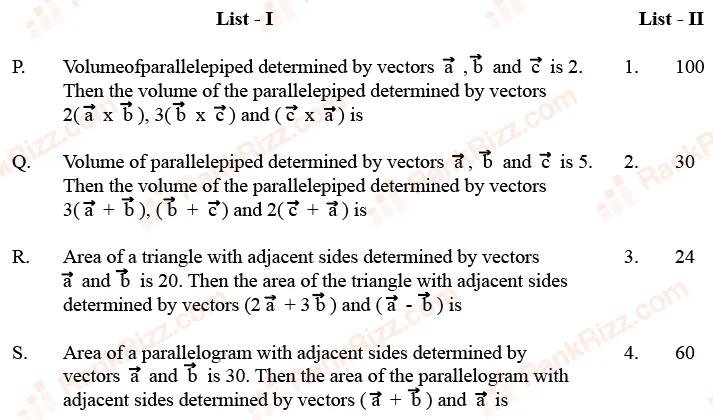
Figure for JEE Advanced 2013 Mathematics question on Scalar triple product and coplanarity
  1. A

    P-4, Q-2, R-3, S-1

  2. B

    P-2, Q-3, R-1, S-4

  3. C

    P-3, Q-4, R-1, S-2

  4. D

    P-1, Q-4, R-3, S-2

JEE ADVANCED 2012 · PAPER 2Vector (cross) product and areaTRANSCRIBED

If a→\overrightarrow{a} and b→\overrightarrow{b} are vectors such that ∣a→+b→∣=29\mid \overrightarrow{a} + \overrightarrow{b} \mid = \sqrt{29} and a→×(2i^+3j^+4k^)=(2i^+3j^+4k^)×b→\overrightarrow{a} \times (2 \hat{i} + 3 \hat{j} + 4 \hat{k}) = (2 \hat{i} + 3\hat{j} + 4 \hat{k}) \times \overrightarrow{b}, then a possible value of (a→+b→).(−7i^+2j^+3k^)(\overrightarrow{a} + \overrightarrow{b}).(-7 \hat{i} + 2 \hat{j} + 3 \hat{k}) is

  1. A

    0

  2. B

    3

  3. C

    4

  4. D

    8

JEE ADVANCED 2012 · PAPER 1Vector algebra, components and section formulaTRANSCRIBED

If a→,b→\overrightarrow{a}, \overrightarrow{b} and c→\overrightarrow{c} are unit vectors satisfying ∣a→−b→∣2+∣b→−c→∣2+∣c→−a→∣2=9\mid \overrightarrow{a} - \overrightarrow{b} \mid^2 + \mid \overrightarrow{b} - \overrightarrow{c} \mid^2 + \mid \overrightarrow{c} - \overrightarrow{a} \mid^2 = 9, then ∣2a→+5b→+5c→∣\mid 2 \overrightarrow{a} + 5 \overrightarrow{b} + 5 \overrightarrow{c}\mid is

JEE ADVANCED 2011 · PAPER 1Scalar (dot) productTRANSCRIBED

Let a→=i^+j^+k^,b→=i^−j^+k^\overrightarrow{a} = \hat{i} + \hat{j} + \hat{k}, \overrightarrow{b} = \hat{i} - \hat{j} + \hat{k} and c→=i^−j^−k^\overrightarrow{c} = \hat{i} - \hat{j} - \hat{k} be three vectors. A vector v→\overrightarrow{v} in the place of a→\overrightarrow{a} and b→\overrightarrow{b}, whose projection on c→\overrightarrow{c} is 13\frac{1}{\sqrt{3}}, is given by

  1. A

    i^−3j^+3k^\hat{i} - 3 \hat{j} + 3 \hat{k}

  2. B

    −3i^−3j^−k^-3 \hat{i} - 3 \hat{j} - \hat{k}

  3. C

    3i^−j^+3k^3 \hat{i} - \hat{j} + 3 \hat{k}

  4. D

    i^+3j^−3k^\hat{i} + 3 \hat{j} - 3 \hat{k}

JEE ADVANCED 2011 · PAPER 1Scalar triple product and coplanarityTRANSCRIBED

The vector(s) which is/are coplanar with vectors i^+j^+2k^\hat{i} + \hat{j} + 2\hat{k} and i^+2j^+k^\hat{i} + 2\hat{j} + \hat{k}, and perpendicular to the vector i^+j^+k^\hat{i} + \hat{j} + \hat{k} is/are

  1. A

    j^−k^\hat{j} - \hat{k}

  2. B

    −i^+j^-\hat{i} + \hat{j}

  3. C

    i^−j^\hat{i} - \hat{j}

  4. D

    −j^+k^- \hat{j} + \hat{k}

JEE ADVANCED 2011 · PAPER 2Scalar (dot) productTRANSCRIBED

Let a→=−i^−k^,b→=−i^+k^\overrightarrow{a} = -\hat{i} - \hat{k}, \overrightarrow{b} = -\hat{i} + \hat{k} and c→=i^+2j^+3k^\overrightarrow{c} = \hat{i} + 2\hat{j} + 3\hat{k} be three given vectors. If r→\overrightarrow{r} is a vector such that r→×b→=c→×b→\overrightarrow{r} \times \overrightarrow{b} = \overrightarrow{c} \times \overrightarrow{b} and r→.a→=0\overrightarrow{r} . \overrightarrow{a} = 0, then the value of r→.b→\overrightarrow{r} . \overrightarrow{b} is

JEE ADVANCED 2010 · PAPER 2Scalar (dot) productTRANSCRIBED

Two adjacent sides of a parallelogram ABCD are given by
AB→=2i^+10j^+11k^\overrightarrow{AB} = 2\hat{i} + 10\hat{j} + 11\hat{k} and AD→=−i^+2j^+2k^\overrightarrow{AD} = -\hat{i} + 2\hat{j} + 2\hat{k}
The side AD is rotated by an acute angle α\alpha in the plane of the parallelogram so that AD becomes AD'. If AD' makes a right angle with the side AB, then the cosine of the angle α\alpha is given by

  1. A

    89\frac{8}{9}

  2. B

    179\frac{\sqrt{17}}{9}

  3. C

    19\frac{1}{9}

  4. D

    459\frac{4\sqrt{5}}{9}

JEE ADVANCED 2010 · PAPER 1Scalar (dot) productTRANSCRIBED

Let P, Q, R and S be the points on the plane with position vectors −2i^−j^,4i^,3i^+3j^-2\hat{i}-\hat{j},4\hat{i},3\hat{i}+3\hat{j} and −3i^+2j^-3\hat{i}+2\hat{j} respectively. The quadrilateral PQRS must be a

  1. A

    parallelogram, which is neither a rhombus nor a rectangle

  2. B

    square

  3. C

    rectangle, but not a square

  4. D

    rhombus, but not a square

JEE ADVANCED 2010 · PAPER 1Scalar triple product and coplanarityTRANSCRIBED

If a→\overrightarrow{a} and b→\overrightarrow{b} are vectors in space given by a→=i^−2j^5\overrightarrow{a} = \frac{\hat{i} - 2 \hat{j}}{\sqrt{5}} and b→=2i^+j^+3k^14\overrightarrow{b} = \frac{2\hat{i} + \hat{j} + 3\hat{k}}{\sqrt{14}}, then the value of (2a→+b→).[(a→×b→)×(a→−2b→)]\left(2\overrightarrow{a} + \overrightarrow{b}\right).\left[\left(\overrightarrow{a} \times \overrightarrow{b}\right) \times \left(\overrightarrow{a} - 2\overrightarrow{b}\right)\right] is

JEE ADVANCED 2009 · PAPER 1Vector (cross) product and areaTRANSCRIBED

If a→,b→,c→\overrightarrow{a},\overrightarrow{b},\overrightarrow{c} and d→\overrightarrow{d} are unit vectors such that (a→×b→).(c→×d→)=1(\overrightarrow{a}\times\overrightarrow{b}).(\overrightarrow{c}\times\overrightarrow{d})=1 and a→.c→=12\overrightarrow{a}.\overrightarrow{c}=\frac{1}{2} then

  1. A

    a→,b→,c→\overrightarrow{a},\overrightarrow{b},\overrightarrow{c} are non-coplanar

  2. B

    a→,c→,d→\overrightarrow{a},\overrightarrow{c},\overrightarrow{d} are non-coplanar

  3. C

    b→,d→\overrightarrow{b},\overrightarrow{d} are non- parallel

  4. D

    a→,d→\overrightarrow{a},\overrightarrow{d} are parallel and b→,c→\overrightarrow{b},\overrightarrow{c}

JEE ADVANCED 2008 · PAPER 1Scalar triple product and coplanarityTRANSCRIBED

The edges of a parallelopiped are of unit length andare parallel to non-coplanar unit vectors a^,b^,c^\hat{a}, \hat{b}, \hat{c} such that
a^.b^=b^.c^=c^.a^=12\hat{a} . \hat{b} = \hat{b} . \hat{c} = \hat{c} . \hat{a} = \frac{1}{2}.
Then, the volume of the parallelopiped is

  1. A

    12\frac{1}{\sqrt{2}}

  2. B

    122\frac{1}{2\sqrt{2}}

  3. C

    32\frac{\sqrt{3}}{2}

  4. D

    13\frac{1}{\sqrt{3}}

JEE ADVANCED 2008 · PAPER 2Scalar (dot) productTRANSCRIBED

Let two non-collinear unit vectors a^\hat{a} and b^\hat{b} form an acute angle. A point P moves so that at any time t the position vector OP→\overrightarrow{OP}(where O is the origin) is given by a^cos⁡t+b^sin⁡t\hat{a} \cos t + \hat{b} \sin t. When is farthest from origin O, let M be the length of OP→\overrightarrow{OP} and u^\hat{u} be the unit vector along OP→\overrightarrow{OP} . Then

  1. A

    u^=a^+b^∣a^+b^∣\hat{u} = \frac{\hat{a} + \hat{b}}{\mid \hat{a} + \hat{b} \mid} and M=(1+a^.b^)12M = (1 + \hat{a}.\hat{b})^{\frac{1}{2}}

  2. B

    u^=a^−b^∣a^−b^∣\hat{u} = \frac{\hat{a} - \hat{b}}{\mid \hat{a} - \hat{b} \mid} and M=(1+a^.b^)12M = (1 + \hat{a}.\hat{b})^{\frac{1}{2}}

  3. C

    u^=a^+b^∣a^+b^∣\hat{u} = \frac{\hat{a} + \hat{b}}{\mid \hat{a} + \hat{b} \mid} and M=(1+2a^.b^)12M = (1 + 2\hat{a}.\hat{b})^{\frac{1}{2}}

  4. D

    u^=a^−b^∣a^−b^∣\hat{u} = \frac{\hat{a} - \hat{b}}{\mid \hat{a} - \hat{b} \mid} and M=(1+2a^.b^)12M = (1 + 2\hat{a}.\hat{b})^{\frac{1}{2}}

JEE ADVANCED 2008 · PAPER 2Vector (cross) product and areaTRANSCRIBED

The unit vector perpendicular to both L1L_1 and L2L_2 is

  1. A

    −i^+7j^+7k^99\frac{-\hat{i} + 7\hat{j} + 7\hat{k}}{\sqrt{99}}

  2. B

    −i^−7j^+5k^53\frac{-\hat{i} - 7\hat{j} + 5\hat{k}}{5\sqrt{3}}

  3. C

    −i^+7j^+5k^53\frac{-\hat{i} + 7\hat{j} + 5\hat{k}}{5\sqrt{3}}

  4. D

    7i^−7j^−k^99\frac{7\hat{i} - 7\hat{j} - \hat{k}}{\sqrt{99}}

JEE ADVANCED 2007 · PAPER 2Vector (cross) product and areaTRANSCRIBED

Let a→,b→,c→\overrightarrow{a}, \overrightarrow{b}, \overrightarrow{c} be unit vectors such that a→+b→+c→=0→\overrightarrow{a} + \overrightarrow{b} + \overrightarrow{c} = \overrightarrow{0}. Which one of the following is correct?

  1. A

    a→×b→=b→×c→=c→×a→=0→\overrightarrow{a} \times \overrightarrow{b} = \overrightarrow{b} \times \overrightarrow{c} = \overrightarrow{c} \times \overrightarrow{a} = \overrightarrow{0}

  2. B

    a→×b→=b→×c→=c→×a→≠0→\overrightarrow{a} \times \overrightarrow{b} = \overrightarrow{b} \times \overrightarrow{c} = \overrightarrow{c} \times \overrightarrow{a} \neq \overrightarrow{0}

  3. C

    a→×b→=b→×c→=a→×c→≠0→\overrightarrow{a} \times \overrightarrow{b} = \overrightarrow{b} \times \overrightarrow{c} = \overrightarrow{a} \times \overrightarrow{c} \neq \overrightarrow{0}

  4. D

    a→×b→,b→×c→,c→×a→\overrightarrow{a} \times \overrightarrow{b}, \overrightarrow{b} \times \overrightarrow{c}, \overrightarrow{c} \times \overrightarrow{a} are mutually perpendicular

JEE ADVANCED 2007 · PAPER 1Scalar triple product and coplanarityTRANSCRIBED

The number of distinct real values of λ\lambda, for which the vectors −λ2i^+j^+k^,i^−λ2j^+k^-\lambda^2 \hat{i} + \hat{j} + \hat{k}, \hat{i} - \lambda^2 \hat{j} + \hat{k} and i^+j^−λ2k^\hat{i} + \hat{j} - \lambda^2 \hat{k} are coplanar, is

  1. A

    zero

  2. B

    one

  3. C

    two

  4. D

    three

JEE ADVANCED 2007 · PAPER 1Vector (cross) product and areaTRANSCRIBED

Let the vectors PQ→,QR→,RS→,ST→,TU→\overrightarrow{PQ}, \overrightarrow{QR}, \overrightarrow{RS}, \overrightarrow{ST}, \overrightarrow{TU} and UP→\overrightarrow{UP} represent the sides of a regular
hexagon.
STATEMENT-1: PQ→×(RS→+ST→)≠0→.\overrightarrow{PQ}\times \left(\overrightarrow{RS} + \overrightarrow{ST}\right) \neq \overrightarrow{0}.
because
STATEMENT-2: PQ→×RS→=0→\overrightarrow{PQ}\times \overrightarrow{RS} = \overrightarrow{0} and PQ→×ST→≠0→\overrightarrow{PQ}\times \overrightarrow{ST} \neq \overrightarrow{0}

  1. A

    Statement-1 is True, Statement-2 is True; Statement-2 is a correct explanation for Statement-1

  2. B

    Statement-1 is True, Statement-2 is True; Statement-2 is NOT a correct explanation for Statement-1

  3. C

    Statement-1 is True, Statement-2 is False

  4. D

    Statement-1 is False, Statement-2 is True