RankRizz

Complex Numbers — JEE Advanced Previous Year Questions

Every Complex Numbers question JEE Advanced has set from 2007–2026, grouped by the idea it tests rather than the order of the syllabus. 39 questions across 6 distinct ideas. Free to read, answer key on every one.

Questions

39

Distinct ideas

6

Share of marks

6%

Difficulty

HARD

The ideas inside Complex Numbers

A chapter is not one subject — it is a handful of procedures the examiner reuses. These are the ones Complex Numbers questions actually test.

01Algebra of complex numbers and square rootsset 3×
02Modulus and conjugateset 10×
03Argument, polar and Euler formset 6×
04De Moivre's theorem and powers of complex numbersset 4×
05Cube roots and nth roots of unityset 4×
06Locus and regions in the Argand planeset 12×
07Rotation and geometry with complex numbersNot set in Advanced

Every Complex Numbers question

21–39 OF 39 · NEWEST FIRST

JEE ADVANCED 2016 · PAPER 2Locus and regions in the Argand planeTRANSCRIBED

Let a,bϵRa, b \epsilon R and a2+b2≠0a^2 + b^2 \neq 0. Suppose S={zϵC:z=1a+ibt,tϵR,t≠0}S = \left\{z \epsilon C : z = \frac{1}{a + ibt}, t \epsilon R, t \neq 0\right\}, where i=−1i = \sqrt{-1}. If z=x+iyz = x + iy and zϵSz \epsilon S, then (x, y) lies on

  1. A

    the circle with radius 12a\frac{1}{2a} and center (12a,0)\left(\frac{1}{2a}, 0\right) for a>0,b≠0a > 0, b \neq 0

  2. B

    the circle with radius −12a-\frac{1}{2a} and center (−12a,0)\left(-\frac{1}{2a}, 0\right) for a<0,b≠0a < 0, b \neq 0

  3. C

    the x-axis for a≠0,b=0a \neq 0, b = 0

  4. D

    the y-axis for a=0,b≠0a = 0, b \neq 0

JEE ADVANCED 2015 · PAPER 2De Moivre's theorem and powers of complex numbersTRANSCRIBED

For any integer k, let αk=cos⁡(kπ7)+isin⁡(kπ7),\alpha_k = \cos \left(\frac{k\pi}{7}\right) + i \sin \left(\frac{k\pi}{7}\right), where i=−1.i = \sqrt -1. The value of the expression ∑k=112∣αk+1−αk∣∑k=13∣α4k−1−α4k−2∣\frac{\sum_{k = 1}^{12}|\alpha_{k + 1} - \alpha_k|}{\sum_{k = 1}^{3}|\alpha_{4k - 1} - \alpha_{4k - 2}|} is

JEE ADVANCED 2013 · PAPER 1Locus and regions in the Argand planeTRANSCRIBED

Let complex numbers α\alpha and 1α\frac{1}{\alpha} lie on circles (x−x0)2+(y−y0)2=r2(x - x_0)^2 + (y - y_0)^2 = r^2 and (x−x0)2+(y−y0)2=4r2(x - x_0)^2 + (y - y_0)^2 = 4r^2, respectively. If z0=x0+iy0z_0 = x_0 + iy_0 Satisfies the equation 2∣z0∣2=r2+2,2 |z_0|^2 = r^2 + 2, then ∣α∣=|\alpha| =

  1. A

    12\frac{1}{\sqrt 2}

  2. B

    12\frac{1}{2}

  3. C

    17\frac{1}{\sqrt 7}

  4. D

    13\frac{1}{3}

JEE ADVANCED 2013 · PAPER 2De Moivre's theorem and powers of complex numbersTRANSCRIBED

Let w=3+i2w=\frac{\sqrt{3}+i}{2} and p=wn:n=1,2,3,...p={{w^{n}}:n=1,2,3,...}. Further H1={ZϵC:Rez>12}H_{1}= \left\{Z\epsilon C : Rez>\frac{1}{2}\right\} and H2={ZϵC:Rez<−12}H_{2}= \left\{Z\epsilon C : Rez<\frac{-1}{2}\right\} where C is the set of all complex numbers. If Z1ϵP∩H1Z_{1}\epsilon P \cap H_{1}, Z2ϵP∩H2Z_{2}\epsilon P \cap H_{2} and O represents the origin, then ∠z1Oz2=\angle z_{1}Oz_{2}=

  1. A

    π2\frac{\pi}{2}

  2. B

    π6\frac{\pi}{6}

  3. C

    2π3\frac{2\pi}{3}

  4. D

    5π6\frac{5\pi}{6}

JEE ADVANCED 2013 · PAPER 2Locus and regions in the Argand planeTRANSCRIBED

Area of S =

  1. A

    10π3\frac{10 \pi}{3}

  2. B

    20π3\frac{20 \pi}{3}

  3. C

    16π3\frac{16 \pi}{3}

  4. D

    32π3\frac{32 \pi}{3}

JEE ADVANCED 2013 · PAPER 2Modulus and conjugateTRANSCRIBED

min⁡z∈S∣1−3i−z∣=\min_{z \in S} \mid 1 - 3i - z \mid =

  1. A

    2−32\frac{2 - \sqrt{3}}{2}

  2. B

    2+32\frac{2 + \sqrt{3}}{2}

  3. C

    3−32\frac{3 - \sqrt{3}}{2}

  4. D

    3+32\frac{3 + \sqrt{3}}{2}

JEE ADVANCED 2012 · PAPER 1Modulus and conjugateTRANSCRIBED

Let z be a complex number suchthat the imaginary part of z is nonzero and a=z2+z+1a = z^2 + z + 1 is real. Then a cannot take the value

  1. A

    -1

  2. B

    13\frac{1}{3}

  3. C

    12\frac{1}{2}

  4. D

    34\frac{3}{4}

JEE ADVANCED 2011 · PAPER 2Cube roots and nth roots of unityTRANSCRIBED

Let ω=eiπ3\omega = e^{\frac{i \pi}{3}} and a, b, c, x, y, z be non-zero complex numbers such that
a+b+c=xa + b + c = x
a+bω+cω2=ya + b \omega + c \omega^2 = y
a+bω2+cω=za + b \omega^2 + c \omega = z.
Ten the value of ∣x∣2+∣y∣2+∣z∣2∣a∣2+∣b∣2+∣c∣2\frac{\mid x \mid^2 + \mid y \mid^2 + \mid z \mid^2}{\mid a \mid^2 + \mid b \mid^2 + \mid c \mid^2} is

JEE ADVANCED 2011 · PAPER 1Modulus and conjugateTRANSCRIBED

If z is any complex number satisfying ∣z−3−2i∣≤2\mid z - 3 - 2i \mid \leq 2, then the minimum value of ∣2z−6+5i∣\mid 2z - 6 + 5i \mid is

JEE ADVANCED 2010 · PAPER 2Locus and regions in the Argand planeTRANSCRIBED

Match the statements in Column-I with those in Column-II.
(Note: Here z takes values in the complex plane and Im z and Re z denote, respectively, the imaginary part and the real part of z.]
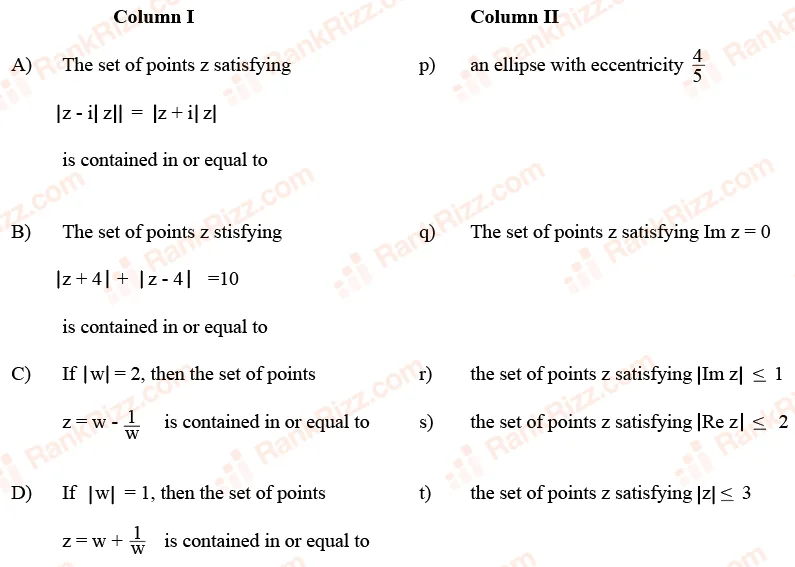
Figure for JEE Advanced 2010 Mathematics question on Locus and regions in the Argand plane
JEE ADVANCED 2010 · PAPER 1Argument, polar and Euler formTRANSCRIBED

Let z1z_1 and z2z_2 be two district complex numbers and let z=(1−t)z1+tz2z = (1 - t)z_1 + tz_2 for some real number t with 0 < t 1. If Arg(w) denotes the principal argument of a nonzero complex number w, then
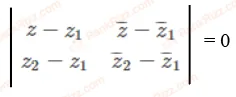
  1. A

    ∣z−z1∣+∣z−z2∣=∣z1−z2∣\mid z - z_1\mid + \mid z - z_2\mid = \mid z_1 - z_2\mid

  2. B

    Arg(z−z1)=Arg(z−z2)Arg(z - z_1) = Arg(z - z_2)

  3. C
    Figure for JEE Advanced 2010 Mathematics question on Argument, polar and Euler form
  4. D

    Arg(z−z1)=Arg(z2−z1)Arg(z - z_1) = Arg(z_2 - z_1)

JEE ADVANCED 2009 · PAPER 1De Moivre's theorem and powers of complex numbersTRANSCRIBED

Let Z=cos⁡θ+i sin⁡θZ=\cos\theta+i\ \sin\theta. Then the value of ∑m=115Im(z2m−1)\sum_{m=1}^{15}Im(z^{2m-1}) at θ=20\theta=2^{0} is

  1. A

    1sin⁡20\frac{1}{\sin2^{0}}

  2. B

    13sin⁡20\frac{1}{3\sin2^{0}}

  3. C

    12sin⁡20\frac{1}{2\sin2^{0}}

  4. D

    14sin⁡20\frac{1}{4\sin2^{0}}

JEE ADVANCED 2009 · PAPER 1Modulus and conjugateTRANSCRIBED

Let z=x+iyz=x+iy be a complex number where x and y are integers. Then the area of the rectangle whose vertices are the roots of the equation Zz‾3+z‾Z3=350Z\overline{z}^{3}+\overline{z}Z^{3}=350 is

  1. A

    48

  2. B

    32

  3. C

    40

  4. D

    80

JEE ADVANCED 2008 · PAPER 2Locus and regions in the Argand planeTRANSCRIBED

A particle P starts from the point z0=1+2iz_0 = 1 + 2i, where i−−1i - \sqrt{-1}. It moves first horizontally away from origin by 5 units and then vertically away from origin by 3 units to reach a point z1z_1. From z1z_1 the particle moves 2\sqrt{2} units in the direction of the vector i^+j^\hat{i} + \hat{j} and then it moves through an angle π2\frac{\pi}{2} in anticlockwise direction on a circle with center at origin, to reach a point z2z_2. The point z2z_2 is given by

  1. A

    6+7i6 + 7i

  2. B

    −7+6i-7 + 6i

  3. C

    7+6i7 + 6i

  4. D

    −6+7i-6 + 7i

JEE ADVANCED 2008 · PAPER 1Locus and regions in the Argand planeTRANSCRIBED

The number of elements in the set A⋂B⋂CA \bigcap B \bigcap C is

  1. A

    0

  2. B

    1

  3. C

    2

  4. D

    ∞\infty

JEE ADVANCED 2008 · PAPER 1Locus and regions in the Argand planeTRANSCRIBED

Let z be any point in A⋂B⋂CA \bigcap B \bigcap C. Then, ∣z+1−i∣2+∣z−5−i∣2\mid z + 1 - i \mid^2 + \mid z - 5 - i \mid^2 lies between

  1. A

    25 and 29

  2. B

    30 ad 34

  3. C

    35 and 39

  4. D

    40 and 44

JEE ADVANCED 2008 · PAPER 1Locus and regions in the Argand planeTRANSCRIBED

Let z be any point in A⋂B⋂CA \bigcap B \bigcap C and let w be any point satisfying ∣w−2−i∣<3\mid w - 2 - i \mid < 3. Then, ∣z∣−∣w∣+3\mid z \mid - \mid w \mid + 3 lies between

  1. A

    -6 and 3

  2. B

    -3 and 6

  3. C

    -6 and 6

  4. D

    -3 and 9

JEE ADVANCED 2007 · PAPER 2Locus and regions in the Argand planeTRANSCRIBED

If ∣z∣=1\mid z \mid = 1 and z≠±1z \neq \pm 1, then all the values of z1−z2\frac{z}{1 - z^2} lie on

  1. A

    a line not passing through the origin

  2. B

    ∣z∣=2\mid z \mid = \sqrt{2}

  3. C

    the x-axis

  4. D

    the y-axis

JEE ADVANCED 2007 · PAPER 1Locus and regions in the Argand planeTRANSCRIBED

A man walks a distance of 3 units from the origin towards the north-east (N45∘E)(N 45^\circ E) direction. From there, he walks a distance of 4 units towards the north-west (N45∘W)(N 45^\circ W) direction to reach a point P. Then the position of P in the Argand plane is

  1. A

    3eiπ4+4i3e^{\frac{i \pi}{4}} + 4i

  2. B

    (3−4i)eiπ4(3 - 4i)e^{\frac{i \pi}{4}}

  3. C

    (4+3i)eiπ4(4 + 3i)e^{\frac{i \pi}{4}}

  4. D

    (3+4i)eiπ4(3 + 4i)e^{\frac{i \pi}{4}}