Q21Reactions of phenolsTRANSCRIBED
The compound that does NOT liberate , on treatment with aqueous sodium bicarbonate solution, is
- A
Benzoic acid
- B
Benzenesulphonic acid
- C
Salicylic acid
- D
Carbolic acid (Phenol)
The 20 Chemistry questions of JEE Advanced 2013 Paper 1, numbered across the whole paper. Pick an answer on any question to check it against the key. Free to read, nothing to download.
The compound that does NOT liberate , on treatment with aqueous sodium bicarbonate solution, is
Benzoic acid
Benzenesulphonic acid
Salicylic acid
Carbolic acid (Phenol)
Concentrated nitric acid, upon long standing, turns yellow-brown due to the formation of
Methylene blue, from its aqueous solution, is adsorbed on activated charcoal at . For this process, the correct statement is
The adsorption requires activation at .
The adsorption is accompanied by a decreasein enthalpy.
The adsorption increases with increase of temperature.
The adsorptionis irreversible.
Sulfide ores are common for the metals
Ag, Cu and Pb
Ag, Cu and Sn
Ag, Mg and Pb
AL, Cu and Pb
The arrangement of ions around ion in solid AX is given in the figure (not drawn to scale). If the radius of is 250 pm, the radius of is
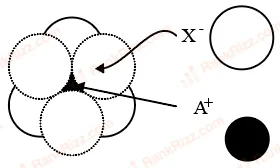
104 pm
125 pm
183 pm
57 pm
Upon treatment with ammoniacal , the metal ion that precipitates as a sulfide is
Fe(III)
Al(III)
Mg(II)
Zn(II)
The standard enthalpies of formation of and glucose(s) at are -400 kJ/mol, -300 kJ/mol and -1300 kJ/mol, respectively. The standard enthalpy of combustion per gram of glucoseat is
+2900 kJ
-2900 kJ
-16.11 kJ
+16.11 kJ
Consider the following complex ions, P, Q and R.
and
The correct order of the complex ions, according to their spin-only magnetic moment values (in B.M.) is
In the reaction,
the time taken for 75% reaction of P is twice the time taken for 50% reaction of P. The concentration of Q varies with reaction time as shown in the figure. The overall order of the reaction is
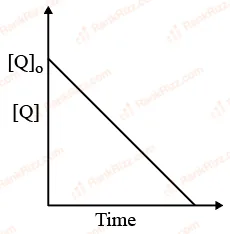
2
3
0
1
KJ in acetone, undergoes reaction with each of P, Q, R and S. The rates of the reaction vary as
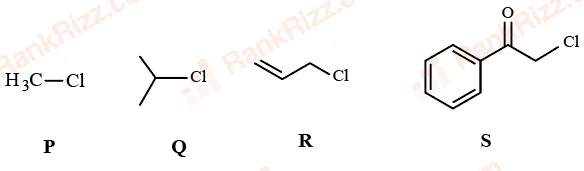
P > Q > R > S
S > P > R > Q
P > R > Q > S
R > P > s > Q
The pair(s) of coordination complexes/ions exhibiting the same kind of isomerism is(are)
and
and
and
and
Among P, Q, R and S, the aromatic compound(s) is/are
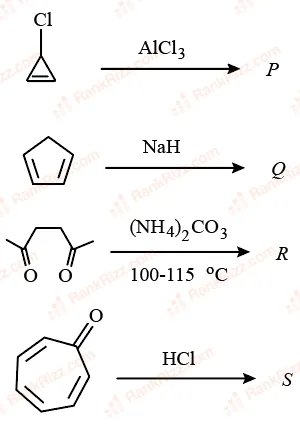
P
Q
R
S
The hyperconjugative stabilities of tert-butyl cation and 2-butene, respectively, are due to
(empty) and electron delocalisations.
and electron delocalisations.
(filled) and electron delocalisations.
p (filled) and electron delocalisations.
Benzene and naphthalene form an ideal solution at room temperature. For this process, the true statement(s) is(are)
is positive
is positive
The initial rate of hydrolysis of methyl acetate (1M) by a weak acid (HA, 1M) is of that of a strong acid (HX, 1M), at . The of HA is
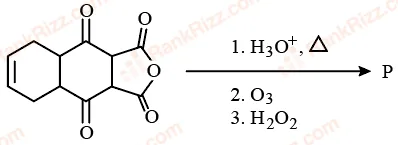
The total number of carboxylic acid groups in the product P is
A tetrapeptide has -COOH group on alanine. This produces glycine (Gly), valine (Val), phenyl alanine (Phe) and alanine (Ala), on complete hydrolysis. For this tetrapeptide, the number of possible sequences(primary structures) with group attached to a chiral center is
s ethylenediaminetetraacetate ion. The total number of bond angles in complex ion is
The total numberof lone-pairs of electrons in melamine is
The atomic masses of He and Ne are 4 and 20 a.m.u., respectively. The value of the de Broglie wavelength of He gas at is "M" imes that of the de Broglie wavelength of Ne at M is