JEE ADVANCED 2013 · PAPER 1+4 / −1MEDIUMTRANSCRIBED
JEE Advanced 2013 Chemistry question — Reactions of carboxylic acids
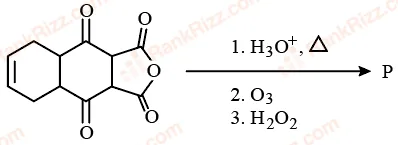
The total number of carboxylic acid groups in the product P is
SOLUTION
Key idea: Hydrolysis opens the anhydride into two COOH groups, each to a ring ketone. On heating, both are lost as . Ozonolysis with oxidative work-up then turns the ring C=C into two new COOH groups.
- : anhydride → diacid (2 COOH). Each COOH sits on a carbon next to a ring C=O, so it is a -keto acid.
- : both -keto acids decarboxylate (2 lost). The result is a bicyclic diketone with no COOH and an intact cyclohexene C=C.
- , then : the CH=CH is cut and each CH becomes COOH, giving 2 COOH.
P therefore contains 2 carboxylic acid groups (on a cyclohexane-1,4-dione framework).
Answer: 2
Tagged Reactions of carboxylic acids. Machine-assigned, so read it as a strong shortlist rather than a verdict.