RankRizzStart free

JEE Advanced 2013 Paper 2 Question Paper

All 60 questions of JEE Advanced 2013 Paper 2, in the order they were asked. Pick an answer on any question to check it against the key. Free to read, nothing to download.

Questions

60

Physics · Chemistry · Mathematics

Answer key

60

questions with a checked key

Under review

0

key not yet trusted

Price

Free

no sign-up

Physics

Q1JEE ADVANCED 2013 · PAPER 2Errors in measurement and significant figuresTRANSCRIBED

Using the expression , one calculates the values of d by measuring the corresponding angles in the range 0 to . The wavelength is exactly known and the error in is constant for all values of . As increases from ,

  1. A

    the absolute error in d remains constant.

  2. B

    the absolute error in d increases.

  3. C

    the fractional error in d remains constant.

  4. D

    the fractional error in d decreases.
Q2JEE ADVANCED 2013 · PAPER 2Relation between field and potential, equipotential surfacesTRANSCRIBED

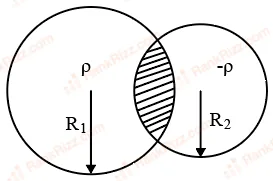
Two non-conducting spheres of radii and and carrying uniform volume charge densities and respectively, are placed such that they partially overlap, as shown in the figure. At all points in the overlapping region,

  1. A

    the electrostatic field is zero.

  2. B

    the electrostatic potential is constant.

  3. C

    the electrostatic field is constant in magnitude.

  4. D

    the electrostatic field has same direction.

Q3JEE ADVANCED 2013 · PAPER 2Calorimetry and specific heat capacityTRANSCRIBED

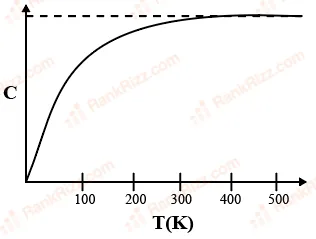
The figure below shows the variation of specific heat capacity (C) of a solid as a function of temperature (T). The temperature is increased continuously from 0 to 500 K at a constant rate. Ignoring any volume change, the following statement(s)is (are) correct to a reasonable approximation.

  1. A

    the rate at which heat is absorbed in the range 0-100 K varies linearly with temperature T.

  2. B

    heat absorbed in increasing the temperature from 0-100 K is less than the heat required for increasing the temperature from 400-500 K.

  3. C

    there is no changein the rate of heat absorption in the range 400-500 K.

  4. D

    the rate of heat absorption increases in the range 200-300 K.

Q4JEE ADVANCED 2013 · PAPER 2Hydrogen spectrum and spectral seriesTRANSCRIBED

The radius of the orbit of an electron in a Hydrogen-like atom is 4.5 , where is the bohr radius. Its orbital angular momentum is . It is given that h is Planck constant and R is Rydberg constant. The possible wavelength(s), when the atom de-excites, is (are)

  1. A

  2. B

  3. C

  4. D

Q5JEE ADVANCED 2013 · PAPER 2Escape speedTRANSCRIBED

Two bodies, each of mass M, are kept fixed with a separation 2L. A particle of mass m is projected from the midpoint of the line joining their centres, perpendicular to the line. The gravitational constant is G. The correct statement(s) is (are)

  1. A

    The minimum initial velocity of the mass m to escape the gravitational field of the two bodiesis

  2. B

    The minimum initial velocity of the mass m to escape the gravitational field of the two bodiesis

  3. C

    The minimum initial velocity of the mass m to escape the gravitational field of the two bodiesis

  4. D

    The energy of the mass m remains constant.

Q6JEE ADVANCED 2013 · PAPER 2Spring-block oscillationsTRANSCRIBED

A particle of mass mis attached to one end of a mass-less spring of force constant k, lying on a frictionless horizontal plane. The other end of the spring is fixed. The particle starts moving horizontally from its equilibrium position at time t = 0 with an initial velocity . When the speed of the particle is 0.5 ,it collides elastically with a rigid wail. After this collision,

  1. A

    the speed of the particle when it returns to its equilibrium position is .

  2. B

    the time at which the particle passes through the equilibrium position for the first time is .

  3. C

    the time at which the maximum compression of the spring occurs is .

  4. D

    the time at which the particle passes through the equilibrium position for the second time is .

Q7JEE ADVANCED 2013 · PAPER 2Ampere's circuital law: cylinders, solenoids and toroidsTRANSCRIBED

A steady current I flows along an infinitely long hollow cylindrical conductor of radius R. This cylinder is placed coaxially inside an infinite solenoid of radius 2R. The solenoid has n turns per unit length and carries a steady current I. Consider a point P at a distance r from the common axis. The correct statement(s) is (are)

  1. A

    In the region 0 < r < R, the magnetic field is non-zero.

  2. B

    In the region R < r < 2R, the magneticfield is along the common axis.

  3. C

    In the region R < r < 2R, the magnetic field is tangential to the circle of radiusr, centered on the axis.

  4. D

    In the region r > 2R, the magnetic field is non-zero.

Q8JEE ADVANCED 2013 · PAPER 2Doppler effect in soundTRANSCRIBED

Two vehicles, each moving with speed u on the samehorizontal straight road, are approaching each other. Wind blows along the road with velocity w. One of these vehicles blows a whistle of frequency . An observerin the other vehicle hears the frequency of the whistle to be . The speed of soundin still air is V. The correct statement(s) is (are)

  1. A

    If the wind blows from the observerto the source, f_2 &gt; f_1.

  2. B

    If the wind blows from the source to the observer, f_2 &gt; f_1.

  3. C

    If the wind blows from observerto the source, f_2 &lt; f_1.

  4. D

    If the wind blows from the source to the observer, f_2 &lt; f_1.

Q9JEE ADVANCED 2013 · PAPER 2Magnetic flux, Faraday's law and Lenz's lawTRANSCRIBED

The magnitude of the induced electric field in the orbit at any instant of time during the time interval of the magnetic field change is

  1. A

  2. B

  3. C

  4. D

Q10JEE ADVANCED 2013 · PAPER 2Magnetic dipole moment of current loops and torque on loopsTRANSCRIBED

The change in the magnetic dipole moment associated with the orbit, at the end of the time interval of the magnetic field change, is

  1. A

  2. B

  3. C

  4. D

Q11JEE ADVANCED 2013 · PAPER 2Nuclear fission, fusion and Q-valueTRANSCRIBED

The correct statement is

  1. A

    The nucleus can emit an alpha particle.

  2. B

    The nucleus can emit a proton.

  3. C

    Deuteron and alpha particle can undergo complete fusion.

  4. D

    The nuclei and can undergo complete fusion

Q12JEE ADVANCED 2013 · PAPER 2Radioactivity: decay law, half-life and decay modesTRANSCRIBED

The kinetic energy (in keV) of the alpha particle, when the nucleus at rest undergoes alpha decay, is

  1. A

    5319

  2. B

    5422

  3. C

    5707

  4. D

    5818

Q13JEE ADVANCED 2013 · PAPER 2Potential energy, conservative forces and energy curvesTRANSCRIBED

The speed of the block whenit reachesthe point Q is

  1. A

    5

  2. B

    10

  3. C

    10

  4. D

    20

Q14JEE ADVANCED 2013 · PAPER 2Potential energy, conservative forces and energy curvesTRANSCRIBED

The magnitude of the normal reaction that acts on the block at the point Q is

  1. A

    7.5 N

  2. B

    8.6 N

  3. C

    11.5 N

  4. D

    22.5 N

Q15JEE ADVANCED 2013 · PAPER 2Electric power and heating effect of currentTRANSCRIBED

If the direct transmission method with a cable of resistance is used, the power dissipation (in %) during transmission is

  1. A

    20

  2. B

    30

  3. C

    40

  4. D

    50

Q16JEE ADVANCED 2013 · PAPER 2AC generator and transformerTRANSCRIBED

In the method using the transformers, assume that the ratio of the numberof turns in the primary to that in the secondary in the step-up transformeris 1 : 10. If the power to the consumers has to be supplied at 200 V, the ratio of the numberof turns in the primary to that in the secondary in the step-down transformer is

  1. A

    200 : 1

  2. B

    150 : 1

  3. C

    100 : 1

  4. D

    50 : 1

Q17JEE ADVANCED 2013 · PAPER 2Dimensional analysis: deriving and checking relationsTRANSCRIBED

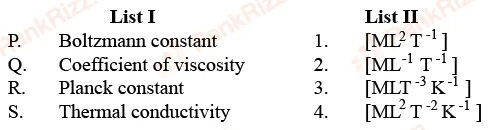
Match List I with List II and select the correct answer using the codes given below the lists :

  1. A

    P-3, Q-1, R-2, S-4

  2. B

    P-3, Q-2, R-1, S-4

  3. C

    P-4, Q-2, R-1, S-3

  4. D

    P-4, Q-1, R-2, S-3

Q18JEE ADVANCED 2013 · PAPER 2Prism: deviation and dispersionTRANSCRIBED

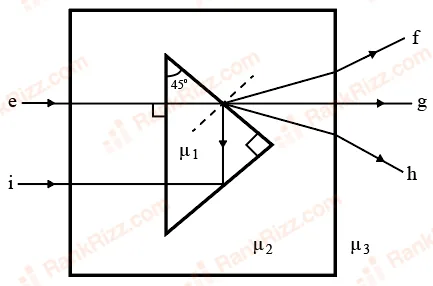
A right angled prism of refractive index is placed in a rectangular block of refractive index , which is surrounded by a medium of refractive index , as Shown in the figure. A ray of light ‘e’ enters the rectangular block at normal incidence. Depending upon the relationships between and , it takes one of the four possible paths ‘ef’, ‘eg’, ‘eh’ or ‘ei’.


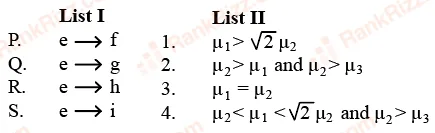
Match the paths in List I with conditions of refractive indices in List II and select the correct answer using the codes given below the lists:

  1. A

    P-2, Q-2, R-1, S-4

  2. B

    P-1, Q-2, R-4, S-3

  3. C

    P-4, Q-1, R-2, S-3

  4. D

    P-2, Q-3, R-4, S-1

Q19JEE ADVANCED 2013 · PAPER 2Radioactivity: decay law, half-life and decay modesTRANSCRIBED

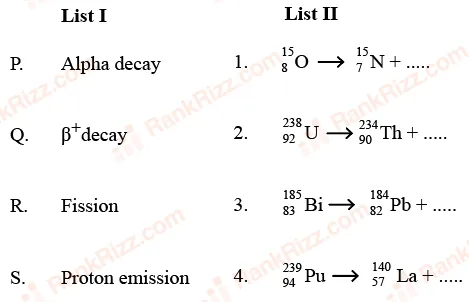
Match List I of the nuclear processes with List II containing parent nucleus and one of the end products of each process and then select the correct answer using the codes given below the lists :

  1. A

    P-4, Q-2, R-1, S-3

  2. B

    P-1, Q-3, R-2, S-4

  3. C

    P-2, Q-1, R-4, S-3

  4. D

    P-4, Q-3, R-2, S-1

Q20JEE ADVANCED 2013 · PAPER 2Multi-step processes and gas-piston-spring systemsTRANSCRIBED

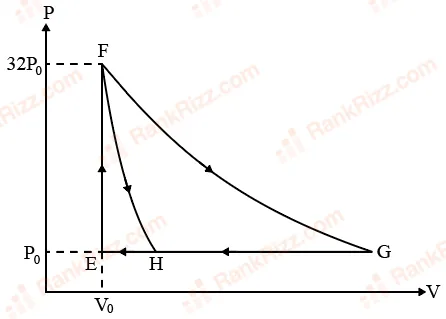
One mole of a monatomic ideal gas is taken along two cyclic processes and as shown in the PV diagram. The processes involved are purely isochoric, isobaric, isothermal or adiabatic.


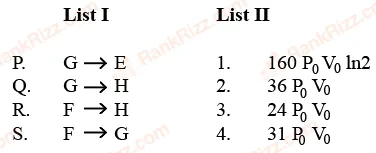
Match the paths in List I with the magnitudes of the work done in List II and select the correct answer using the codes given below the lists.

  1. A

    P-4, Q-3, R-2, S-1

  2. B

    P-4, Q-3, R-1, S-2

  3. C

    P-3, Q-1, R-2, S-4

  4. D

    P-1, Q-3, R-2, S-4

Chemistry

Q21JEE ADVANCED 2013 · PAPER 2Sulphur and its compoundsTRANSCRIBED

The correct statement(s) about is(are)

  1. A

    bond lengths are equal.

  2. B

    Thermal decomposition of is endothermic.

  3. C

    is diamagnetic in nature.

  4. D

    has a bentstructure.

Q22JEE ADVANCED 2013 · PAPER 2Resonance and hyperconjugationTRANSCRIBED

Inthe nuclear transmutation

  1. A

  2. B

  3. C

  4. D

Q23JEE ADVANCED 2013 · PAPER 2Extraction of Fe, Cu, Zn, Al, Ag and AuTRANSCRIBED

The carbon-based reduction method is NOT used for the extraction of

  1. A

    tin from

  2. B

    iron from

  3. C

    aluminium from

  4. D

    magnesium from

Q24JEE ADVANCED 2013 · PAPER 2Law of mass action and equilibrium constants Kc and KpTRANSCRIBED

The thermal dissociation equilibrium is studied under different conditions.

  1. A

    is dependent on T

  2. B

    K is independent of the initial amount of

  3. C

    Kis dependenton the pressure of at a given T

  4. D

    is independentof the catalyst, if any

Q25JEE ADVANCED 2013 · PAPER 2Solubility product and common ion effectTRANSCRIBED

The of is at 298 K. The solubility (in ) of in a solution is

  1. A

  2. B

  3. C

  4. D

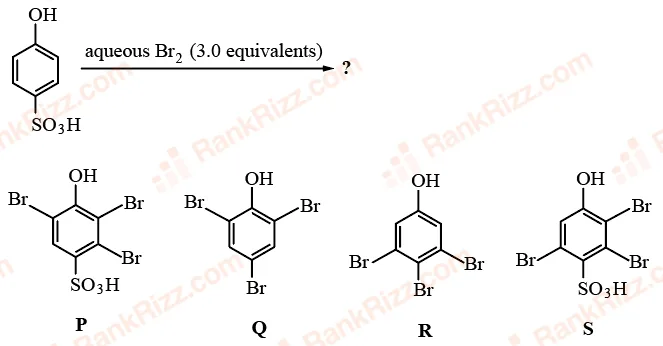
Q26JEE ADVANCED 2013 · PAPER 2Reactions of phenolsTRANSCRIBED

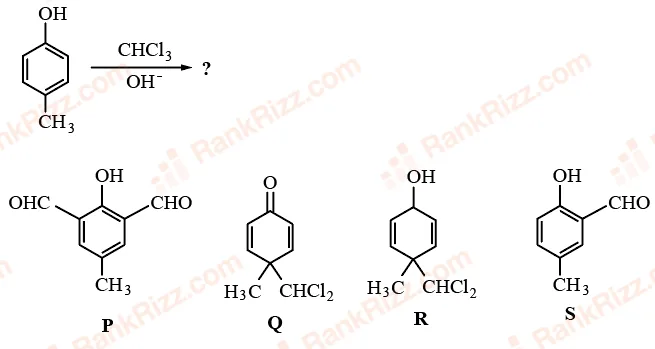
In the following reaction, the product(s) formed is(are)

  1. A

    P (major)

  2. B

    Q (minor)

  3. C

    R (minor)

  4. D

    S (major)

Q27JEE ADVANCED 2013 · PAPER 2Reactions of phenolsTRANSCRIBED

The major product(s) of the following reaction is(are)

  1. A

    P

  2. B

    Q

  3. C

    R

  4. D

    S

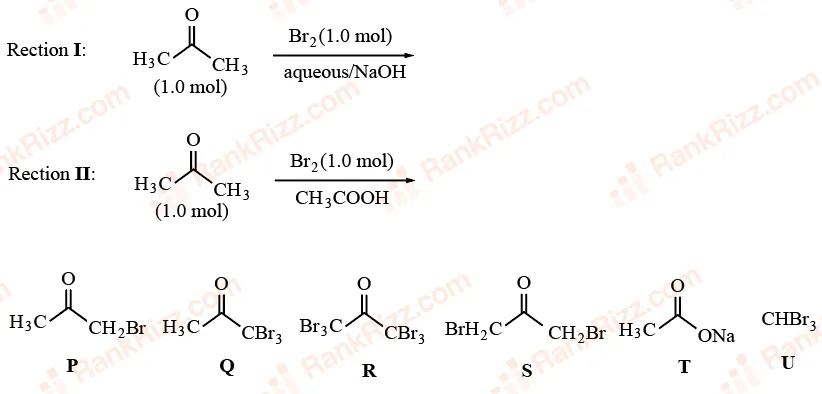
Q28JEE ADVANCED 2013 · PAPER 2Aldol condensation, Cannizzaro and related reactionsTRANSCRIBED

After completion of the reactions (I and IT), the organic compound(s) in the reaction mixtures is(are)

  1. A

    Reaction I:P and Reaction II:P

  2. B

    Reaction I:U, acetone and Reaction II:Q, acetone

  3. C

    Reaction I:7, U, acetone and Reaction II:P

  4. D

    Reaction I:R, acetone and Reaction II:S, acetone

Q29JEE ADVANCED 2013 · PAPER 2First law: work, heat and internal energyTRANSCRIBED

The succeeding operations that enable this transformation of states are

  1. A

    Heating, cooling, heating, cooling

  2. B

    Cooling, heating, cooling, heating

  3. C

    Heating, cooling, cooling, heating

  4. D

    Cooling, heating, heating, cooling

Q30JEE ADVANCED 2013 · PAPER 2First law: work, heat and internal energyTRANSCRIBED

The pair of isochoric processes among the transformation of states is

  1. A

    K to L and L to M

  2. B

    L to M and N to K

  3. C

    L to M and M to N

  4. D

    M to N and N to K

Q31JEE ADVANCED 2013 · PAPER 2Oxoacids of halogens and interhalogen compoundsTRANSCRIBED

P and Q,respectively, are the sodium salts of

  1. A

    hypochlorus and chloric acids

  2. B

    hypochlorus and chlorus acids

  3. C

    chloric and perchloric acids

  4. D

    chloric and hypochlorus acids

Q32JEE ADVANCED 2013 · PAPER 2Oxoacids of halogens and interhalogen compoundsTRANSCRIBED

R, S and T, respectively, are

  1. A

    and

  2. B

    and

  3. C

    and

  4. D

    and

Q33JEE ADVANCED 2013 · PAPER 2Group analysis and confirmatory tests of cationsTRANSCRIBED

The precipitate P contains

  1. A

  2. B

  3. C

  4. D

Q34JEE ADVANCED 2013 · PAPER 2Group analysis and confirmatory tests of cationsTRANSCRIBED

The coloured solution S contains

  1. A

  2. B

  3. C

  4. D

Q35JEE ADVANCED 2013 · PAPER 2Reactions of carboxylic acidsTRANSCRIBED

Compounds formed from P and @Q are, respectively

  1. A

    Optically active S and optically active pair (T,U)

  2. B

    Optically inactive S and optically inactive pair (T, U)

  3. C

    Optically active pair (T, U) and optically active S

  4. D

    Optically inactive pair (T, U) and optically inactive S

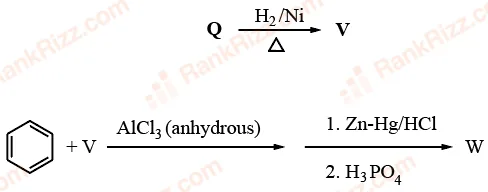
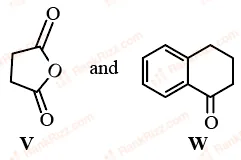
Q36JEE ADVANCED 2013 · PAPER 2Reactions of carboxylic acidsTRANSCRIBED

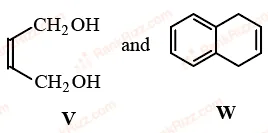
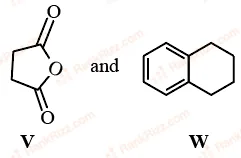
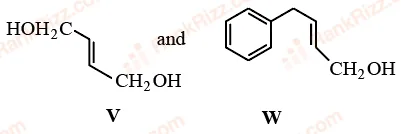
In the following reaction sequences V and W are, respectively

  1. A
  2. B
  3. C
  4. D
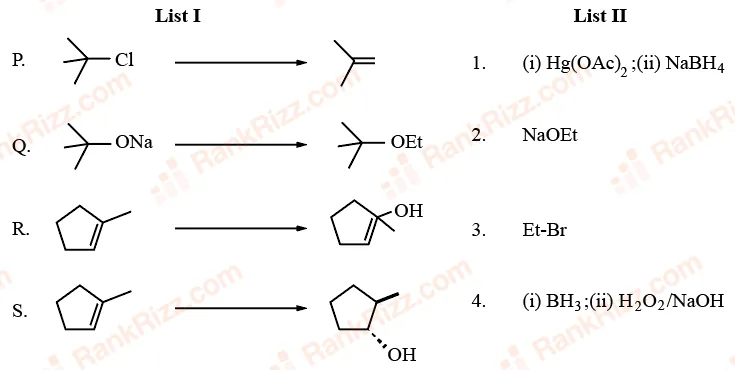
Q37JEE ADVANCED 2013 · PAPER 2EthersTRANSCRIBED

Match the chemical conversions in List I with the appropriate reagents in List II and select the correct answer using the code given below the lists:

  1. A

    P-2, Q-3, R-1, S-4

  2. B

    P-3, Q-2, R-1, S-4

  3. C

    P-2, Q-3, R-4, S-1

  4. D

    P-3, Q-2, R-4, S-1

Q38JEE ADVANCED 2013 · PAPER 2Oxoacids of halogens and interhalogen compoundsTRANSCRIBED

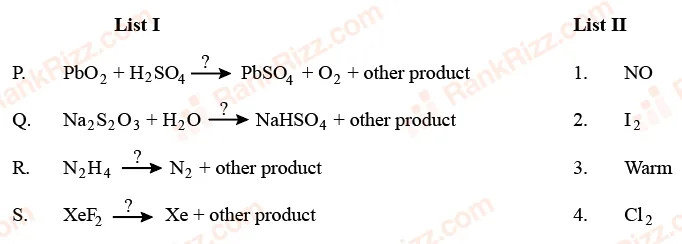
The unbalanced chemical reactions given in List I show missing reagent or condition (?) which are provided in List II. Match List I with List Il and select the correct answer using the code given below the lists :

  1. A

    P-4, Q-2, R-3, S-1

  2. B

    P-3, Q-2, R-1, S-4

  3. C

    P-1, Q-4, R-2, S-3

  4. D

    P-3, Q-4, R-2, S-1

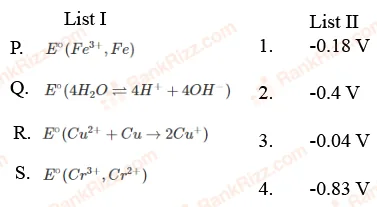
Q39JEE ADVANCED 2013 · PAPER 2Electrode potentials, electrochemical series and cell EMFTRANSCRIBED

The standard reduction potential data at is given below.
;

;

;

;

;

;

;

Match of the redox pair in List I with the values given in List II and select the correct answer using the code given below the lists:

  1. A

    P-4, Q-1, R-2, S-3

  2. B

    P-2, Q-3, R-4, S-1

  3. C

    P-1, Q-2, R-3, S-4

  4. D

    P-3, Q-4, R-1, S-2

Q40JEE ADVANCED 2013 · PAPER 2Conductance, conductivity and molar conductivityTRANSCRIBED

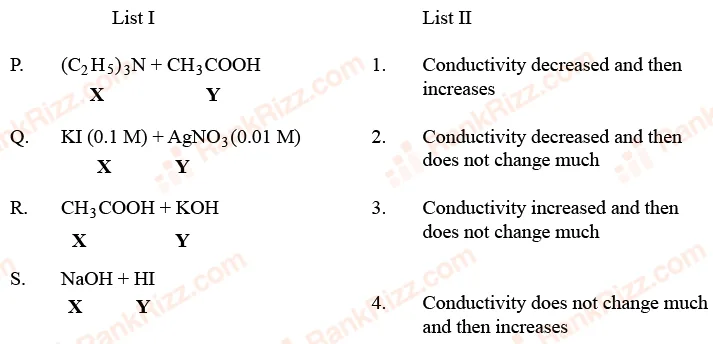
An aqueous solution of X is added slowly to an aqueous solution of Y as shown in List J. The variation in conductivity of these reactions is given in List II. Match List I with List II and select the correct answer using the code given below the lists:

  1. A

    P-3, Q-4, R-2, S-1

  2. B

    P-4, Q-3, R-2, S-1

  3. C

    P-2, Q-3, R-4, S-1

  4. D

    P-1, Q-4, R-3, S-2

Mathematics

Q41JEE ADVANCED 2013 · PAPER 2De Moivre's theorem and powers of complex numbersTRANSCRIBED

Let and . Further H_{1}= \left\{Z\epsilon C : Rez&gt;\frac{1}{2}\right\} and H_{2}= \left\{Z\epsilon C : Rez&lt;\frac{-1}{2}\right\} where C is the set of all complex numbers. If , and O represents the origin, then

  1. A

  2. B

  3. C

  4. D

Q42JEE ADVANCED 2013 · PAPER 2Logarithmic and exponential equations and inequalitiesTRANSCRIBED

If , then x =

  1. A

  2. B

  3. C

  4. D

Q43JEE ADVANCED 2013 · PAPER 2Matrix multiplication, powers and matrix equationsTRANSCRIBED

Let be a complex cuberoot of unity with and be a matrix with . Then , when n =

  1. A

    57

  2. B

    55

  3. C

    58

  4. D

    56

Q44JEE ADVANCED 2013 · PAPER 2Optimization word and geometry problemsTRANSCRIBED

The function has a local minimum or a local maximum at x =

  1. A

  2. B

  3. C

    2

  4. D

Q45JEE ADVANCED 2013 · PAPER 2Definite integral as limit of a sumTRANSCRIBED

For a (the set of all real numbers), ,
Then a =

  1. A

    5

  2. B

    7

  3. C

  4. D

Q46JEE ADVANCED 2013 · PAPER 2Intercepts and position of a pointTRANSCRIBED

Circle(s) touching x - axis at a distance 3 from the origin and having an intercept of length on y-axis is (are)

  1. A

  2. B

  3. C

  4. D

Q47JEE ADVANCED 2013 · PAPER 2Foot of perpendicular, image and distance from a lineTRANSCRIBED

Two lines and are coplanar. Then can take value(s)

  1. A

    1

  2. B

    2

  3. C

    3

  4. D

    4

Q48JEE ADVANCED 2013 · PAPER 2Circumradius, inradius, exradii, medians and bisectorsTRANSCRIBED

In a triangle PQR, P is the largest angle and . Further the incircle of the triangle touches the sides PQ, QR and RP at N, L and M respectively, such that the lengths of PN, QL and RM are consecutive even integers. Then possible length(s) of the side(s) of the triangle is (are)

  1. A

    16

  2. B

    18

  3. C

    24

  4. D

    22

Q49JEE ADVANCED 2013 · PAPER 2Locus and regions in the Argand planeTRANSCRIBED

Area of S =

  1. A

  2. B

  3. C

  4. D

Q50JEE ADVANCED 2013 · PAPER 2Modulus and conjugateTRANSCRIBED

  1. A

  2. B

  3. C

  4. D

Q51JEE ADVANCED 2013 · PAPER 2Conditional probability and multiplication theoremTRANSCRIBED

If 1 ball is drawn from each of the boxes , and , the probability that all 3 drawn balls are of the same colour is

  1. A

  2. B

  3. C

  4. D

Q52JEE ADVANCED 2013 · PAPER 2Bayes' theoremTRANSCRIBED

If 2 balls are drawn (without replacement) from a randomly selected box and one of the balls is white and the otherball is red, the probability that these 2 balls are drawn
from box is

  1. A

  2. B

  3. C

  4. D

Q53JEE ADVANCED 2013 · PAPER 2Optimization word and geometry problemsTRANSCRIBED

Which of the following is true for 0 < x < 1?

  1. A

    0 &lt; f(x) &lt; \infty

  2. B

    -\frac{1}{2} &lt; f(x) &lt; \frac{1}{2}

  3. C

    -\frac{1}{4} &lt; f(x) &lt; 1

  4. D

    -\infty &lt; f(x) &lt; 0

Q54JEE ADVANCED 2013 · PAPER 2Optimization word and geometry problemsTRANSCRIBED

If the function assumes its minimum in the interval [0, 1] at which of the following is true ?

  1. A

    f'(x) &lt; f(x), \frac{1}{4} &lt; x &lt; \frac{3}{4}

  2. B

    f'(x) &gt; f(x), 0 &lt; x &lt; \frac{1}{4}

  3. C

    f'(x) &lt; f(x), 0 &lt; x &lt; \frac{1}{4}

  4. D

    f'(x) &lt; f(x), \frac{3}{4} &lt; x &lt; 1

Q55JEE ADVANCED 2013 · PAPER 2Tangents, pair of tangents and chord of contactTRANSCRIBED

Length of chord PQ is

  1. A

    7a

  2. B

    5a

  3. C

    2a

  4. D

    3a

Q56JEE ADVANCED 2013 · PAPER 2Tangents, pair of tangents and chord of contactTRANSCRIBED

If chord PQ subtends an angle at the vertex of , then

  1. A

  2. B

  3. C

  4. D

Q57JEE ADVANCED 2013 · PAPER 2Tangents, pair of tangents and chord of contactTRANSCRIBED

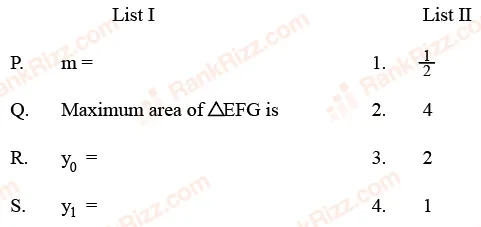
A line L : y = mx + 3 meets y-axis at E(0, 3) and the arc of the parabola at the point . The tangent to the parabola at intersects the y-axis at . The slope m of the line L is chosen such that the area of the triangle EFG has a local maximum.
Match List I and List II and select the correct answer using the code given below the lists:

  1. A

    P-4, Q-1, R-2, S-3

  2. B

    P-3, Q-4, R-1, S-2

  3. C

    P-1, Q-3, R-2, S-4

  4. D

    P-1, Q-3, R-4, S-2

Q58JEE ADVANCED 2013 · PAPER 2Properties and simplification of inverse trigonometric functionsTRANSCRIBED

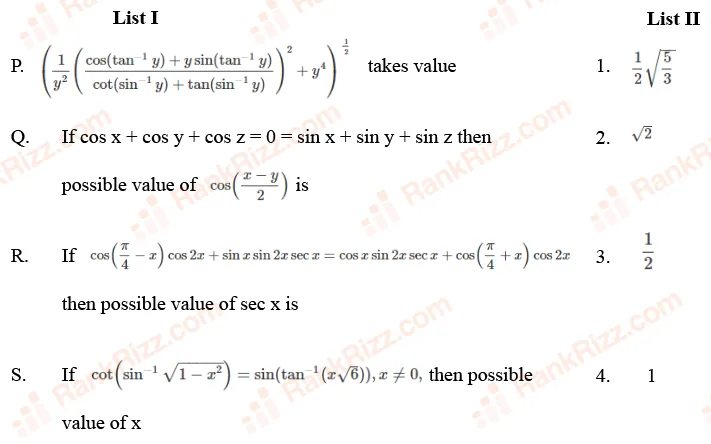
Match List I with List II and select the correct answer using the code given below the lists:

  1. A

    P-4, Q-3, R-1, S-2

  2. B

    P-4, Q-3, R-2, S-1

  3. C

    P-3, Q-4, R-2, S-1

  4. D

    P-3, Q-4, R-1, S-2

Q59JEE ADVANCED 2013 · PAPER 2Line and plane: intersection, coplanarity and projectionTRANSCRIBED

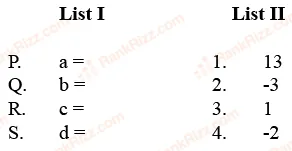
Consider the lines and the planes . Let ax + by + cz = d be the equation of the plane pasing through the point of intersection of lines and , and perpendicular to planes and .
Match List — I with List — II and select the correct answer using the code given below the lists :

  1. A

    P-3, Q-2, R-4, S-1

  2. B

    P-1, Q-3, R-4, S-2

  3. C

    P-3, Q-2, R-1, S-4

  4. D

    P-2, Q-4, R-1, S-3

Q60JEE ADVANCED 2013 · PAPER 2Scalar triple product and coplanarityTRANSCRIBED

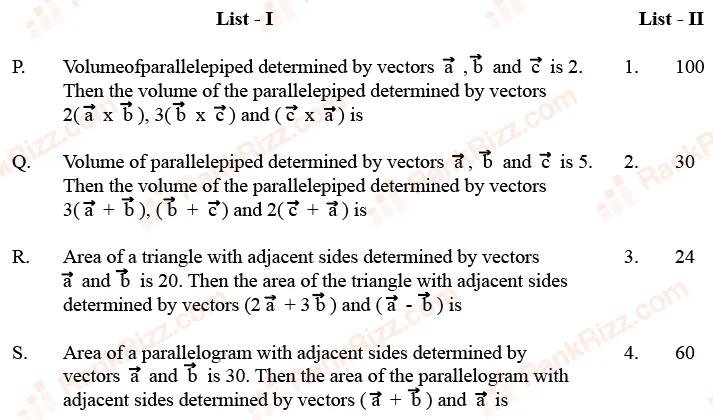
Match List - I with List - II and select the correct answer using the code given below the lists:

  1. A

    P-4, Q-2, R-3, S-1

  2. B

    P-2, Q-3, R-1, S-4

  3. C

    P-3, Q-4, R-1, S-2

  4. D

    P-1, Q-4, R-3, S-2