RankRizz

JEE Advanced 2013 Paper 1: Maths

The 20 Maths questions of JEE Advanced 2013 Paper 1, numbered across the whole paper. Pick an answer on any question to check it against the key. Free to read, nothing to download.

Maths

Q41Locus and regions in the Argand planeTRANSCRIBED

Let complex numbers α\alpha and 1α\frac{1}{\alpha} lie on circles (x−x0)2+(y−y0)2=r2(x - x_0)^2 + (y - y_0)^2 = r^2 and (x−x0)2+(y−y0)2=4r2(x - x_0)^2 + (y - y_0)^2 = 4r^2, respectively. If z0=x0+iy0z_0 = x_0 + iy_0 Satisfies the equation 2∣z0∣2=r2+2,2 |z_0|^2 = r^2 + 2, then ∣α∣=|\alpha| =

  1. A

    12\frac{1}{\sqrt 2}

  2. B

    12\frac{1}{2}

  3. C

    17\frac{1}{\sqrt 7}

  4. D

    13\frac{1}{3}

Q42Total probability theoremTRANSCRIBED

Four persons independently solve a certain problem correctly with probabilities 12,34,14,18.\frac{1}{2}, \frac{3}{4}, \frac{1}{4}, \frac{1}{8}. Then the probability that the problem is solved correctly by at least one of them is

  1. A

    235256\frac{235}{256}

  2. B

    21256\frac{21}{256}

  3. C

    3256\frac{3}{256}

  4. D

    253256\frac{253}{256}

Q43Definite integrals: properties and King's ruleTRANSCRIBED

Let f:[12,1]→Rf : \left[\frac{1}{2}, 1\right] \rightarrow R (the set of all real numbers) be a positive, non-constant and differentiable function such that f′(x)<2f(x)f'(x) < 2 f (x) and f(12)=1f\left(\frac{1}{2}\right) = 1 Then the value of ∫121f(x)dx\int_{\frac{1}{2}}^{1} f(x) dx lies in the interval

  1. A

    (2e−1,2e)(2 e - 1, 2e)

  2. B

    (e−1,2e−1)(e - 1, 2e - 1)

  3. C

    (e−12,e−1)\left(\frac{e - 1}{2}, e - 1 \right)

  4. D

    (0,e−12)\left(0, \frac{e - 1}{2}\right)

Q44Equations with parameters and trigonometric inequalitiesTRANSCRIBED

The number of points in (−∞,∞)(-\infty, \infty), for which x2−xsin⁡x−cos⁡x=0,x^2 - x \sin x - \cos x = 0, is

  1. A

    6

  2. B

    4

  3. C

    2

  4. D

    0

Q45Area between curvesTRANSCRIBED

The area enclosed by the curves y=sin⁡x+cos⁡xy = \sin x + \cos x and y=∣cos⁡x−sin⁡x∣y = |\cos x - \sin x| over the interval [0,π2]\left[0, \frac{\pi}{2}\right] is

  1. A

    4(2−1)4(\sqrt 2 - 1)

  2. B

    22(2−1)2 \sqrt 2(\sqrt 2 - 1)

  3. C

    2(2+1)2(\sqrt 2 + 1)

  4. D

    22(2+1)2\sqrt 2(\sqrt 2 + 1)

Q46Variable separable equationsTRANSCRIBED

A curve passes through the point (1,π6).\left(1, \frac{\pi}{6}\right). Let the slope of the curve at each point (x, y) be yx+sec⁡(yx),x>0.\frac{y}{x} + \sec \left(\frac{y}{x}\right), x > 0. Then the equation of the curve is

  1. A

    sin⁡(yx)=log⁡x+12\sin \left(\frac{y}{x}\right) = \log x + \frac{1}{2}

  2. B

    cosec(yx)=log⁡x+2cosec \left(\frac{y}{x}\right) = \log x + 2

  3. C

    sec⁡(2yx)=log⁡+2\sec \left(\frac{2y}{x}\right) = \log + 2

  4. D

    cos⁡(2yx)=log⁡x+12\cos \left(\frac{2y}{x}\right) = \log x + \frac{1}{2}

Q47Series of inverse trigonometric functionsTRANSCRIBED

The value of cot⁡(∑n=123cot⁡−1(1+∑k=1n2k))\cot \left(\sum_{n = 1}^{23}\cot^{-1} \left(1 + \sum_{k = 1}^n 2k\right)\right) is

  1. A

    2325\frac{23}{25}

  2. B

    2523\frac{25}{23}

  3. C

    2324\frac{23}{24}

  4. D

    2423\frac{24}{23}

Q48Equations of a line in various formsTRANSCRIBED

For a > b > c > 0, the distance between (1, 1) and the point of intersection of the lines ax + by + c = 0 and bx + ay + c = 0 is less than 222 \sqrt 2. Then

  1. A

    a + b - c > 0

  2. B

    a - b + c < 0

  3. C

    a - b + c > 0

  4. D

    a + b - c < 0

Q49Line and plane: intersection, coplanarity and projectionTRANSCRIBED

Perpendiculars are drawn from points on the line x+22=y+1−1=z3\frac{x + 2}{2} = \frac{y + 1}{-1} = \frac{z}{3} to the plane x + y + z = 3. The feet of perpendiculars lie on the line

  1. A

    x5=y−18=z−2−13\frac{x}{5} = \frac{y - 1}{8} = \frac{z - 2}{-13}

  2. B

    x2=y−13=z−2−5\frac{x}{2} = \frac{y - 1}{3} = \frac{z - 2}{-5}

  3. C

    x4=y−13=z−2−7\frac{x}{4} = \frac{y - 1}{3} = \frac{z - 2}{-7}

  4. D

    x2=y−1−7=z−25\frac{x}{2} = \frac{y - 1}{-7} = \frac{z - 2}{5}

Q50Scalar triple product and coplanarityTRANSCRIBED

Let PR→=3i^+j^−2k^\overrightarrow{PR} = 3\widehat{i} + \widehat{j} - 2\widehat{k} and SQ→=i^−3j^−4k^\overrightarrow{SQ} = \widehat{i} - 3 \widehat{j} - 4\widehat{k} determine diagonals of a parallelogram PQRS and PT→=i^+2j^+3k^\overrightarrow{PT} = \widehat{i} + 2\widehat{j} + 3\widehat{k} be another vector. Then the volume of the PT→,PQ→\overrightarrow{PT}, \overrightarrow{PQ} and PS→\overrightarrow{PS} is

  1. A

    5

  2. B

    20

  3. C

    10

  4. D

    30

Q51Sums of natural numbers, squares and cubesTRANSCRIBED

Let Sn=∑k=14n(−1)k(k+1)2k2.S_n = \sum_{k = 1}^{4n}(-1)^{\frac {k (k + 1)}{2}} k^2. Then SnS_n can take value(s)

  1. A

    1056

  2. B

    1088

  3. C

    1120

  4. D

    1332

Q52Transpose, symmetric and skew-symmetric matricesTRANSCRIBED

For 3×33 \times 3 matrices M and N, whichof the following statement(s) is (are) NOT correct ?

  1. A

    NTMNN^T M N is symmetric or skew symmetric, according as M is symmetric or skew symmetric

  2. B

    M N - N M is skew symmetric for all symmetric matrices M and N

  3. C

    M N is symmetric for all symmetric matrices M and N

  4. D

    (adj M) (adj N) = adj (M N) for all invertible matrices and N

Q53Equations with parameters and trigonometric inequalitiesTRANSCRIBED

Let f(x)=xsin⁡πx,x>0f(x) = x \sin \pi x, x > 0 Then for all natural numbers n, f′(x)f'(x) vanishes at

  1. A

    a unique point in the interval (n,n+12)\left(n, n + \frac{1}{2}\right)

  2. B

    a unique point in the interval (n+12,n+1)\left(n + \frac{1}{2}, n + 1\right)

  3. C

    a unique point in the interval (n,n+1)(n, n + 1)

  4. D

    two points in the interval (n,n+1)(n, n + 1)

Q54Optimization word and geometry problemsTRANSCRIBED

A rectangular sheet of fixed perimeter with sides having their lengths in the ratio 8: 15 is converted into an open rectangular box by folding after removing squares of equal area from all four corners. If the total area of removed squares is 100, the resulting box has maximum volume. Then the lengths of the sides of the rectangular sheet are

  1. A

    24

  2. B

    32

  3. C

    45

  4. D

    60

Q55Foot of perpendicular, image and distance from a lineTRANSCRIBED

A line l passing through the origin is perpendicular to the lines
l1:(3+t)i^+(−1+2t)j^+(4+2t)k^,−∞<t<∞l_1 : (3 + t)\widehat{i} + (-1 + 2t)\widehat{j} + (4 + 2t)\widehat{k}, -\infty < t < \infty
l2:(3+2s)i^+(3+2s)j^+(2+s)k^,−∞<s<∞l_2 : (3 + 2s)\widehat{i} + (3 + 2s)\widehat{j} + (2 + s)\widehat{k}, -\infty < s < \infty
Then, the coordinate(s) of the point(s) on l2l_2 at a distance of 17\sqrt 17 from the point of intersection of ll and l1l_1 is (are)

  1. A

    (73,73,53)\left(\frac{7}{3}, \frac{7}{3}, \frac{5}{3}\right)

  2. B

    (−1,−1,0)(-1, -1, 0)

  3. C

    (1,1,1)(1, 1, 1)

  4. D

    (79,79,89)\left(\frac{7}{9}, \frac{7}{9}, \frac{8}{9}\right)

Q56Products of coefficients and calculus-based sumsTRANSCRIBED

The coefficients of three consecutive terms of (1+x)n+5(1 + x)^{n + 5} are in the ratio 5:10:145 : 10 : 14. Then n =

Q57Arithmetic progressionTRANSCRIBED

A pack contains n cards numberedfrom 1 to n. Two consecutive numbered cards are removed from the pack and the sum of the numbers on the remaining cards is 1224. If the smaller of the numbers on the removed cards is k, then k - 20 =

Q58Conditional probability and multiplication theoremTRANSCRIBED

Of the three independent events E1,E2E_1, E_2 and E3E_3 the probability that only E1E_1 occurs is α\alpha only E2E_2 occurs is β\beta and only E3E_3 occurs is γ\gamma. Let the probability p that none of events E1,E2E_1, E_2 or E3E_3 occurs satisfy the equations (α−2β)p=αβ(\alpha - 2\beta) p = \alpha \beta and (β−3γ)p=2βγ(\beta - 3\gamma) p = 2 \beta \gamma. All the given probabilities are assumed tolie in the interval (0, 1).
Then ProbabilityofoccurrenceofE1ProbabilityofoccurrenceofE3=\frac{Probability of occurrence of E_1}{Probability of occurrence of E_3} =

Q59Tangents to an ellipseTRANSCRIBED

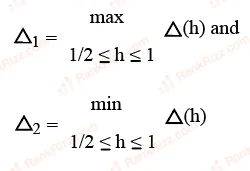
A vertical line passing through the point (h, 0) intersects the ellipse x24+y23=1\frac{x^2}{4} + {y^2}{3} = 1 at the points P and Q. Let the tangents to the ellipse at P and Q meet at the point R. If △(h)\triangle (h) = area of the triangle PQR,

Figure for JEE Advanced 2013 Mathematics question on Tangents to an ellipse

, then 85△1−8△2=\frac{8}{\sqrt 5} \triangle_1 - 8 \triangle_2 =

Q60Combinations and selections with conditionsTRANSCRIBED

Consider the set of eight vectors V={ai^+bj^+ck^:a,b,c∈{−1,1}}V = \left\{{a\widehat{i} + b\widehat{j} + c \widehat{k} : a, b, c \in \left\{-1, 1\right\}} \right\}. Three non-coplanar vectors can be chosen from Vin 2p2^p ways. Then p is