RankRizz

Young's double slit experiment: fringe width and intensity — JEE Main Previous Year Questions

Every JEE Main question on Young's double slit experiment: fringe width and intensity, one of the ideas inside Wave Optics: 68 questions from 2004–2026, 37 of them in the last five years. Newest first, answer key on every one. Free to read.

Questions

68

Years asked

19

Since

2004

Of the chapter

34%

Every Young's double slit experiment: fringe width and intensity question

41–60 OF 68 · NEWEST FIRST

JEE MAIN 2020 · 07 JAN S2Young's double slit experiment: fringe width and intensityTRANSCRIBED

In a Young's double slit experiment, the separation between the slits is 0.15 mm. In the experiment, a source of light of wavelength 589 nm is used and the interference pattern is observed on a screen kept 1.5 m away. The separation between the successive bright fringes on the screen is:

  1. A

    6.9 mm

  2. B

    3.9 mm

  3. C

    5.9 mm

  4. D

    4.9 mm

JEE MAIN 2020 · 09 JAN S2Young's double slit experiment: fringe width and intensityTRANSCRIBED

In a Young's double slit experiment 15 fringes are observed on a small portion of the screen when light of wavelength 500 nm is used. Ten fringes are observed on the same section of the screen when another light source of wavelength λ\lambda is used. Then the value of λ\lambda is (in nm) ___________.

JEE MAIN 2019 · 09 JAN S2Young's double slit experiment: fringe width and intensityTRANSCRIBED

In a young's double slit experiment, the slits are placed 0.320 mm apart. Light of wavelength λ=500\lambda = 500 nm is incident on the slits. The total number of bright fringes that are observed in the angular range −30∘≤θ≤30∘-30^{\circ} \leq \theta \leq 30^{\circ} is:

  1. A

    321

  2. B

    641

  3. C

    320

  4. D

    640

JEE MAIN 2019 · 09 APR S1Young's double slit experiment: fringe width and intensityTRANSCRIBED

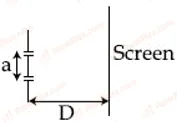
The figure shows a Young's double slit experimental setup. It is observed that when a thin transparent sheet of thickness t and refractive index μ\mu is put in front of one of the slits, the central maximum gets shifted by a distance equal to n fringe width. If the wavelength of light used is λ\lambda then t will be:

Figure for JEE Main 2019 Physics question on Young's double slit experiment: fringe width and intensity
  1. A

    Dλa(μ−1)\frac{D\lambda}{a(\mu - 1)}

  2. B

    nλ(μ−1)\frac{n\lambda}{(\mu - 1)}

  3. C

    2nλ(μ−1)\frac{2n\lambda}{(\mu - 1)}

  4. D

    2Dλa(μ−1)\frac{2D\lambda}{a(\mu - 1)}

JEE MAIN 2019 · 12 APR S1Young's double slit experiment: fringe width and intensityTRANSCRIBED

In a double slit experiment, when a thin film of thickness t having refractive index μ is introduced in front of one of the slits, the maximum at the centre of the fringe pattern shifts by one fringe width. The value of t is (λ\lambda is the wavelength of the light used):

  1. A

    λ2(μ−1)\frac{\lambda}{2(\mu - 1)}

  2. B

    λ(2μ−1)\frac{\lambda}{(2\mu - 1)}

  3. C

    2λ(μ−1)\frac{2\lambda}{(\mu - 1)}

  4. D

    λ(μ−1)\frac{\lambda}{(\mu - 1)}

JEE MAIN 2019 · 10 JAN S2Young's double slit experiment: fringe width and intensityTRANSCRIBED

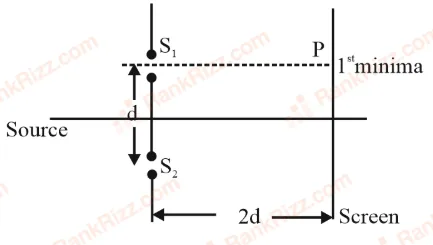
Consider a Young's double slit experiment as shown in figure. What should be the slit separation dd in terms of wavelength λ\lambda such that the first minima occurs directly in front of the slit (S1S_1)?

Figure for JEE Main 2019 Physics question on Young's double slit experiment: fringe width and intensity
  1. A

    λ(5−2)\frac{\lambda}{(5 - \sqrt{2})}

  2. B

    λ2(5−2)\frac{\lambda}{2(\sqrt{5} - 2)}

  3. C

    λ2(5−2)\frac{\lambda}{2(5 - \sqrt{2})}

  4. D

    λ5−2\frac{\lambda}{\sqrt{5} - 2}

JEE MAIN 2017 · 02 APR OFFLINEYoung's double slit experiment: fringe width and intensityTRANSCRIBED

In a Young's double slit experiment, slits are separated by 0.5 mm, and the screen is placed 150 cm away. A beam of light consisting of two wavelengths, 650 nm and 520 nm, is used to obtain interference fringes on the screen. The least distance from the common central maximum to the point where the bright fringes due to both the wavelengths coincide is:

  1. A

    15.6 mm

  2. B

    1.56 mm

  3. C

    7.8 mm

  4. D

    9.75 mm

JEE MAIN 2016 · 09 APR ONLINEYoung's double slit experiment: fringe width and intensityTRANSCRIBED

In Young's double-slit experiment, the distance between slits and the screen is 1 m and monochromatic light of wavelength 600 nm is being used. A person standing near the slits is looking at the fringe pattern. When the separation between the slits is varied, the interference pattern disappears for a particular distance d0d_0 between the slits. If the angular resolution of the eye is 160°\frac{1}{60}°, then the value of d0d_0 is close to

  1. A

    1 mm

  2. B

    3 mm

  3. C

    2 mm

  4. D

    4 mm

JEE MAIN 2015 · 04 APR OFFLINEYoung's double slit experiment: fringe width and intensityTRANSCRIBED

On a hot summer night, the refractive index of air is the smallest near the ground and increases with a height from the ground. When a light beam is directed horizontally, the Huygens' principle leads us to conclude that as it travels, the light beam,

  1. A

    bends upward.

  2. B

    becomes narrower.

  3. C

    goes horizontally without any deflection.

  4. D

    bends downward.

JEE MAIN 2015 · 11 APR ONLINEYoung's double slit experiment: fringe width and intensityTRANSCRIBED

In a Young's double slit experiment with light of wavelength λ\lambda, the separation of slits is dd and distance of screen is DD such that D≫d≫λD \gg d \gg \lambda. If the Fringe width is β\beta, the distance from point of maximum intensity to the point where intensity falls to half of the maximum intensity on either side is:

  1. A

    β4\frac{\beta}{4}

  2. B

    β3\frac{\beta}{3}

  3. C

    β6\frac{\beta}{6}

  4. D

    β2\frac{\beta}{2}

JEE MAIN 2014 · 09 APR ONLINEYoung's double slit experiment: fringe width and intensityTRANSCRIBED

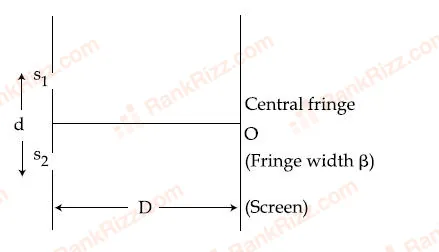
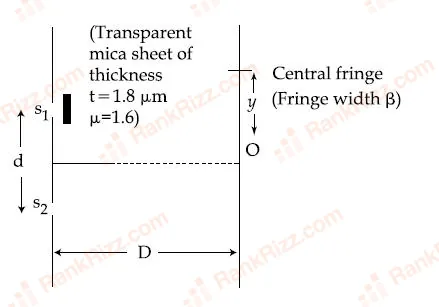
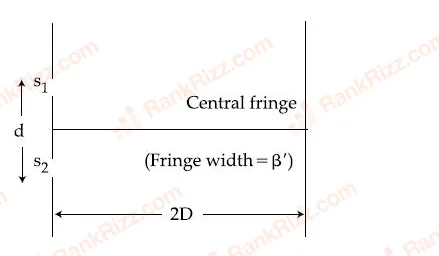
Using monochromatic light of wavelength λ\lambda, an experimentalist sets up the Young's double slit experiment in three ways as shown. If she observes that y=β′y = \beta', the wavelength of light used is:

Figure for JEE Main 2014 Physics question on Young's double slit experiment: fringe width and intensity Figure for JEE Main 2014 Physics question on Young's double slit experiment: fringe width and intensity Figure for JEE Main 2014 Physics question on Young's double slit experiment: fringe width and intensity
  1. A

    520 nm

  2. B

    580 nm

  3. C

    540 nm

  4. D

    560 nm

JEE MAIN 2014 · 12 APR ONLINEYoung's double slit experiment: fringe width and intensityTRANSCRIBED

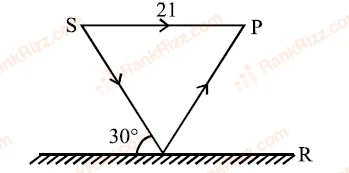
Interference pattern is observed at 'P' due to superimposition of two rays coming out from a source 'S' as shown in the figure. The value of 'l' for which maxima is obtained at 'P' is: (R is perfect reflecting surface)

Figure for JEE Main 2014 Physics question on Young's double slit experiment: fringe width and intensity
  1. A

    l=2nλ3−1l = \frac{2n\lambda}{\sqrt{3}-1}

  2. B

    l=(2n−1)λ2(3−1)l = \frac{(2n-1)\lambda}{2(\sqrt{3}-1)}

  3. C

    l=(2n−1λ)34(2−3)l = \frac{(2n-1\lambda)\sqrt{3}}{4(2-\sqrt{3})}

  4. D

    l=(2n−1)λ3−1l = \frac{(2n-1)\lambda}{\sqrt{3}-1}

JEE MAIN 2014 · 11 APR ONLINEYoung's double slit experiment: fringe width and intensityTRANSCRIBED

Two monochromatic light beams of intensity 16 and 9 units are interfering. The ratio of intensities of bright and dark parts of the resultant pattern is:

  1. A

    169\frac{16}{9}

  2. B

    43\frac{4}{3}

  3. C

    71\frac{7}{1}

  4. D

    491\frac{49}{1}

JEE MAIN 2013 · 25 APR ONLINEYoung's double slit experiment: fringe width and intensityTRANSCRIBED

A thin glass plate of thickness 25003λ\frac{2500}{3}\lambda (λ\lambda is wavelength of light used) and refractive index μ=1.5\mu = 1.5 is inserted between one of the slits and the screen in Young's double slit experiment. At a point on the screen equidistant from the slits, the ratio of the intensities before and after the introduction of the glass plate is :

  1. A

    2 : 1

  2. B

    1 : 4

  3. C

    4 : 1

  4. D

    4 : 3

JEE MAIN 2013 · 25 APR ONLINEYoung's double slit experiment: fringe width and intensityTRANSCRIBED

The source that illuminates the double-slit in 'double-slit interference experiment' emits two distinct monochromatic waves of wavelength 500 nm and 600 nm, each of them producing its own pattern on the screen. At the central point of the pattern when path difference is zero, maxima of both the patterns coincide and the resulting interference pattern is most distinct at the region of zero path difference. But as one moves out of this central region, the two fringe systems are gradually out of step such that maximum due to one wavelength coincides with the minimum due to the other and the combined fringe system becomes completely indistinct. This may happen when path difference in nm is:

  1. A

    2000

  2. B

    3000

  3. C

    1000

  4. D

    1500

JEE MAIN 2013 · 09 APR ONLINEYoung's double slit experiment: fringe width and intensityTRANSCRIBED

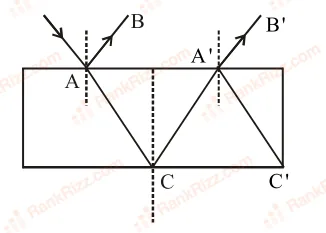
A ray of light of intensity I is incident on a parallel glass slab at point A as shown in the diagram. It undergoes partial reflection and refraction. At each reflection, 25% of incident energy is reflected. The rays AB and A'B' undergo interference. The ratio of ImaxI_{max} and IminI_{min} is :

Figure for JEE Main 2013 Physics question on Young's double slit experiment: fringe width and intensity
  1. A

    49 : 1

  2. B

    7 : 1

  3. C

    4 : 1

  4. D

    8 : 1

JEE MAIN 2013 · 23 APR ONLINEYoung's double slit experiment: fringe width and intensityTRANSCRIBED

nn identical waves each of intensity I0I_0 interfere with each other. The ratio of maximum intensities if the interference is (i) coherent and (ii) incoherent is :

  1. A

    n2n^2

  2. B

    1n\frac{1}{n}

  3. C

    1n2\frac{1}{n^2}

  4. D

    nn

JEE MAIN 2013 · 07 APR ONLINEYoung's double slit experiment: fringe width and intensityTRANSCRIBED

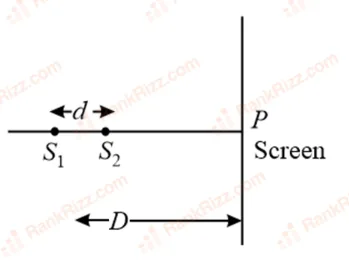
Two coherent point sources S1S_1 and S2S_2 are separated by a small distance dd as shown in the figure. The fringes obtained on the screen will be

Figure for JEE Main 2013 Physics question on Young's double slit experiment: fringe width and intensity
  1. A

    semi-circles

  2. B

    concentric circles

  3. C

    points

  4. D

    straight lines

JEE MAIN 2013 · 22 APR ONLINEYoung's double slit experiment: fringe width and intensityTRANSCRIBED

This question has Statement-1 and Statement-2. Of the four choices given after the Statements, choose the one that best describes the two Statements.
Statement-1: In Young's double slit experiment, the number of fringes observed in the field of view is small with longer wavelength of light and is large with shorter wavelength of light.
Statement-2: In the double slit experiment the fringe width depends directly on the wavelength of light.

  1. A

    Statement-1 is true, Statement-2 is true and the Statement-2 is correct explanation of the Statement-1.

  2. B

    Statement-1 is false and the Statement-2 is true.

  3. C

    Statement-1 is true Statement-2 is true and the Statement-2 is not correct explanation of the Statement-1.

  4. D

    Statement-1 is true and the Statement-2 is false.

JEE MAIN 2012Young's double slit experiment: fringe width and intensityTRANSCRIBED

In Young's double slit experiment, one of the slit is wider than other, so that the amplitude of the light from one slit is double of that from other slit. If ImI_m be the maximum intensity, the resultant intensity II when they interfere at phase difference ϕ\phi is given by

  1. A

    Im9(4+5cos⁡ϕ)\frac{I_m}{9}(4 + 5\cos\phi)

  2. B

    Im3(1+2cos⁡2ϕ2)\frac{I_m}{3}\left(1 + 2\cos^2\frac{\phi}{2}\right)

  3. C

    Im5(1+4cos⁡2ϕ2)\frac{I_m}{5}\left(1 + 4\cos^2\frac{\phi}{2}\right)

  4. D

    Im9(1+8cos⁡2ϕ2)\frac{I_m}{9}\left(1 + 8\cos^2\frac{\phi}{2}\right)