RankRizz
JEE MAIN 2014 · 12 APR ONLINE+4 / −1MEDIUMTRANSCRIBED

JEE Main 2014 Physics question — Young's double slit experiment: fringe width and intensity

Interference pattern is observed at 'P' due to superimposition of two rays coming out from a source 'S' as shown in the figure. The value of 'l' for which maxima is obtained at 'P' is: (R is perfect reflecting surface)
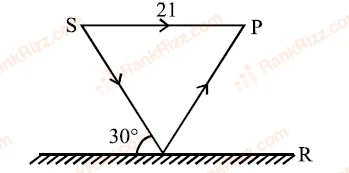
Figure for JEE Main 2014 Physics question on Young's double slit experiment: fringe width and intensity
SOLUTION

The direct path traveled by the first ray is x1=SP=2lx_1 = SP = 2l

For the second ray reflected from surface RR, let the point of reflection be OO. SO=OP=lcos⁡30∘=2l3SO = OP = \frac{l}{\cos 30^\circ} = \frac{2l}{\sqrt{3}}

The total path length of the reflected ray is x2=SO+OP=4l3x_2 = SO + OP = \frac{4l}{\sqrt{3}}

The geometric path difference between the two rays is Δxgeom=x2−x1=4l3−2l=2l(2−33)\Delta x_{geom} = x_2 - x_1 = \frac{4l}{\sqrt{3}} - 2l = 2l \left( \frac{2 - \sqrt{3}}{\sqrt{3}} \right)

Reflection from the perfect reflecting surface RR (denser medium) introduces a phase change of π\pi, which is equivalent to an additional path difference of λ2\frac{\lambda}{2}. The net path difference is Δx=Δxgeom+λ2\Delta x = \Delta x_{geom} + \frac{\lambda}{2}

Δx=2l(2−33)+λ2\Delta x = 2l \left( \frac{2 - \sqrt{3}}{\sqrt{3}} \right) + \frac{\lambda}{2}

For constructive interference (maxima) at point PP: Δx=nλ\Delta x = n\lambda

2l(2−33)+λ2=nλ2l \left( \frac{2 - \sqrt{3}}{\sqrt{3}} \right) + \frac{\lambda}{2} = n\lambda

2l(2−33)=(n−12)λ=(2n−1)λ22l \left( \frac{2 - \sqrt{3}}{\sqrt{3}} \right) = \left(n - \frac{1}{2}\right)\lambda = \frac{(2n - 1)\lambda}{2}

l=(2n−1)λ34(2−3)l = \frac{(2n - 1)\lambda \sqrt{3}}{4(2 - \sqrt{3})}

Tagged Young's double slit experiment: fringe width and intensity. Machine-assigned, so read it as a strong shortlist rather than a verdict.

SubjectPhysics
TopicYoung's double slit experiment: fringe width and intensity
TypeMultiple choice