RankRizz
JEE MAIN 2014 · 09 APR ONLINE+4 / −1MEDIUMTRANSCRIBED

JEE Main 2014 Physics question — Young's double slit experiment: fringe width and intensity

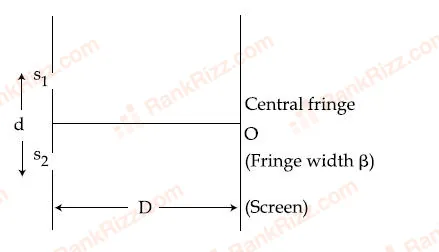
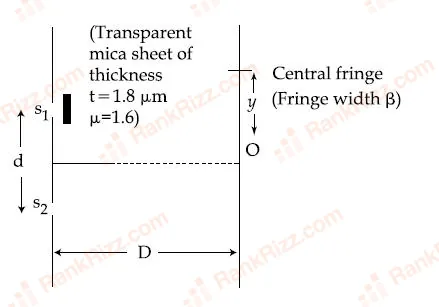
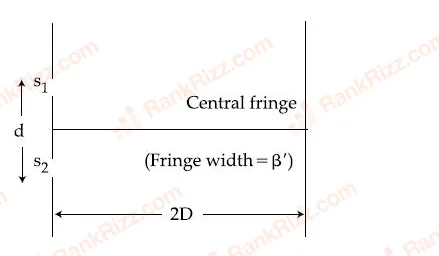
Using monochromatic light of wavelength λ\lambda, an experimentalist sets up the Young's double slit experiment in three ways as shown. If she observes that y=β′y = \beta', the wavelength of light used is:

Figure for JEE Main 2014 Physics question on Young's double slit experiment: fringe width and intensity Figure for JEE Main 2014 Physics question on Young's double slit experiment: fringe width and intensity Figure for JEE Main 2014 Physics question on Young's double slit experiment: fringe width and intensity
SOLUTION

The standard formula for fringe width is β=λDd\beta = \frac{\lambda D}{d}.

From Case 1: The initial configuration has a screen distance DD and slit separation dd. β=λDd\beta = \frac{\lambda D}{d}

From Case 3: The screen distance is doubled to 2D2D, while the slit separation remains dd. The new fringe width is β′=λ(2D)d=2β\beta' = \frac{\lambda (2D)}{d} = 2\beta

From Case 2: When a transparent mica sheet of thickness tt and refractive index μ\mu is introduced in front of one of the slits, the entire fringe pattern shifts. The distance yy that the central fringe shifts is given by the formula: 

y=Dd(μ−1)ty = \frac{D}{d}(\mu - 1)t

We are given the condition: y=β′y = \beta'

Dd(μ−1)t=λ(2D)d\frac{D}{d}(\mu - 1)t = \frac{\lambda (2D)}{d}

(μ−1)t=2λ(\mu - 1)t = 2\lambda

(1.6−1)×(1.8×10−6)=2λ(1.6 - 1) \times (1.8 \times 10^{-6}) = 2\lambda

0.6×1.8×10−6=2λ0.6 \times 1.8 \times 10^{-6} = 2\lambda

1.08×10−6=2λ1.08 \times 10^{-6} = 2\lambda

λ=1.08×10−62=0.54×10⁻⁶ m\lambda = \frac{1.08 \times 10^{-6}}{2} = 0.54 \times 10^{-6}\text{ m}

λ=540×10−9 m=540 nm\lambda = 540 \times 10^{-9}\text{ m} = 540\text{ nm}

Tagged Young's double slit experiment: fringe width and intensity. Machine-assigned, so read it as a strong shortlist rather than a verdict.

SubjectPhysics
TopicYoung's double slit experiment: fringe width and intensity
TypeMultiple choice