JEE MAIN 2026Polarisation: Malus's law and Brewster's lawTRANSCRIBED
The angle of polarization for any medium is , what will be critical angle for this :
- A
- B
- C
- D
Every JEE Main question on Polarisation: Malus's law and Brewster's law, one of the ideas inside Wave Optics: 38 questions from 2004–2026, 20 of them in the last five years. Newest first, answer key on every one. Free to read.
Questions
38
Years asked
15
Since
2004
Of the chapter
19%
Questions on Polarisation: Malus's law and Brewster's law in each year it was asked, the latest 12 of 15.
1–20 OF 38 · NEWEST FIRST
The angle of polarization for any medium is , what will be critical angle for this :
Au unpolarised light is incident at an inteiface of two dielectric media having refractive indices of 2 (incident medium) and (medium) respectively. To satisfy the condition that reflected and refracted rays are perpendicular to each other, the angle of incidence is ___.
When an unpolarized light falls at a particular angle on a glass plate (placed in air), it is observed that the reflected beam is linearly polarized. The angle of refracted
beam with respect to the normal is ______ .
( (1.52) = , refractive indices of air and glass are 1.00 and 1.52, respectively.)
An unpolarized light of certain intensity passes through a combination of two polarizers whose transmission axes are at 30° and 90°, respectively, with respect to the horizontal axis. A third polarizer with its transmission axis at 60° with the horizontal axis is placed between the two existing polarizers. The ratio of the output intensities with and without the third polarizer is ______.
An unpolarized light is incident on the plane interface of air-dielectric medium shown in figure. If the incident angle is equal to Brewster angle, identify the expression representing reflected wave.
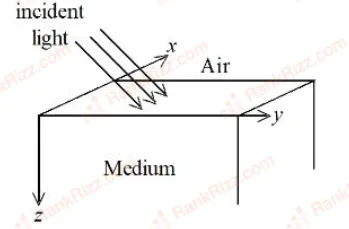
An unpolarized light of intensity passes through polarizer and then through a certain optically active solution and finally it goes to analyser. If the angle between analyser and polariser is 0 and intensity of light emerged from analyser is , the angle of rotation of the light by the solution with respect to analyser is _______ degrees.
Two polarisers and are placed in such a way that the intensity of the transmitted light will be zero. A third polariser is inserted in between and , at the particular angle between and . The transmitted intensity of the light passing through all three polarisers is maximum. The angle between the polarisers and is :
In a Young's double slit experiment, three polarizers are kept as shown in the figure. The transmission axes of and are orthogonal to each other. The polarizer covers both the slits with its transmission axis at to those of and . An unpolarized light of wavelength and intensity is incident on and .The intensity at a point after where the path difference between the light waves from and is
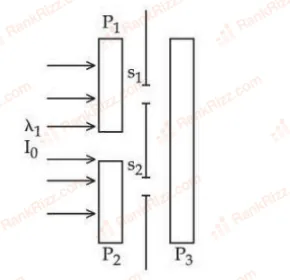
A beam of unpolarised light of intensity is passed through a polaroid and then through another polaroid which is oriented so that its principal plane makes an angle of relative to that of . The intensity of emergent light is:
When a polaroid sheet is rotated between two crossed polaroids then the transmitted light intensity will be maximum for a rotation of :
60°
30°
90°
45°
When unpolarized light is incident at an angle of 60° on a transparent medium from air. The reflected ray is completely polarized. The angle of refraction in the medium is
30°
60°
90°
45°
Two polaroids and are placed in such a way that the pass-axis of polaroids are perpendicular to each other. Now, another polaroid is placed between and bisecting angle between them. If intensity of unpolarised light is then intensity of transmitted light after passing through polaroid will be:
Zero
Given below are two statements :
Statement I : If the Brewster's angle for the light propagating from air to glass is , then Brewster's angle for the light propagating from glass to air is .
Statement II : The Brewster's angle for the light propagating from glass to air is , where is the refractive index of glass.
In the light of the above statements, choose the correct answer from the options given below :
Both Statements I and Statement II are true.
Statement I is true but Statement II is false.
Both Statement I and Statement II are false.
Statement I is false but Statement II is true.
Given below are two statements:
Statement I: If the Brewster's angle for the light propagating from air to glass is , then Brewster's angle for the light propagating from glass to air is .
Statement II: The Brewster's angle for the light propagating from glass to air is , where is the refractive index of glass.
In the light of the above statements, choose the correct answer from the options given below:
Both Statements I and Statement II are true.
Statement I is true but Statement II is false.
Both Statements I and Statement II are false.
Statement I is false but Statement II is true.
'' polarizing sheets are arranged such that each makes an angle 45° with the proceeding sheet. An unpolarized light of intensity is incident into this arrangement. The output intensity is found to be . The value of will be:
3
6
5
4
As shown in figures, three identical polaroids , and are placed one after another. The pass axis of and are inclined at angle of and with respect to axis of . The source has an intensity of W m. The intensity of light at point is ______ W m.
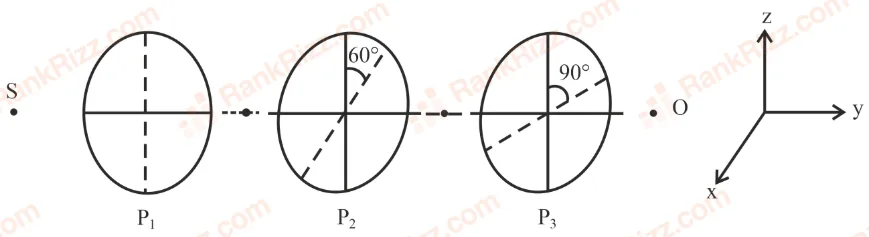
Unpolarised light is incident on the boundary between two dielectric media, whose dielectric constants are (medium ) and (medium ), respectively. To satisfy the condition, so that the reflected and refracted rays are perpendicular to each other, the angle of incidence should be , the value of is ______.
(Given for dielectric media, )
Unpolarised light of intensity 32 W m passes through the combination of three polaroids such that the pass axis of the last polaroid is perpendicular to that of the pass axis of first polaroid. If intensity of emerging light is 3 W m, then the angle between pass axis of first two polaroids is _______ .
A light whose electric field vectors are completely removed by using a good polaroid, allowed to incident on the surface of the prism at Brewster's angle. Choose the most suitable option for the phenomenon related to the prism.
Reflected and refracted rays will be perpendicular to each other.
Wave will propagate along the surface of prism.
No refraction, and there will be total reflection of light.
No reflection. and there will be total transmission of light.
An unpolarised light beam of intensity is passed through a polaroid P and then through another polaroid Q which is oriented in such a way that its passing axis makes an angle of 30° relative to that of P. The intensity of the emergent light is