RankRizz
JEE MAIN 2013 · 07 APR ONLINE+4 / −1MEDIUMTRANSCRIBED

JEE Main 2013 Physics question — Second law, heat engines, refrigerators and reversibility

The below P-V diagram represents the thermodynamic cycle of an engine, operating with an ideal mono-atomic gas. The amount of heat, extracted from the source in a single cycle, is:
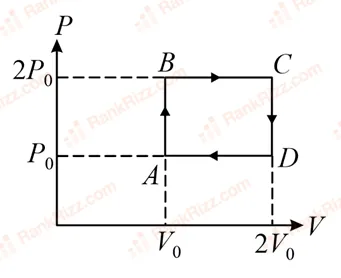
Figure for JEE Main 2013 Physics question on Second law, heat engines, refrigerators and reversibility
SOLUTION

Heat is extracted from the source during the parts of the cycle where the heat change (QQ) is positive. In the given P-V diagram, this occurs along the path A→B→CA \to B \to C.

Q=ΔU+WQ = \Delta U + W

ΔU=nCvΔT=32(PfVf−PiVi)\Delta U = n C_v \Delta T = \frac{3}{2} (P_f V_f - P_i V_i) (for monoatomic gas)

Work Done (WABCW_{ABC}):

Process A→BA \to B is isochoric, so WAB=0W_{AB} = 0. Process B→CB \to C is isobaric expansion at 2P02P_0. WABC=WBC=PΔV=2P0(2V0−V0)=2P0V0W_{ABC} = W_{BC} = P \Delta V = 2P_0(2V_0 - V_0) = 2P_0 V_0

Internal Energy Change (ΔUABC\Delta U_{ABC}):

From state A(P0,V0)A (P_0, V_0) to state C(2P0,2V0)C (2P_0, 2V_0), 

ΔUABC=32(PCVC−PAVA)\Delta U_{ABC} = \frac{3}{2} (P_C V_C - P_A V_A)

ΔUABC=32(4P0V0−P0V0)=32(3P0V0)=92P0V0\Delta U_{ABC} = \frac{3}{2} (4P_0 V_0 - P_0 V_0) = \frac{3}{2} (3P_0 V_0) = \frac{9}{2} P_0 V_0

Total Heat Extracted (QinQ_{in}):

Qin=ΔUABC+WABCQ_{in} = \Delta U_{ABC} + W_{ABC}

Qin=(9+42)P0V0=132P0V0Q_{in} = \left( \frac{9 + 4}{2} \right) P_0 V_0 = \frac{13}{2} P_0 V_0

        Tagged Second law, heat engines, refrigerators and reversibility. Machine-assigned, so read it as a strong shortlist rather than a verdict.

        SubjectPhysics
        TopicSecond law, heat engines, refrigerators and reversibility
        TypeMultiple choice