JEE MAIN 2025 · 29 JAN S2+4 / −1MEDIUMTRANSCRIBED
JEE Main 2025 Physics question — Isothermal and adiabatic processes
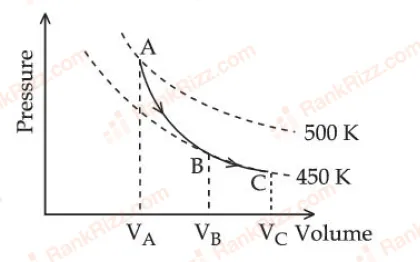
A poly-atomic molecule (, where R is gas constant) goes from phase space point to point to point A to B is an adiabatic path B and C to is an isothermal path. The net heat absorbed per unit mole by the system is :
SOLUTION
From the graph, is adiabatic, so no heat is exchanged in this part:
Hence net heat absorbed by the gas comes only during , which is an isothermal expansion.
For one mole of an ideal gas in an isothermal process,
From the diagram, the path lies on the isotherm, so
Also,
Therefore,
Tagged Isothermal and adiabatic processes. Machine-assigned, so read it as a strong shortlist rather than a verdict.