A monoatomic gas of mass 4.0 u is kept in an insulated container. The container is moving with velocity 30 m s. If the container is suddenly stopped then a change in temperature of the gas ( = gas constant) is . Value of is,
Every JEE Main question on Zeroth and first law of thermodynamics, one of the ideas inside Thermodynamics: 34 questions from 2004–2026, 17 of them in the last five years. Newest first, answer key on every one. Free to read.
Questions
34
Years asked
14
Since
2004
Of the chapter
18%
21–34 OF 34 · NEWEST FIRST
A monoatomic gas of mass 4.0 u is kept in an insulated container. The container is moving with velocity 30 m s. If the container is suddenly stopped then a change in temperature of the gas ( = gas constant) is . Value of is,
Match the thermodynamics processes taking place in a system with the correct conditions. In the table: is the heat supplied, is the work done and is change in internal energy of the system.
Process Condition
(I) Adiabatic (A)
(II) Isothermal (B)
(III) Isochoric (C)
(IV) Isobaric (D)
(I)-(A), (II)-(B), (III)-(D), (IV)-(D)
(I)-(B), (II)-(A), (III)-(D), (IV)-(C)
(I)-(A), (II)-(A), (III)-(B), (IV)-(C)
(I)-(B), (II)-(D), (III)-(A), (IV)-(C)
Following figure shows two processes A and B for a gas. If and are the amount of heat absorbed by the system in two cases, and and are changes in internal energies, respectively, then:

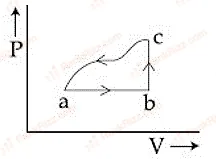
A sample of an ideal gas is taken through the cyclic process abca as shown in the figure. The change in the internal energy of the gas along the path ca is -180 J. The gas absorbs 250 J of heat along the path ab and 60 J along the path bc. The work done by the gas along the path abc is:

130 J
100 J
120 J
140 J
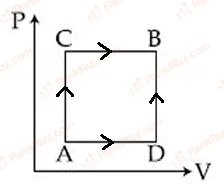
A gas can be taken from A to B via two different processes ACB and ADB.
When path ACB is used 60 J of heat flows into the system and 30 J of work is done by the system. If the path ADB is used then work done by the system is 10 J, the heat flows into the system in the path ADB is:
100 J
20 J
40 J
80 J
A monoatomic gas is compressed from a volume of 2 m to a volume of 1 m at a constant pressure of 100 N m. Then it is heated at constant volume by supplying 150 J of energy. As a result, the internal energy of the gas:
Decreases by 50 J
Increases by 250 J
Decreases by 250 J
0 J
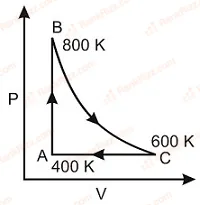
One mole of diatomic ideal gas undergoes a cyclic process ABC as shown in figure. The process BC is adiabatic. The temperatures at A, B and C are 400 K, 800 K and 600 K respectively. Choose the correct statement:

The change in internal energy in whole cyclic process is 250 R
The change in internal energy in the process CA is 700 R
The change in internal energy in the process AB is -350 R
The change in internal energy in the process BC is -500 R
Given that 1 g of water in liquid phase has volume 1 cm and in vapour phase 1671 cm at atmospheric pressure and the latent heat of vaporization of water is 2256 J/g; the change in the internal energy in joules for 1 g of water at 373 K when it changes from liquid phase to vapour phase at the same temperature is :
2256
167
2089
1
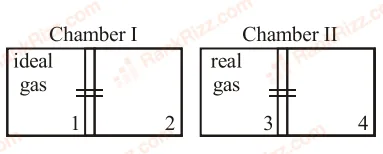
There are two identical chambers, completely thermally insulated from surroundings. Both chambers have a partition wall dividing the chambers in two compartments. Compartment 1 is filled with an ideal gas and Compartment 3 is filled with a real gas. Compartments 2 and 4 are vacuum. A small hole (orifice) is made in the partition walls and the gases are allowed to expand in vacuum.
Statement - 1 : No change in the temperature of the gas takes place when ideal gas expands in vacuum. However, the temperature of real gas goes down (cooling) when it expands in vacuum.
Statement - 2 : The internal energy of an ideal gas is only kinetic. The internal energy of a real gas is kinetic as well as potential.

Statement-1 is false and Statement-2 is true.
Statement-1 and Statement-2 both are true. Statement-2 is the correct explanation of Statement-1.
Statement-1 is true and Statement-2 is false.
Statement-1 and Statement-2 both are true. Statement-2 is not correct explanation of Statement-1.
A thermally insulated vessel contains an ideal gas of molecular mass and ratio of specific heats . It is moving with speed and is suddenly brought to rest. Assuming no heat is lost to the surroundings, its temperature increases by:
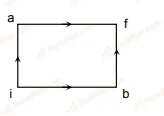
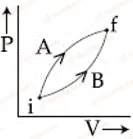
When a system is taken from state to state along the path iaf, it is found that cal and cal.
Along the path 'ibf' cal. W along the path ibf is
6 cal
16 cal.
66 cal.
14 cal.
Which of the following is incorrect regarding the first law of thermodynamics?
It is applicable to any cyclic process
It is a restatement of the principle of conservation of energy
It introduces the concept of the internal energy
It introduces the concept of the entropy
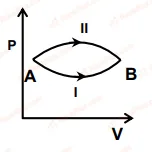
A system goes from to via two processes I and II as shown in the figure. If and are the changes in internal energies in the processes I and II respectively, the 
relation between and can not be determined
Which of the following statements is correct for any thermodynamic system?
The internal energy changes in all processes.
Internal energy and entropy are state functions.
The change in entropy can never be zero.
The work done in an adiabatic process is always zero.