RankRizz

Semiconductors: energy bands, intrinsic and extrinsic — JEE Main Previous Year Questions

Every JEE Main question on Semiconductors: energy bands, intrinsic and extrinsic, one of the ideas inside Semiconductor Electronics: 9 questions from 2004–2012, 1 of them in the last five years. Newest first, answer key on every one. Free to read.

Questions

9

Years asked

5

Since

2004

Of the chapter

4%

When JEE Main asked it

Questions on Semiconductors: energy bands, intrinsic and extrinsic in each year it was asked.

20121
20071
20063
20051
20043

Every Semiconductors: energy bands, intrinsic and extrinsic question

1–9 OF 9 · NEWEST FIRST

JEE MAIN 2012Semiconductors: energy bands, intrinsic and extrinsicTRANSCRIBED

This question has Statement 1 and Statement 2. Of the four choices given after the Statements, choose the one that best describes the two Statements. Statement 1: A pure semiconductor has negative temperature coefficient of resistance. Statement 2: On raising the temperature, more charge carriers are released into the conduction band.

  1. A

    Statement 1 is false, Statement 2 is true.

  2. B

    Statement 1 is true, Statement 2 is false.

  3. C

    Statement 1 is true, Statement 2 is true, Statement 2 is not a correct explanation of Statement 1.

  4. D

    Statement 1 is true, Statement 2 is true, Statement 2 is the correct explanation of Statement 1.
JEE MAIN 2007Semiconductors: energy bands, intrinsic and extrinsicTRANSCRIBED

Carbon, silicon and germanium have four valence electrons each. At room temperature which one of the following statements is most appropriate?

  1. A

    The number of free conduction electrons is significant in C but small in Si and Ge.

  2. B

    The number of free conduction electrons is negligibly small in all the three.

  3. C

    The number of free electrons for conduction is significant in all the three.

  4. D

    The number of free electrons for conduction is significant only in Si and Ge but small in C.

JEE MAIN 2006Semiconductors: energy bands, intrinsic and extrinsicTRANSCRIBED

A solid which is transparent to visible light and whose conductivity increases with temperature is formed by

  1. A

    Metallic binding

  2. B

    Ionic binding

  3. C

    Covalent binding

  4. D

    Van der Waals binding

JEE MAIN 2006Semiconductors: energy bands, intrinsic and extrinsicTRANSCRIBED

If the ratio of the concentration of electrons that of holes in a semiconductor is 75\dfrac{7}{5} and the ratio of currents is 74\dfrac{7}{4}, then what is the ratio of their drift velocities?

  1. A

    47\dfrac{4}{7}

  2. B

    58\dfrac{5}{8}

  3. C

    45\dfrac{4}{5}

  4. D

    54\dfrac{5}{4}

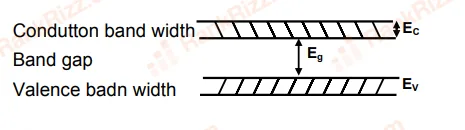
JEE MAIN 2006Semiconductors: energy bands, intrinsic and extrinsicTRANSCRIBED

If the lattice constant of this semiconductor is decreased, then which of the following is correct?Figure for JEE Main 2006 Physics question on Semiconductors: energy bands, intrinsic and extrinsic

  1. A

    All Ec,Eg,EvE_c, E_g, E_v decrease

  2. B

    All FFF_F increase

  3. C

    EcE_c, and EvE_v increase but EgE_g decreases

  4. D

    EcE_c, and EvE_v decrease EgE_g increases

JEE MAIN 2005Semiconductors: energy bands, intrinsic and extrinsicTRANSCRIBED

The electrical conductivity of a semiconductor increases when electromagnetic radiation of wavelength shorter than 24802480 nm is incident on it. The band gap (in eV) for the semiconductor is

  1. A

    1.11.1 eV

  2. B

    2.52.5 eV

  3. C

    0.50.5 eV

  4. D

    0.70.7 eV

JEE MAIN 2004Semiconductors: energy bands, intrinsic and extrinsicTRANSCRIBED

The thermistors are usually made of

  1. A

    metals with low temperature coefficient of resistivity

  2. B

    metals with high temperature coefficient of resistivity

  3. C

    metal oxides with high temperature coefficient of resistivity

  4. D

    semiconducting materials having low temperature coefficient of resistivity.

JEE MAIN 2004Semiconductors: energy bands, intrinsic and extrinsicTRANSCRIBED

A piece of copper and another of germanium are cooled from room temperature to 7777 K, the resistance of

  1. A

    each of them increases

  2. B

    each of them decreases

  3. C

    copper decreases and germanium increases

  4. D

    copper increases and germanium decreases

JEE MAIN 2004Semiconductors: energy bands, intrinsic and extrinsicTRANSCRIBED

The manifestation of band structure in solids is due to

  1. A

    Heisenberg's uncertainty principle

  2. B

    Pauli's exclusion principle

  3. C

    Bohr's correspondence principle

  4. D

    Boltzmann's law