Rolling with friction, slipping and impulsive forces — JEE Main Previous Year Questions
Every JEE Main question on Rolling with friction, slipping and impulsive forces, one of the ideas inside Rotational Motion: 45 questions from 2013–2026, 26 of them in the last five years. Newest first, answer key on every one. Free to read.
Every Rolling with friction, slipping and impulsive forces question
21–40 OF 45 · NEWEST FIRST
JEE MAIN 2022 · 26 JUN S2Rolling with friction, slipping and impulsive forcesTRANSCRIBED
A solid spherical ball is rolling on a frictionless horizontal plane surface about its axis of symmetry. The ratio of rotational kinetic energy of the ball to its total kinetic energy is
JEE MAIN 2022 · 25 JUL S1Rolling with friction, slipping and impulsive forcesTRANSCRIBED
A solid cylinder and a solid sphere, having same mass M and radius R, roll down the same inclined plane from top without slipping. They start from rest. The ratio of velocity of the solid cylinder to that of the solid sphere, with which they reach the ground, will be
JEE MAIN 2022 · 29 JUN S1Rolling with friction, slipping and impulsive forcesTRANSCRIBED
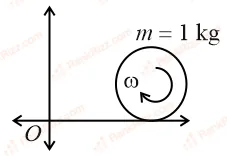
A spherical shell of 1 kg mass and radius R is rolling with angular speed ω on horizontal plane (as shown in figure). The magnitude of angular momentum of the shell about the origin O is 3aR2ω. The value of a will be
JEE MAIN 2022 · 27 JUN S2Rolling with friction, slipping and impulsive forcesTRANSCRIBED
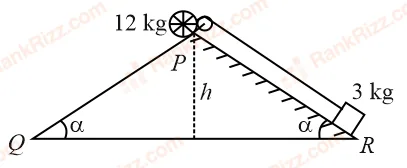
A rolling wheel of 12 kg is on an inclined plane at position P and connected to a mass of 3 kg through a string of fixed length and pulley as shown in figure. Consider PR as friction free surface. The velocity of centre of mass of the wheel when it reaches at the bottom Q of the inclined plane PQ will be 21xgh m s−1. The value of x (rounded off to the nearest integer) is ______.
JEE MAIN 2022 · 26 JUL S1Rolling with friction, slipping and impulsive forcesTRANSCRIBED
A disc of mass 1 kg and radius R is free to rotate about a horizontal axis passing through its centre and perpendicular to the plane of disc. A body of same mass as that of disc is fixed at the highest point of the disc. Now the system is released, when the body comes to the lowest position, its angular speed will be 43Rx rad s−1 where x= ______.
JEE MAIN 2021 · 25 FEB S2Rolling with friction, slipping and impulsive forcesTRANSCRIBED
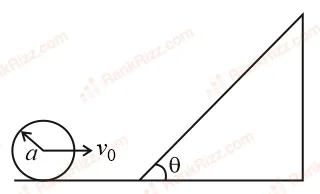
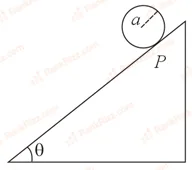
A sphere of radius a and mass m rolls along a horizontal plane with constant speed v0. It encounters an inclined plane at angle θ and climbs upward. Assuming that it rolls without slipping, how far up the sphere will travel?
JEE MAIN 2021 · 17 MAR S2Rolling with friction, slipping and impulsive forcesTRANSCRIBED
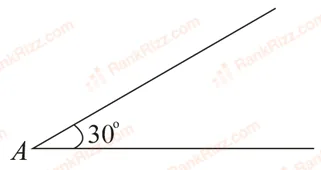
A sphere of mass 2 kg and radius 0.5 m is rolling with an initial speed of 1 m s−1 goes up an inclined plane which makes an angle of 30° with the horizontal plane, without slipping. How low will the sphere take to return to the starting point A?
JEE MAIN 2021 · 22 JUL S1Rolling with friction, slipping and impulsive forcesTRANSCRIBED
Consider a situation in which a ring, a solid cylinder and a solid sphere roll down on the same inclined plane without slipping. Assume that they start rolling from rest and having identical diameter. The correct statement for this situation is
A
The sphere has the greatest and the ring has the least velocity of the centre of mass at the bottom of the inclined plane.
B
The ring has the greatest and the cylinder has the least velocity of the centre of mass at the bottom of the inclined plane.
C
All of them will have same velocity.
D
The cylinder has the greatest and the sphere has the least velocity of the centre of mass at the bottom of the inclined plane.
JEE MAIN 2021 · 20 JUL S2Rolling with friction, slipping and impulsive forcesTRANSCRIBED
Two bodies, a ring and a solid cylinder of same material are rolling down without slipping an inclined plane. The radii of the bodies are same. The ratio of velocity of the centre of mass at the bottom of the inclined plane of the ring to that of the cylinder is 2x. Then, the value of x is ___.
JEE MAIN 2021 · 17 MAR S1Rolling with friction, slipping and impulsive forcesTRANSCRIBED
The following bodies, (1) a ring, (2) a disc, (3) a solid cylinder, (4) a solid sphere, of same mass m and radius R are allowed to roll down without slipping simultaneously from the top of the inclined plane. The body which will reach first at the bottom of the inclined plane is ________. [Mark the body as per their respective numbering given in the question]
JEE MAIN 2021 · 16 MAR S2Rolling with friction, slipping and impulsive forcesTRANSCRIBED
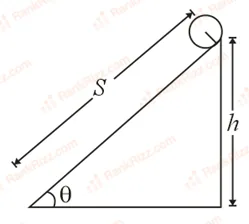
A solid disc of radius a and mass m rolls down without slipping on an inclined plane making an angle θ with the horizontal. The acceleration of the disc will be b2gsinθ, where b is ________. (Round off to the Nearest Integer) (g = acceleration due to gravity, θ = angle as shown in figure)
JEE MAIN 2021 · 20 JUL S1Rolling with friction, slipping and impulsive forcesTRANSCRIBED
A circular disc reaches from top to bottom of an inclined plane of length L. When it slips down the plane, it takes time t1. When it rolls down the plane, it takes time t2. The value of t1t2 is x3. The value of x will be ___.
JEE MAIN 2021 · 22 JUL S1Rolling with friction, slipping and impulsive forcesTRANSCRIBED
The centre of a wheel rolling on a plane surface moves with a speed v0. A particle on the rim of the wheel at the same level as the centre will be moving at a speed xv0. Then the value of x is ___.
JEE MAIN 2020 · 07 JAN S1Rolling with friction, slipping and impulsive forcesTRANSCRIBED
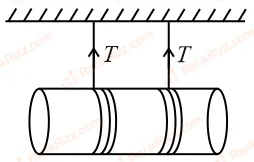
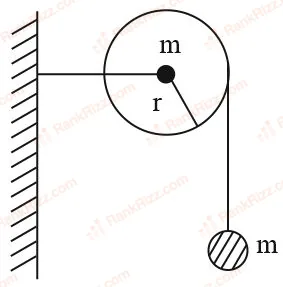
As shown in the figure, a bob of mass m is tied to a massless string whose other end portion is wound on a fly wheel (disc) of radius r and mass m. When released from rest the bob starts falling vertically. When it has covered a distance of h, the angular speed of the wheel will be:
JEE MAIN 2020 · 08 JAN S2Rolling with friction, slipping and impulsive forcesTRANSCRIBED
A uniform sphere of mass 500 g rolls without slipping on a plane horizontal surface with its centre moving at a speed of 5.00 cm s−1. Its kinetic energy is:
JEE MAIN 2019 · 09 JAN S2Rolling with friction, slipping and impulsive forcesTRANSCRIBED
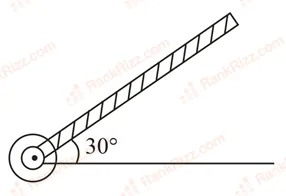
A rod of length 50 cm is pivoted at one end. It is raised such that it makes an angle of 30∘ from the horizontal as shown and released from rest. Its angular speed when it passes through the horizontal (in rad s−1) will be: (g=10 ms−2)
JEE MAIN 2019 · 10 JAN S1Rolling with friction, slipping and impulsive forcesTRANSCRIBED
A homogeneous solid cylindrical roller of radius R and mass M is pulled on a cricket pitch by a horizontal force. Assuming rolling without slipping, angular acceleration of the cylinder is:
JEE MAIN 2019 · 09 APR S1Rolling with friction, slipping and impulsive forcesTRANSCRIBED
The following bodies are made to roll up (without slipping) the same inclined plane from a horizontal plane: (i) a ring of radius R, (ii) a solid cylinder of radius 2R and (iii) a solid sphere of radius 4R. If, in each case, the speed of the center of mass at the bottom of the incline is same, the ratio of the maximum heights they climb is: