JEE Main 2022 Physics question — Rolling with friction, slipping and impulsive forces
A solid cylinder of length is suspended symmetrically through two massless strings, as shown in the figure.
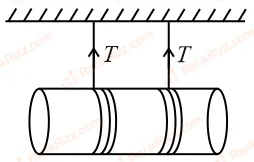
The distance from the initial rest position, the cylinder should be unbinding the strings to achieve a speed of , is _____ cm. (take )
SOLUTION
We need to find the downward distance () the solid cylinder must fall while unbinding from the two strings to achieve a linear center-of-mass speed of .
1. Identify the Physical Principles
As the cylinder falls, it undergoes combined translational and rotational motion. Since the strings are wrapped around it and unbind without slipping, the system obeys the principle of Conservation of Mechanical Energy.
The potential energy lost by the cylinder during its descent is entirely converted into translational kinetic energy and rotational kinetic energy:
2. Analyze the System Parameters
- Linear velocity () =
- Acceleration due to gravity () =
- The moment of inertia () of a solid cylinder of mass and radius rotating about its central axis is:
- Since the strings unbind without slipping, the relationship between linear velocity () and angular velocity () is:
3. Substitute and Simplify the Energy Equation
Substitute the expressions for and into the kinetic energy terms:
Combine the kinetic energy fractions:
The mass () cancels out from both sides of the equation, leaving:
4. Calculate the Distance ()
Isolate and substitute the given values into the equation:
Convert the distance from meters to centimeters:
Conclusion
The distance from the initial rest position that the cylinder should descend is 120 cm.
Tagged Rolling with friction, slipping and impulsive forces. Machine-assigned, so read it as a strong shortlist rather than a verdict.