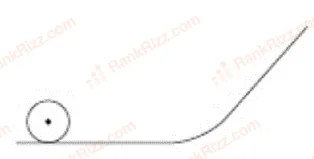
A solid sphere and solid cylinder of identical radii approach an incline with the same linear velocity (see figure). Both roll without slipping all throughout. The two climb maximum heights and on the incline. The ratio is given by:
- A
- B
- C
- D
1
Every JEE Main question on Rolling with friction, slipping and impulsive forces, one of the ideas inside Rotational Motion: 45 questions from 2013–2026, 26 of them in the last five years. Newest first, answer key on every one. Free to read.
Questions
45
Years asked
11
Since
2013
Of the chapter
16%
41–45 OF 45 · NEWEST FIRST
A solid sphere and solid cylinder of identical radii approach an incline with the same linear velocity (see figure). Both roll without slipping all throughout. The two climb maximum heights and on the incline. The ratio is given by:

1
A uniform solid cylindrical roller of mass is being pulled on a horizontal surface with force parallel to the surface and applied at its centre. If the acceleration of the cylinder is and it is rolling without slipping then the value of is:
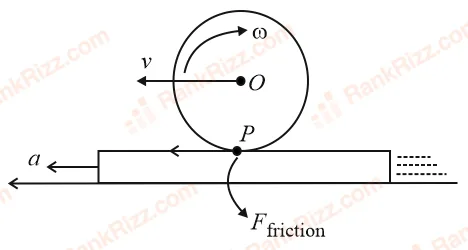
Consider a cylinder of mass M resting on a rough horizontal rug that is pulled out from under it with acceleration 'a' perpendicular to the axis of the cylinder. What is at point P? It is assumed that the cylinder does not slip.

Ma
Mg
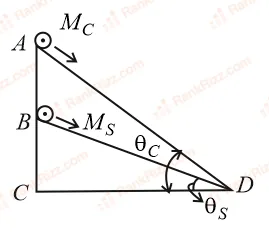
A cylinder of mass M and sphere of mass M are placed at points A and B of two inclines, respectively. (See figure). If they roll on the incline without slipping such that their accelerations are the same, then the ratio is:

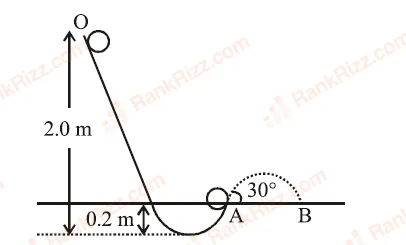
A tennis ball (treated as hollow spherical shell) starting from O rolls down a hill. At point A, the ball becomes air borne leaving at an angle of 30° with the horizontal. The ball strikes the ground at B. What is the value of the distance AB? (Moment of inertia of a spherical shell of mass m and radius R about its diameter = )

1.87 m
2.08 m
1.57 m
1.77 m
RELATED ROTATIONAL MOTION TOPICS