JEE MAIN 2014 · 09 APR ONLINE+4 / −1MEDIUMTRANSCRIBED
JEE Main 2014 Physics question — Spring-block oscillations
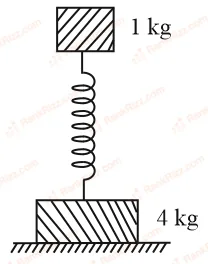
Two bodies of masses 1 kg and 4 kg are connected to a vertical spring, as shown in the figure. The smaller mass executes simple harmonic motion of angular frequency 25 rad s, and amplitude 1.6 cm while the bigger mass remains stationary on the ground. The maximum force exerted by the system on the floor is (take m s).
SOLUTION
The force exerted by the system on the floor is the sum of the weight of the mass and the downward force exerted by the spring.
The spring constant can be determined from the angular frequency and the oscillating mass :
Tagged Spring-block oscillations. Machine-assigned, so read it as a strong shortlist rather than a verdict.