RankRizz

Motion of charged particles in a magnetic field — JEE Main Previous Year Questions

Every JEE Main question on Motion of charged particles in a magnetic field, one of the ideas inside Moving Charges & Magnetism: 69 questions from 2005–2026, 37 of them in the last five years. Newest first, answer key on every one. Free to read.

Questions

69

Years asked

15

Since

2005

Of the chapter

28%

Every Motion of charged particles in a magnetic field question

61–69 OF 69 · NEWEST FIRST

JEE MAIN 2015 · 10 APR ONLINEMotion of charged particles in a magnetic fieldTRANSCRIBED

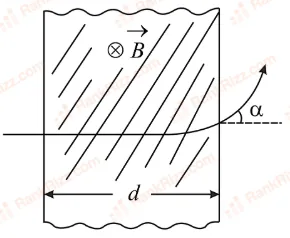
A proton (mass mm), accelerated by a potential difference VV, flies through a uniform transverse magnetic field BB. The field occupies a region of the space by a width dd. Let α\alpha be the angle of deviation of the proton from the initial direction of motion (see the figure), then the value of sin⁡α\sin \alpha will be:

Figure for JEE Main 2015 Physics question on Motion of charged particles in a magnetic field
  1. A

    B2qdmV\frac{B}{2}\sqrt{\frac{qd}{mV}}

  2. B

    Bdq2mVBd\sqrt{\frac{q}{2mV}}

  3. C

    Bdq2mV\frac{B}{d}\sqrt{\frac{q}{2mV}}

  4. D

    qVBd2mqV\sqrt{\frac{Bd}{2m}}

JEE MAIN 2014 · 12 APR ONLINEMotion of charged particles in a magnetic fieldTRANSCRIBED

A positive charge 'q' of mass 'm' is moving along the +x axis. We wish to apply a uniform magnetic field B for time Δt\Delta t so that the charge reverses its direction crossing the y axis at a distance d. Then:

  1. A

    B=mvqdB = \frac{mv}{qd} and Δt=πdv\Delta t = \frac{\pi d}{v}

  2. B

    B=mv2qdB = \frac{mv}{2qd} and Δt=πd2v\Delta t = \frac{\pi d}{2v}

  3. C

    B=2mvqdB = \frac{2mv}{qd} and Δt=πd2v\Delta t = \frac{\pi d}{2v}

  4. D

    B=2mvqdB = \frac{2mv}{qd} and Δt=πdv\Delta t = \frac{\pi d}{v}

JEE MAIN 2013 · 23 APR ONLINEMotion of charged particles in a magnetic fieldTRANSCRIBED

A particle of charge 16×10−1616 \times 10^{-16} C moving with velocity 10 ms−1^{-1} along x-axis enters a region where magnetic field of induction B⃗\vec{B} is along the y-axis and an electric field of magnitude 10410^4 Vm−1^{-1} is along the negative z-axis. If the charged particle continues moving along x-axis, the magnitude of B⃗\vec{B} is :

  1. A

    16×10316 \times 10^3 Wb m−2^{-2}

  2. B

    2×1032 \times 10^3 Wb m−2^{-2}

  3. C

    1×1031 \times 10^3 Wb m−2^{-2}

  4. D

    4×1034 \times 10^3 Wb m−2^{-2}

JEE MAIN 2012Motion of charged particles in a magnetic fieldTRANSCRIBED

Proton, Deuteron and alpha particle of the same kinetic energy are moving in circular trajectories in a constant magnetic field. The radii of proton, deuteron and alpha particle are respectively rp,rdr_p, r_d and rαr_\alpha. Which one of the following relations is correct?

  1. A

    rα=rp=rdr_\alpha = r_p = r_d

  2. B

    rα=rp<rdr_\alpha = r_p < r_d

  3. C

    rα>rd>rpr_\alpha > r_d > r_p

  4. D

    rα=rd>rpr_\alpha = r_d > r_p

JEE MAIN 2012Motion of charged particles in a magnetic fieldTRANSCRIBED

This question has Statement 1 and Statement 2. Of the four choices given after the Statements, choose the one that best describes the two Statements. Statement 1: A charged particle is moving at right angle to a static magnetic field. During the motion the kinetic energy of the charge remains unchanged. Statement 2: Static magnetic field exert force on a moving charge in the direction perpendicular to the magnetic field.

  1. A

    Statement 1 is false, Statement 2 is true.

  2. B

    Statement 1 is true, Statement 2 is true, Statement 2 is not the correct explanation of Statement 1.

  3. C

    Statement 1 is true, Statement 2 is false.

  4. D

    Statement 1 is true, Statement 2 is true, Statement 2 is the correct explanation of Statement 1.

JEE MAIN 2012Motion of charged particles in a magnetic fieldTRANSCRIBED

A proton and a deuteron are both accelerated through the same potential difference and enter in a magnetic field perpendicular to the direction of the field. If the deuteron follows a path of radius RR, assuming the neutron and proton masses are nearly equal, the radius of the proton's path will be

  1. A

    2R\sqrt{2}R

  2. B

    R2\frac{R}{\sqrt{2}}

  3. C

    R2\frac{R}{2}

  4. D

    RR

JEE MAIN 2012Motion of charged particles in a magnetic fieldTRANSCRIBED

The magnetic force acting on charged particle of charge 2μC2\mu C in magnetic field of 2T2T acting in yy-direction, when the particle velocity is (2i^+3j^)×106(2\hat{i} + 3\hat{j})\times 10^6 ms−1^{-1} is

  1. A

    88 N in z-direction

  2. B

    88 N in y-direction

  3. C

    44 N in y-direction

  4. D

    44 N in z-direction

JEE MAIN 2007Motion of charged particles in a magnetic fieldTRANSCRIBED

A charged particle moves through a magnetic field perpendicular to its direction. Then

  1. A

    the momentum changes but the kinetic energy is constant

  2. B

    both momentum and kinetic energy of the particle are not constant

  3. C

    both, momentum and kinetic energy of the particle are constant

  4. D

    kinetic energy changes but the momentum is constant

JEE MAIN 2005Motion of charged particles in a magnetic fieldTRANSCRIBED

A charged particle of mass mm and charge qq travels on a circular path of radius rr that is perpendicular to a magnetic field BB. The time taken by the particle to complete one revolution is

  1. A

    2πmqB\frac{2\pi mq}{B}

  2. B

    2πq2Bm\frac{2\pi q^2 B}{m}

  3. C

    2πqBm\frac{2\pi q B}{m}

  4. D

    2πmqB\frac{2\pi m}{q B}