RankRizz

Motion of charged particles in a magnetic field — JEE Main Previous Year Questions

Every JEE Main question on Motion of charged particles in a magnetic field, one of the ideas inside Moving Charges & Magnetism: 69 questions from 2005–2026, 37 of them in the last five years. Newest first, answer key on every one. Free to read.

Questions

69

Years asked

15

Since

2005

Of the chapter

28%

Every Motion of charged particles in a magnetic field question

41–60 OF 69 · NEWEST FIRST

JEE MAIN 2021 · 27 AUG S1Motion of charged particles in a magnetic fieldTRANSCRIBED

Two ions of masses 4 amu and 16 amu have charges +2e and +3e respectively. These ions pass through the region of the constant perpendicular magnetic field. The kinetic energy of both ions is the same. Then:

  1. A

    lighter ion will be deflected less than heavier ion

  2. B

    lighter ion will be deflected more than heavier ion

  3. C

    both ions will be deflected equally

  4. D

    no ion will be deflected

JEE MAIN 2021 · 20 JUL S1Motion of charged particles in a magnetic fieldTRANSCRIBED

A deuteron and an alpha particle having equal kinetic energy enter perpendicular into a magnetic field. Let rdr_d and rαr_\alpha be their respective radii of circular path. The value of rdrα\frac{r_d}{r_\alpha} is equal to:

  1. A

    12\frac{1}{\sqrt{2}}

  2. B

    2\sqrt{2}

  3. C

    1

  4. D

    2

JEE MAIN 2021 · 25 JUL S2Motion of charged particles in a magnetic fieldTRANSCRIBED

Two ions having same mass have charges in the ratio 1 : 2. They are projected normally in a uniform magnetic field with their speeds in the ratio 2 : 3. The ratio of the radii of their circular trajectories is,

  1. A

    1 : 4

  2. B

    4 : 3

  3. C

    3 : 1

  4. D

    2 : 3

JEE MAIN 2021 · 26 AUG S2Motion of charged particles in a magnetic fieldTRANSCRIBED

If the maximum value of accelerating potential provided by a radio frequency oscillator is 12 kV. The number of revolution made by a proton in a cyclotron to achieve one sixth the speed of light is:
[mp=1.67×10⁻²⁷m_p = 1.67 \times 10^{-27} kg, e=1.6×10⁻¹⁹e = 1.6 \times 10^{-19} C, Speed of light = 3×1083 \times 10^8 m s−1^{-1}]

JEE MAIN 2020 · 07 JAN S2Motion of charged particles in a magnetic fieldTRANSCRIBED

A particle of mass mm and charge qq has an initial velocity v⃗=v0j^\vec{v} = v_0 \hat{j}. If an electric field E⃗=E0i^\vec{E} = E_0 \hat{i} and magnetic field B⃗=B0i^\vec{B} = B_0 \hat{i} act on the particle, its speed will double after a time

  1. A

    2mv0qE0\frac{2mv_0}{qE_0}

  2. B

    3mv0qE0\frac{3mv_0}{qE_0}

  3. C

    3mv0qE0\frac{\sqrt{3}mv_0}{qE_0}

  4. D

    2mv0qE0\frac{\sqrt{2}mv_0}{qE_0}

JEE MAIN 2020 · 06 SEP S1Motion of charged particles in a magnetic fieldTRANSCRIBED

A particle of charge qq and mass mm is moving with a velocity −vi^-v\hat{i} (v≠0)(v \neq 0) towards a large screen placed in the Y−ZY-Z plane at distance dd. If there is a magnetic field B⃗=B0k^\vec{B} = B_0\hat{k}, the minimum value of vv for which the particle will not hit the screen is:

  1. A

    qdB03m\frac{qdB_0}{3m}

  2. B

    2qdB0m\frac{2qdB_0}{m}

  3. C

    qdB0m\frac{qdB_0}{m}

  4. D

    qdB02m\frac{qdB_0}{2m}

JEE MAIN 2020 · 02 SEP S2Motion of charged particles in a magnetic fieldTRANSCRIBED

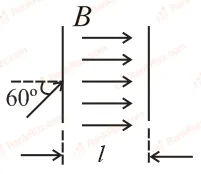
The figure shows a region of length 'l' with a uniform magnetic field of 0.3 T in it and a proton entering the region with velocity 4×1054 \times 10^5 m s−1^{-1} making an angle 60°° with the field. If proton completes 10 revolution by the time it cross the region shown, 'l' is close to (mass of proton =1.67×10−27= 1.67 \times 10^{-27} kg, charge of the proton =1.6×10−19= 1.6 \times 10^{-19} C):

Figure for JEE Main 2020 Physics question on Motion of charged particles in a magnetic field
  1. A

    0.11 m

  2. B

    0.88 m

  3. C

    0.44 m

  4. D

    0.22 m

JEE MAIN 2020 · 03 SEP S1Motion of charged particles in a magnetic fieldTRANSCRIBED

A charged particle carrying charge 1 μC\mu C is moving with velocity (2i^+3j^+4k^)\left(2\hat{i} + 3\hat{j} + 4\hat{k}\right) m s−1^{-1}. If an external magnetic field of (5i^+3j^−6k^)×10−3\left(5\hat{i} + 3\hat{j} - 6\hat{k}\right) \times 10^{-3} T exists in the region where the particle is moving then the force on the particle is F⃗×10−9\vec{F} \times 10^{-9} N. The vector F⃗\vec{F} is:

  1. A

    −0.30i^+0.32j^−0.09k^-0.30\hat{i} + 0.32\hat{j} - 0.09\hat{k}

  2. B

    −30i^+32j^−9k^-30\hat{i} + 32\hat{j} - 9\hat{k}

  3. C

    −300i^+320j^−90k^-300\hat{i} + 320\hat{j} - 90\hat{k}

  4. D

    −3.0i^+32j^−0.9k^-3.0\hat{i} + 32\hat{j} - 0.9\hat{k}

JEE MAIN 2020 · 09 JAN S2Motion of charged particles in a magnetic fieldTRANSCRIBED

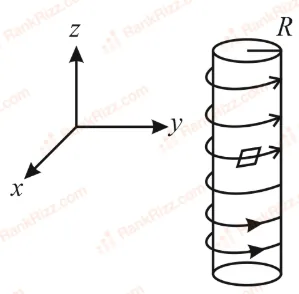
An electron gun is placed inside a long solenoid of radius RR on its axis. The solenoid has nn turns/length and carries a current II. The electron gun shoots an electron along the radius of the solenoid with speed vv. If the electron does not hit the surface of the solenoid, maximum possible value of vv is (all symbols have their standard meaning):

Figure for JEE Main 2020 Physics question on Motion of charged particles in a magnetic field
  1. A

    eμ0nIRm\frac{e\mu_0 nIR}{m}

  2. B

    eμ0nIR2m\frac{e\mu_0 nIR}{2m}

  3. C

    eμ0nIR4m\frac{e\mu_0 nIR}{4m}

  4. D

    2eμ0nIRm\frac{2e\mu_0 nIR}{m}

JEE MAIN 2020 · 02 SEP S1Motion of charged particles in a magnetic fieldTRANSCRIBED

A beam of protons with speed 4×1054 \times 10^5 m s−1^{-1} enters a uniform magnetic field of 0.3 T at an angle of 60°° to the magnetic field, the pitch of the resulting helical path of protons is close to: (Mass of the proton =1.67×10−27= 1.67 \times 10^{-27} kg, charge of the proton =1.69×10−19= 1.69 \times 10^{-19} C)

  1. A

    2 cm

  2. B

    5 cm

  3. C

    12 cm

  4. D

    4 cm

JEE MAIN 2020 · 06 SEP S1Motion of charged particles in a magnetic fieldTRANSCRIBED

An electron is moving along +x+x direction with a velocity of 6×10⁶ ms−16 \times 10^6\,\text{ms}^{-1}. It enters a region of uniform electric field of 300 V/cm300\,V/cm pointing along +y+y direction. The magnitude and direction of the magnetic field set up in this region such that the electron keeps moving along the xx direction will be:

  1. A

    3×10⁻⁴ T3 \times 10^{-4}\,\text{T}, along +z+z direction

  2. B

    5×10⁻³ T5 \times 10^{-3}\,\text{T}, along −z-z direction

  3. C

    5×10⁻³ T5 \times 10^{-3}\,\text{T}, along +z+z direction

  4. D

    3×10⁻⁴ T3 \times 10^{-4}\,\text{T}, along −z-z direction

JEE MAIN 2020 · 08 JAN S1Motion of charged particles in a magnetic fieldTRANSCRIBED

Proton with kinetic energy of 1 MeV moves from south to north. It gets an acceleration of 101210^{12} m/s2^2 by an applied magnetic field (west to east). The value of magnetic field: (Rest mass of proton is 1.6×10−271.6 \times 10^{-27} kg)

  1. A

    0.71 mT

  2. B

    7.1 mT

  3. C

    0.071 mT

  4. D

    71 mT

JEE MAIN 2019 · 11 JAN S1Motion of charged particles in a magnetic fieldTRANSCRIBED

In an experiment, electrons are accelerated, from rest, by applying a voltage of 500 V. Calculate the radius of the path if a magnetic field 100 mT is then applied. [Charge of the electron =1.6×10−19= 1.6 \times 10^{-19} C; Mass of the electron =9.1×10−31= 9.1 \times 10^{-31} kg]

  1. A

    7.5×10−37.5 \times 10^{-3} m

  2. B

    7.5×10−27.5 \times 10^{-2} m

  3. C

    7.5 m

  4. D

    7.5×10−47.5 \times 10^{-4} m

JEE MAIN 2019 · 09 JAN S2Motion of charged particles in a magnetic fieldTRANSCRIBED

A particle having the same charge as of electron moves in a circular path of radius 0.5 cm under the influence of a magnetic field of 0.5 T. If an electric field of 100 V/m makes it to move in a straight path, then the mass of the particle is (Given charge of electron =1.6×10−19= 1.6 \times 10^{-19} C)

  1. A

    9.1×10−319.1 \times 10^{-31} kg

  2. B

    1.6×10−271.6 \times 10^{-27} kg

  3. C

    2.0×10−242.0 \times 10^{-24} kg

  4. D

    1.6×10−191.6 \times 10^{-19} kg

JEE MAIN 2019 · 12 JAN S1Motion of charged particles in a magnetic fieldTRANSCRIBED

A proton and an α\alpha-particle (with their masses in the ratio of 1 : 4 and charges in the ratio of 1 : 2) are accelerated from rest through a potential difference V. If a uniform magnetic field (B) is set up perpendicular to their velocities, the ratio of the radii rp:rαr_p : r_{\alpha} of the circular paths described by them will be:

  1. A

    1 : 3

  2. B

    1:21 : \sqrt{2}

  3. C

    1 : 2

  4. D

    1:31 : \sqrt{3}

JEE MAIN 2019 · 12 APR S2Motion of charged particles in a magnetic fieldTRANSCRIBED

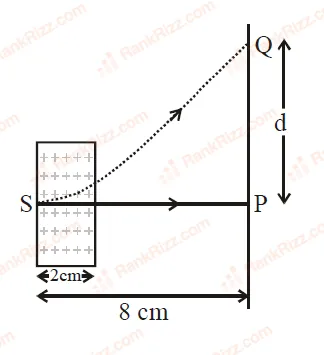
An electron, moving along the x-axis with an initial energy of 100 eV, enters a region of magnetic field B⃗=(1.5×10⁻³\vec{B} = (1.5 \times 10^{-3} T)k^\hat{k} at S (see figure). The field extends between x = 0 and x = 2 cm. The electron is detected at the point Q on a screen placed 8 cm away from the point S. The distance d between P and Q (on the screen) is:
(electron’s charge 1.6×10⁻¹⁹C1.6 ×10^{−19} C, mass of electron =9.1×10⁻³¹kg=9.1×10^{−31} kg)

Figure for JEE Main 2019 Physics question on Motion of charged particles in a magnetic field
  1. A

    1.22 cm

  2. B

    12.87 cm

  3. C

    11.65 cm

  4. D

    2.25 cm

JEE MAIN 2019 · 10 APR S1Motion of charged particles in a magnetic fieldTRANSCRIBED

A proton, an electron, and a Helium nucleus, have the same energy. They are in circular orbits in a plane due to magnetic field perpendicular to the plane. Let rpr_p, rer_e and rHer_{He} be their respective radii, then,

  1. A

    re>rp=rHer_e > r_p = r_{He}

  2. B

    re<rp=rHer_e < r_p = r_{He}

  3. C

    re<rp<rHer_e < r_p < r_{He}

  4. D

    re>rp>rHer_e > r_p > r_{He}

JEE MAIN 2019 · 11 JAN S2Motion of charged particles in a magnetic fieldTRANSCRIBED

The region between y=0y = 0 and y=dy = d contains a magnetic field B⃗=Bz^\vec{B} = B\hat{z}. A particle of mass m and charge q enters the region with a velocity v⃗=vi^\vec{v} = v\hat{i}. If d=mv2qBd = \frac{mv}{2qB}, the acceleration of the charged particle at the point of its emergence at the other side is:

  1. A

    qvBm(12i^−32j^)\frac{qvB}{m}\left(\frac{1}{2}\hat{i} - \frac{\sqrt{3}}{2}\hat{j}\right)

  2. B

    qvBm(32i^+12j^)\frac{qvB}{m}\left(\frac{\sqrt{3}}{2}\hat{i} + \frac{1}{2}\hat{j}\right)

  3. C

    qvBm(−j^+i^2)\frac{qvB}{m}\left(\frac{-\hat{j}+\hat{i}}{\sqrt{2}}\right)

  4. D

    None of the above

JEE MAIN 2019 · 11 JAN S2Motion of charged particles in a magnetic fieldTRANSCRIBED

A particle of mass m and charge q is in an electric and magnetic field given by E⃗=2i^+3j^\vec{E} = 2\hat{i} + 3\hat{j}; B⃗=4j^+6k^\vec{B} = 4\hat{j} + 6\hat{k}. The charged particle is shifted from the origin to the point P(x=1;y=1)(x = 1; y = 1) along a straight path. The magnitude of the total work done is:

  1. A

    (0.35)q

  2. B

    5q

  3. C

    (2.5) q

  4. D

    (0.15)q

JEE MAIN 2017 · 08 APR ONLINEMotion of charged particles in a magnetic fieldTRANSCRIBED

In a certain region static electric and magnetic fields exist. The magnetic field is given by B⃗=B0(i^+2j^−4k^)\vec{B} = B_0(\hat{i} + 2\hat{j} - 4\hat{k}). If a test charge moving with a velocity v⃗=v0(3i^−j^+2k^)\vec{v} = v_0(3\hat{i} - \hat{j} + 2\hat{k}) experiences no force in that region, then the electric field in the region, in SI units, is:

  1. A

    E⃗=−v0B0(i^+j^+7k^)\vec{E} = -v_0 B_0(\hat{i} + \hat{j} + 7\hat{k})

  2. B

    E⃗=−v0B0(3i^−2j^−4k^)\vec{E} = -v_0 B_0(3\hat{i} - 2\hat{j} - 4\hat{k})

  3. C

    E⃗=v0B0(14j^+7k^)\vec{E} = v_0 B_0(14\hat{j} + 7\hat{k})

  4. D

    E⃗=−v0B0(14j^+7k^)\vec{E} = -v_0 B_0(14\hat{j} + 7\hat{k})