An electron moves through a uniform magnetic field T. At a particular instant of time, the velocity of electron is . If the magnetic force acting on electron is N, where is the charge of electron, then the value of is ____ T.
Every JEE Main question on Motion of charged particles in a magnetic field, one of the ideas inside Moving Charges & Magnetism: 69 questions from 2005–2026, 37 of them in the last five years. Newest first, answer key on every one. Free to read.
Questions
69
Years asked
15
Since
2005
Of the chapter
28%
21–40 OF 69 · NEWEST FIRST
An electron moves through a uniform magnetic field T. At a particular instant of time, the velocity of electron is . If the magnetic force acting on electron is N, where is the charge of electron, then the value of is ____ T.
An electron with kinetic energy enters a region of uniform magnetic field of perpendicular to its direction. An electric field is applied perpendicular to the direction of velocity and magnetic field. The value of , so that electron moves along the same path, is ______ . (Given, mass of electron , electric charge )
An electron is moving along the positive x-axis. If uniform magnetic field is applied parallel to the negative z-axis, then
A. The electron will experience magnetic force along positive y-axis
B. The electron will experience magnetic force along negative y-axis
C. The electron will not experience any force in magnetic field
D. The electron will continue to move along the positive x-axis
E. The electron will move along circular path in magnetic field
Choose the correct answer from the option given below:
A and E only
C and D only
B and E only
B and D only
A charge particle moving in magnetic field B, has the components of velocity along B as well as perpendicular to B. The path of the charge particle will be
helical path with the axis perpendicular to the direction of magnetic field B
helical path with the axis along magnetic field B
circular path
straight along the direction of magnetic field B
A charge particle of 2 C accelerated by a potential difference of 100 V enters a region of uniform magnetic field of magnitude 4 mT at right angle to the direction of field. The charge particle completes semicircle of radius 3 cm inside magnetic field. The mass of the charge particle is _____ kg.
A proton with a kinetic energy of 2.0 eV moves into a region of uniform magnetic field of magnitude T. The angle between the direction of magnetic field and velocity of proton is 60°. The pitch of the helical path taken by the proton is ______ cm. (Take, mass of proton = kg and charge on proton = C).
Two charged particles, having same kinetic energy, are allowed to pass through a uniform magnetic field perpendicular to the direction of motion. If the ratio of radii of their circular paths is and their respective masses ratio is . Then, the ratio of their charges will be
A charge particle is moving in a uniform magnetic field . If it has an acceleration of , then the value of will be
A proton and an alpha particle of the same velocity enter in a uniform magnetic field which is acting perpendicular to their direction of motion. The ratio of the radii of the circular paths described by the alpha particle and proton is
A cyclotron is used to accelerate protons. If the operating magnetic field is 1.0 T and the radius of the cyclotron 'dees' is 60 cm, the kinetic energy of the accelerated protons in MeV will be: [use kg, C]
12
18
16
32
A velocity selector consists of electric field and magnetic field with . The value required for an electron of energy moving along the positive x-axis to pass undeflected is (Given, mass of electron )
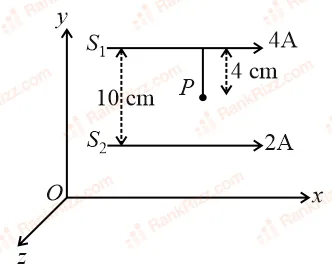
Two long parallel conductors and are separated by a distance cm and carrying currents of A and A respectively. The conductors are placed along -axis in plane. There is a point located between the conductors (as shown in figure).
A charge particle of coulomb is passing through the point with velocity m s.
The force acting on the charge particle is N. The value of is

A charge particle moves along circular path in a uniform magnetic field in a cyclotron. The kinetic energy of the charge particle increases to 4 times its initial value. What will be the ratio of new radius to the original radius of circular path of the charge particle?
1 : 1
1 : 2
2 : 1
1 : 4
A proton, a deuteron and an -particle with same kinetic energy enter into a uniform magnetic field at right angle to magnetic field. The ratio of the radii of their respective circular paths is :
None of these
Given below are two statements:
Statement I: The electric force changes the speed of the charged particle and hence changes its kinetic energy; whereas the magnetic force does not change the kinetic energy of the charged particle.
Statement II: The electric force accelerates the positively charged particle perpendicular to the direction of electric field. The magnetic force accelerates the moving charged particle along the direction of magnetic field.
In the light of the above statements, choose the most appropriate answer from the options below:
Both Statement I and Statement II are correct.
Both Statement I and Statement II are incorrect.
Statement I is correct but Statement II is incorrect.
Statement I is incorrect but Statement II is correct.
A singly ionized magnesium atom ion is accelerated to kinetic energy keV, and is projected perpendicularly into a magnetic field of the magnitude T. The radius of path formed will be ______ cm.
A deuteron and a proton moving with equal kinetic energy enter into a uniform magnetic field at right angle to the field. If and are the radii of their circular paths respectively, then the ratio will be where is ______
A charge is moving distance in the magnetic field . Find the value of work done by .
1
Infinite
Zero
A proton, a deuteron and an particle are moving with same momentum in a uniform magnetic field. The ratio of magnetic forces acting on them is ______ and their speed is ______ in the ratio.
2 : 1 : 1 and 4 : 2 : 1
1 : 2 : 4 and 2 : 1 : 1
4 : 2 : 1 and 2 : 1 : 1
1 : 2 : 4 and 1 : 1 : 2
A proton and an -particle, having kinetic energies and , respectively, enter into a magnetic field at right angles. The ratio of the radii of the trajectory of proton to that of -particle is 2 : 1. The ratio of is:
1 : 8
8 : 1
1 : 4
4 : 1