JEE Main 2015 Physics question — Motion of charged particles in a magnetic field
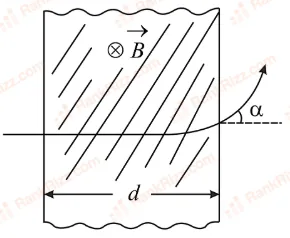
A proton (mass ), accelerated by a potential difference , flies through a uniform transverse magnetic field . The field occupies a region of the space by a width . Let be the angle of deviation of the proton from the initial direction of motion (see the figure), then the value of will be:
SOLUTION
When a proton of mass and charge is accelerated through a potential difference , it gains kinetic energy.
As the proton enters the uniform transverse magnetic field , it experiences a Lorentz force that causes it to move in a circular arc of radius . The magnetic force provides the necessary centripetal force.
In the right-angled triangle formed by the radius and the width of the field,
Tagged Motion of charged particles in a magnetic field. Machine-assigned, so read it as a strong shortlist rather than a verdict.